Biodegradable Polymer Synthesis
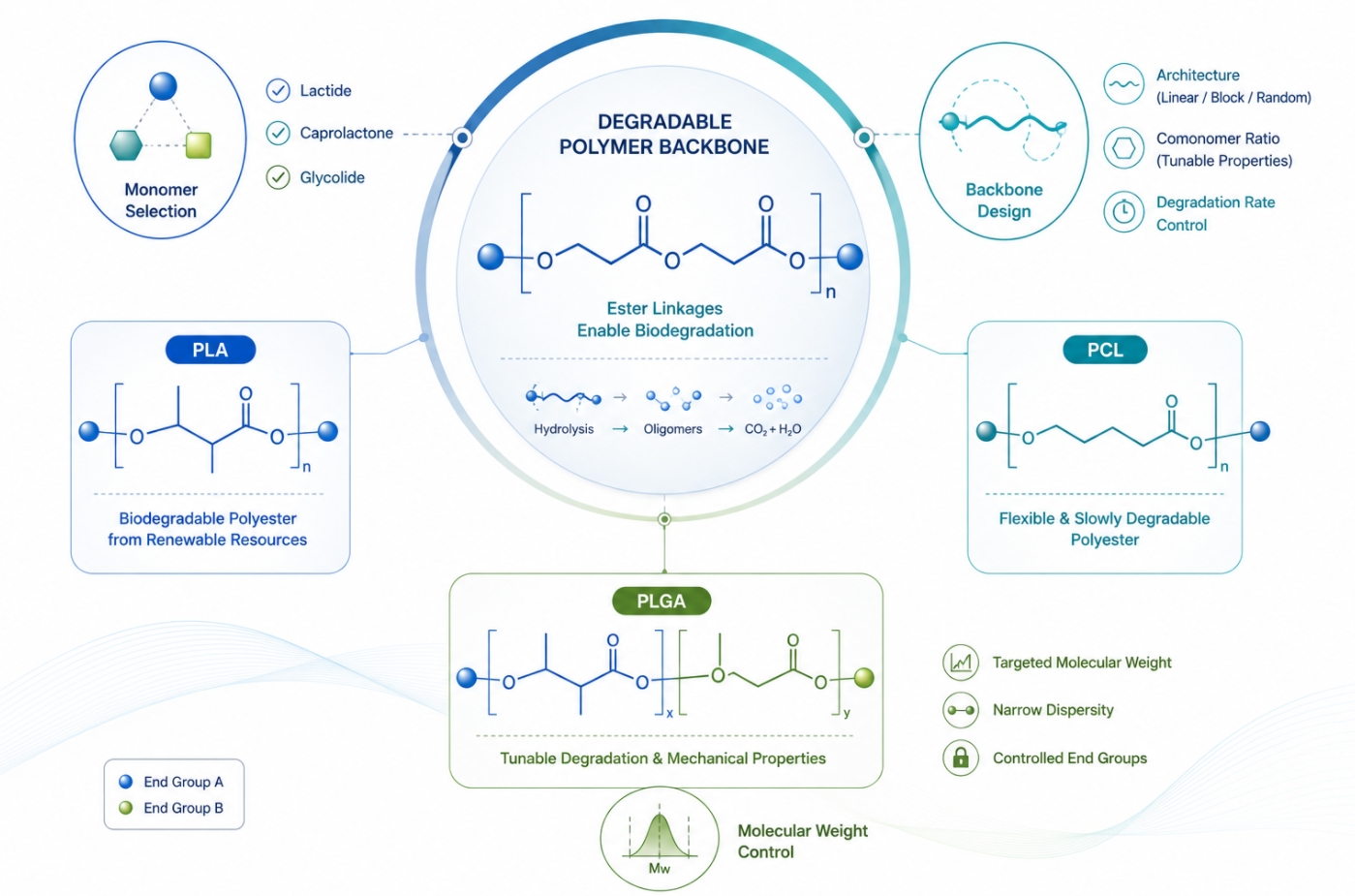
Biodegradable polymer synthesis focuses on preparing degradable polymer materials with defined backbone chemistry, monomer composition, molecular weight, end groups, thermal behavior, and sample format. BOC Sciences supports the synthesis of PLA, PCL, PLGA, PGA, biodegradable polyesters, aliphatic polycarbonates, polyanhydrides, polyethers, biodegradable block copolymers, amphiphilic copolymers, and functional degradable polymers for films, particles, fibers, coatings, soft materials, packaging-related studies, and advanced material research. BOC Sciences supports biodegradable polymer projects from degradable backbone selection and route design to molecular feature optimization, purification, characterization, and sample delivery. Related capabilities include polymer synthesis service, polymerization technologies, polymer characterization service, and polymer modification service.
Biodegradable Polymer Systems We Can Prepare
Biodegradable polymer design is strongly affected by backbone chemistry, monomer purity, water sensitivity, end-group structure, crystallinity, and thermal transitions. A PLA sample, a PCL-based soft segment, and a PLGA copolymer may all be degradable, but their synthesis routes, purification requirements, processing behavior, and characterization priorities can be very different. BOC Sciences helps clients select suitable degradable polymer systems according to target structure and material use.
PLA and Polylactide Polymer Synthesis
- Supports PLA, PLLA, PDLA, PDLLA, and related polylactide materials for degradable polymer research.
- Routes may involve lactide ring-opening polymerization, initiator control, catalyst selection, or end-group design.
- Key factors include stereochemistry, molecular weight, dispersity, crystallinity, Tg/Tm, end groups, and residual monomer.
- Suitable for films, fibers, particles, packaging-related materials, soft materials, and degradable polymer studies.
PCL and Polycaprolactone Synthesis
- Supports PCL homopolymers, PCL copolymers, PCL block polymers, and end-functionalized PCL materials.
- Routes may include ε-caprolactone ring-opening polymerization, macroinitiator methods, or chain extension.
- Development considers monomer purity, moisture control, molecular weight, crystallinity, flexibility, end groups, and thermal properties.
- Suitable for flexible materials, films, particles, coating precursors, composites, and soft material research.
PLGA and Biodegradable Copolymer Synthesis
- Supports PLGA, PLA-co-PCL, PCL-co-PEG, polyester copolymers, and biodegradable copolymer systems.
- Routes may use copolymer ROP, sequential feeding, macroinitiator chain extension, or combined strategies.
- Key factors include monomer ratio, sequence distribution, molecular weight, end groups, Tg, crystallinity, and degradable structure.
- Suitable for projects requiring tunable flexibility, thermal behavior, composition, and processing properties.
Biodegradable Polycarbonate Synthesis
- Supports aliphatic polycarbonates, trimethylene carbonate-based polymers, and related degradable copolymers.
- Routes may involve cyclic carbonate ROP, copolymerization, macroinitiator methods, or functional monomer strategies.
- Development evaluates carbonate backbone content, end groups, molecular weight, flexibility, thermal behavior, and functionalization potential.
- Suitable for flexible materials, coatings, soft networks, films, and functional degradable polymers.
Polyanhydride and Polyester-based Materials
- Supports polymers containing anhydride, ester, or mixed degradable linkages for material research.
- Routes may involve polycondensation, melt polymerization, solution polymerization, coupling, or functional monomer strategies.
- Key concerns include monomer reactivity, moisture sensitivity, molecular weight, end-group stability, and purification difficulty.
- Suitable for films, coatings, degradable additives, composites, and functional material development.
Functional Biodegradable Polymer Synthesis
- Supports degradable polymers with hydroxyl, carboxyl, amino, azide, alkyne, maleimide, PEG, fluorescent, or crosslinkable groups.
- Functional groups may be introduced through functional initiators, functional monomers, end-group conversion, or post-polymerization modification.
- Development considers functional group stability, end-group retention, coupling ability, purification, and storage conditions.
- Suitable for surface modification, crosslinking, particle preparation, self-assembly, and functional material research.
Biodegradable Block and Graft Copolymer Synthesis
- Supports PLA-b-PEG, PCL-b-PEG, PLA-b-PCL, graft, star-like, and amphiphilic biodegradable polymers.
- Routes may combine ROP, RAFT, ATRP, macroinitiator methods, click coupling, or other compatible strategies.
- Key factors include block ratio, chain extension, solubility, self-assembly, particle formation, and architecture verification.
- Suitable for micelles, particles, nanostructures, soft materials, and interface-focused polymer systems.
Biodegradable Polymer Precursors for Networks and Particles
- Supports degradable precursors for networks, particles, microspheres, films, coatings, and hydrogel-related materials.
- End groups may include acrylate, methacrylate, thiol, azide, alkyne, hydroxyl, or carboxyl functionalities.
- Development evaluates molecular weight, end-group reactivity, solvent compatibility, curing window, and sample stability.
- Suitable for soft networks, coatings, particles, microspheres, and processable degradable material platforms.
Need a Biodegradable Polymer with Defined Backbone and Molecular Features?
Share your target polymer type, monomer composition, molecular weight range, end-group requirements, sample quantity, preferred synthesis route, sample format, and intended material application. BOC Sciences can evaluate feasibility and prepare a tailored biodegradable polymer synthesis proposal.
From Degradable Backbone Design to Polymer Sample Preparation
Biodegradable polymer synthesis requires careful alignment between monomer chemistry, route selection, molecular weight target, end-group stability, and the intended material format. Moisture, residual monomer, crystallinity, and catalyst compatibility can all influence the final sample. BOC Sciences provides a structured service path for degradable polymer design, synthesis, purification, and characterization.
1Biodegradable Polymer Target and Feasibility Assessment
- Evaluates target polymer type, backbone structure, monomer composition, molecular weight range, end groups, sample format, and application direction.
- Determines whether ROP, polycondensation, copolymerization, chain extension, coupling, or post-modification is suitable.
- Identifies risks such as moisture sensitivity, poor monomer quality, low molecular weight, unstable end groups, and difficult purification.
- Provides a project information checklist and initial technical suggestions before synthesis begins.
2Monomer Selection and Purity Review
- Assesses lactide, glycolide, caprolactone, cyclic carbonate, anhydride, diol, diacid, or functional monomer suitability.
- Reviews monomer purity, water content, inhibitor status, storage conditions, ring-opening activity, and side reaction risks.
- Can connect with monomer synthesis service when special monomers or functional precursors are required.
- Monomer quality is reviewed because it can affect molecular weight, structure control, and analytical reliability.
3Polymerization Route and Catalyst Strategy Design
- Selects ring-opening polymerization, polycondensation, chain extension, living polymerization, or combined routes according to target backbone.
- Designs initiators, catalysts, solvent systems, temperature, reaction time, feed ratio, and water/oxygen control conditions.
- Reviews catalyst compatibility, end-group retention, chain growth, residual monomer, and molecular weight distribution.
- Gives special attention to ROP feasibility for PLA, PCL, PLGA, and polycarbonate-related projects.
4Molecular Weight, Composition and End-group Control
- Supports tuning of Mn, Mw, dispersity, monomer ratio, block ratio, end groups, crystallinity, and thermal behavior.
- Adjusts monomer-to-initiator ratio, conversion, reaction time, catalyst loading, macroinitiator design, and purification strategy.
- Uses GPC/SEC, NMR, FTIR, DSC, and related methods to evaluate molecular weight, composition, and structure.
- Provides feasibility guidance based on monomer type, polymerization mechanism, and realistic route limitations.
5Functionalization and Copolymer Architecture Support
- Supports biodegradable homopolymers, random copolymers, block copolymers, graft structures, star-like polymers, and end-functional polymers.
- Introduces hydroxyl, carboxyl, amino, azide, alkyne, PEG, thiol, maleimide, or crosslinkable groups when feasible.
- Reviews functional group stability, later coupling potential, self-assembly behavior, crosslinking suitability, and storage conditions.
- Can connect with functional polymer synthesis, block copolymer synthesis, and modification-related services.
6Purification and Residual Monomer Removal
- Provides polymer isolation and purification through precipitation, dialysis, extraction, column separation, ultrafiltration, centrifugation, filtration, or drying.
- Removes or reduces residual monomers, oligomers, catalysts, initiators, small molecules, salts, and unreacted precursors.
- Selects purification methods according to polymer solubility, molecular weight, end groups, and sample format.
- Explains how purification may affect yield, molecular weight, end-group retention, and final material properties.
7Biodegradable Polymer Characterization
- Supports GPC/SEC, NMR, FTIR, DSC, TGA, end-group analysis, elemental analysis, DLS, Zeta potential, SEM/TEM, rheology, and mechanical testing.
- Evaluates thermal behavior, crystallinity, particle size, morphology, solution stability, or degradation-related changes when relevant.
- Selects characterization around project goals instead of adding low-value tests without decision relevance.
- Reviews structure, composition, molecular weight, thermal properties, and sample morphology together.
8Sample Format and Follow-up Material Support
- Delivers powder, granules, solid samples, solutions, dispersions, film precursors, particle precursors, microsphere precursors, or crosslinkable precursors when feasible.
- Supports follow-up particle preparation, hydrogel development, coating precursor preparation, film processing, composite evaluation, or functionalization.
- Provides handling suggestions related to drying, storage, solvent selection, moisture protection, or low-temperature conditions.
- Delivers samples with synthesis summaries, purification notes, characterization data, and technical observations.
How Biodegradable Polymer Structure and Performance Can Be Evaluated
Biodegradable polymer characterization should connect synthesis results with material behavior. Molecular weight, monomer composition, crystallinity, Tg, Tm, end groups, morphology, and residual impurities may all influence processing and degradation-related studies. BOC Sciences selects analytical methods according to polymer type, sample format, and the client's intended material evaluation.
| Biodegradable Polymer Type | Common Synthesis Route | Key Evaluation Items | Typical Characterization |
|---|---|---|---|
| PLA/Polylactide | Lactide ROP, stereocontrolled ROP | Mn, dispersity, stereochemistry, Tg/Tm, residual monomer | GPC/SEC, NMR, DSC, FTIR |
| PCL/Polycaprolactone | ε-Caprolactone ROP, chain extension | Molecular weight, crystallinity, flexibility, end groups | GPC/SEC, NMR, DSC, TGA |
| PLGA Copolymers | Lactide/glycolide copolymerization | Monomer ratio, Tg, end groups, composition | NMR, GPC/SEC, DSC |
| Biodegradable Polycarbonates | Cyclic carbonate ROP, copolymerization | Carbonate content, flexibility, thermal behavior | NMR, FTIR, DSC, TGA |
| Polyanhydrides | Polycondensation, coupling routes | Anhydride linkage, moisture sensitivity, stability | FTIR, NMR, thermal analysis |
| Biodegradable Block Copolymers | ROP, macroinitiator route, chain extension | Block ratio, chain extension, self-assembly | GPC/SEC, NMR, DLS |
| Functional Biodegradable Polymers | Functional initiator, post-modification | End groups, reactivity, storage stability | NMR, FTIR, titration |
| Amphiphilic Biodegradable Polymers | PEG-based block or graft routes | Solubility, particle size, hydrophilic/hydrophobic balance | DLS, Zeta, NMR |
| Crosslinkable Biodegradable Precursors | End-functionalization, acrylation, coupling | Crosslinking sites, gelation, processability | FTIR, rheology, swelling test |
| Specialty Biodegradable Polymers | Project-specific route | Processability, purity, morphology, stability | Project-specific analytical package |
Why Choose BOC Sciences for Biodegradable Polymer Synthesis
- Backbone-focused Synthesis Capability: BOC Sciences supports PLA, PCL, PLGA, PGA, biodegradable polyesters, aliphatic polycarbonates, polyanhydrides, polyethers, and related degradable copolymer systems.
- Flexible Route Design for Degradable Polymers: Projects can be developed through ring-opening polymerization, polycondensation, copolymerization, chain extension, macroinitiator routes, coupling chemistry, or end-group functionalization.
- Molecular Weight and Composition Optimization: BOC Sciences helps adjust Mn, Mw, dispersity, monomer ratio, block ratio, end groups, crystallinity, Tg, Tm, and other structure-related material features.
- Moisture-sensitive Monomer and Reaction Handling: Special attention is given to lactide, glycolide, caprolactone, cyclic carbonate, anhydride, and other monomers that may be affected by moisture, purity, storage, or side reactions.
- Functional and Architecture-controlled Polymer Support: BOC Sciences can support biodegradable homopolymers, random copolymers, block copolymers, graft structures, star-like polymers, amphiphilic systems, and end-functional degradable polymers.
- Integrated Purification and Residual Removal: Purification strategies can be designed to reduce residual monomers, catalysts, oligomers, initiators, salts, small molecules, and unreacted functional precursors.
- Structure-linked Characterization Support: BOC Sciences combines GPC/SEC, NMR, FTIR, DSC, TGA, DLS, Zeta potential, morphology analysis, and mechanical testing according to polymer type and project objective.
- Application-oriented Sample Delivery: Samples can be prepared as powder, granules, solutions, dispersions, film precursors, particle precursors, microsphere precursors, coating precursors, or crosslinkable intermediates when feasible.
From Polymer Type Selection to Biodegradable Material Delivery
A biodegradable polymer project often starts with a target material form rather than a single reaction. The same polymer backbone may be prepared as a powder, film precursor, particle precursor, block copolymer, or functional intermediate. BOC Sciences follows a staged workflow to define the degradable structure, test route feasibility, optimize molecular features, and deliver samples with relevant analytical support.

1Requirement Communication and Degradable Polymer Target Definition
The project begins by confirming the target polymer type, monomer composition, molecular weight range, end groups, sample quantity, sample format, and application direction. BOC Sciences also clarifies whether the client needs powder, granules, solution, dispersion, film precursor, particle precursor, crosslinking precursor, or soft material precursor.

2Monomer and Backbone Feasibility Assessment
Lactide, glycolide, caprolactone, cyclic carbonate, anhydride, and other degradable monomer systems are reviewed for reaction suitability. The assessment considers whether the target backbone can provide the desired thermal behavior, flexibility, crystallinity, and sample form while identifying risks such as water content, low ring-opening activity, side reactions, or unstable end groups.
3Synthesis Route and Reaction Condition Design
BOC Sciences designs the ROP, polycondensation, copolymerization, chain extension, macroinitiator, or functionalization route according to project requirements. Reaction planning includes initiator system, catalyst, solvent, temperature, reaction time, feed ratio, and water or oxygen control. Characterization methods are also selected to confirm structure, composition, molecular weight, and thermal behavior.

4Small-scale Synthesis and Molecular Feature Optimization
Small-scale synthesis is performed to evaluate conversion, molecular weight, dispersity, end groups, solubility, and byproduct formation. Depending on early results, the monomer-to-initiator ratio, catalyst level, reaction time, temperature, solvent, conversion target, or purification method may be adjusted to better match molecular weight, composition, and sample format requirements.

5Purification, Characterization and Stability Review
The biodegradable polymer is purified according to solubility, molecular weight, residual monomer level, catalyst residue, and end-group stability. Characterization may include GPC/SEC, NMR, FTIR, DSC, TGA, DLS, Zeta potential, morphology analysis, or mechanical testing. Results are reviewed against thermal behavior, processability, stability, and intended material use.

6Sample Delivery and Follow-up Material Support
BOC Sciences delivers biodegradable polymer samples with available synthesis summaries, purification notes, characterization data, and technical recommendations. Follow-up support may include end-group functionalization, block design, particle preparation, microsphere preparation, hydrogel precursor development, film precursor preparation, composite evaluation, or additional route optimization for continued material development.
Where Biodegradable Polymers Support Material Development
Biodegradable polymers can be designed for many material forms, but their suitability depends on structure, molecular weight, crystallinity, thermal behavior, morphology, and processing conditions. BOC Sciences prepares degradable polymer samples for films, fibers, particles, coatings, soft materials, self-assembled systems, functional platforms, and degradation-related material studies without making unsupported claims about absolute degradation outcomes.
Films, Fibers and Packaging-related Materials
- PLA, PCL, PBS-related systems, and biodegradable polyesters can support film, fiber, and packaging-related research.
- Thermal behavior, crystallinity, flexibility, tensile behavior, film formation, and processing window should be evaluated.
- Molecular weight and monomer composition can strongly influence processability and mechanical response.
- Can connect with polymer thermal analysis for Tg, Tm, crystallinity, and thermal stability.
- Suitable for material screening, film precursors, fiber-related studies, and degradable resin evaluation.
Polymer Particles and Microspheres
- Biodegradable polymers can be used for particles, microspheres, nanostructures, and dispersion-based systems.
- Molecular weight, end groups, solvent compatibility, particle size, PDI, Zeta potential, and morphology matter.
- Polymer purity and residual solvent considerations should be included during particle development.
- Can connect with polymer nanoparticle synthesis for particle-focused projects.
- Suitable for degradable particle materials, microsphere precursors, and colloidal polymer research.
Soft Materials and Hydrogel Precursors
- Biodegradable polymers can be functionalized or copolymerized to support soft materials and network precursors.
- Crosslinking sites, swelling behavior, flexibility, degradable linkages, and mechanical properties may be considered.
- End-functional PLA, PCL, PEG-polyester systems, or degradable copolymers may be suitable.
- Can connect with polymer hydrogel synthesis for network-focused development.
- Suitable for soft materials, gel precursors, and degradable network studies.
Coatings, Adhesives and Reactive Binders
- PCL, PLA copolymers, polyesters, and functional biodegradable polymers can support coating and binder research.
- Tg, flexibility, adhesion, end-group reactivity, crosslinking ability, and thermal stability should be reviewed.
- Functional end groups may support curing, surface interaction, or formulation compatibility.
- Suitable for coating precursors, reactive binders, adhesive components, and material screening.
- Stability and processing conditions should be considered during sample format selection.
Compatibilizers and Composite Materials
- Biodegradable copolymers, graft polymers, and functional polymers can support composite interface design.
- Backbone compatibility, end groups, hydrophilic-hydrophobic balance, filler interaction, and mechanical properties are relevant.
- Functionalized degradable polymers may improve interaction with fibers, fillers, particles, or other polymer phases.
- Can connect with polymer physical and mechanical analysis for property evaluation.
- Suitable for composite research, filler modification, and compatibilizer development.
Self-assembled and Amphiphilic Systems
- PEG-PLA, PEG-PCL, PLA-PCL, and amphiphilic biodegradable copolymers can support self-assembly studies.
- Block ratio, molecular weight, hydrophilic-hydrophobic balance, particle size, PDI, and stability are important.
- Amphiphilic degradable polymers may be prepared as micelle or nanoparticle precursors.
- Can connect with polymer micelle synthesis for assembly-oriented projects.
- Suitable for soft nanostructures, dispersions, and polymer colloid research.
Functional Degradable Polymer Platforms
- End-group or side-group functionalization can make degradable polymers useful for coupling, crosslinking, or surface modification.
- Functional group stability, end-group retention, reactivity, storage conditions, and purification should be reviewed.
- Reactive PLA, PCL, PLGA, or polyester derivatives can support functional materials and particle precursors.
- Can connect with block copolymer synthesis when degradable segment architecture is part of the design.
- Suitable for functional films, soft materials, particles, and interface-focused polymer systems.
Thermal, Mechanical and Degradation-related Studies
- Biodegradable polymer development often requires thermal, mechanical, morphology, and degradation-related evaluation.
- DSC, TGA, tensile testing, compression testing, swelling, mass change, molecular weight change, and morphology may be useful.
- Degradation behavior depends on structure, crystallinity, sample form, surface area, and test environment.
- Can connect with polymer structure morphology analysis when surface or particle changes need evaluation.
- Results should be interpreted within clearly defined testing conditions rather than assumed universally.
Ready to Develop a Degradable Polymer Material?
Send your target biodegradable polymer type, monomer composition, molecular weight range, end-group needs, sample format, and application direction. BOC Sciences can evaluate feasibility and prepare a practical biodegradable polymer synthesis plan.
Frequently Asked Questions
-
What types of biodegradable polymers can BOC Sciences synthesize?
BOC Sciences can support PLA, PCL, PLGA, PGA, biodegradable polyesters, aliphatic polycarbonates, polyanhydrides, biodegradable block copolymers, amphiphilic copolymers, and functional degradable polymers. Feasibility depends on monomer availability, polymerization route, target molecular weight, end-group needs, purification requirements, and final sample format.
-
Which synthesis method is commonly used for PLA and PCL?
Ring-opening polymerization is commonly used for PLA and PCL because cyclic lactide and caprolactone monomers can be converted into polyester chains with tunable molecular weight and end groups. Catalyst, initiator, temperature, moisture control, monomer purity, and conversion all influence the polymer structure and final material properties.
-
Can biodegradable polymer molecular weight be controlled?
Molecular weight can often be adjusted by changing monomer-to-initiator ratio, catalyst system, reaction time, conversion, temperature, macroinitiator structure, and purification strategy. The achievable control depends on monomer quality, moisture sensitivity, polymerization mechanism, side reactions, and target sample format, so analytical confirmation by GPC/SEC is usually recommended.
-
What information should I provide before starting a project?
Please provide the target biodegradable polymer type, monomer composition, molecular weight range, dispersity expectation, end-group requirements, functional groups, sample quantity, preferred route, solvent restrictions, desired sample format, and intended material application. Literature procedures, prior synthesis results, or reference material specifications can also support route evaluation.
-
Can biodegradable polymers be functionalized after synthesis?
Yes. Biodegradable polymers can often be modified through end-group conversion, functional initiators, coupling reactions, click chemistry, PEGylation, acrylation, or chain extension. Functionalization feasibility depends on end-group stability, polymer solubility, degradation sensitivity, reaction conditions, purification method, and whether the modified polymer must remain suitable for downstream material processing.
-
How are residual monomers and catalysts removed?
Residual monomers, catalysts, initiators, salts, oligomers, and small molecules may be reduced through precipitation, dialysis, extraction, ultrafiltration, chromatography, washing, vacuum drying, or freeze drying. The best method depends on polymer solubility, molecular weight, thermal sensitivity, end groups, and final sample format. Purification strategy should be planned early.
-
What characterization data are useful for biodegradable polymers?
Useful characterization may include GPC/SEC for molecular weight, NMR for composition and end groups, FTIR for functional groups, DSC for Tg, Tm and crystallinity, TGA for thermal stability, DLS and Zeta for particles, morphology analysis, and mechanical testing when films, fibers, coatings, or networks are involved.
-
Can degradation behavior be predicted from synthesis data alone?
Synthesis data can indicate structural factors such as backbone chemistry, molecular weight, crystallinity, end groups, and copolymer composition, but degradation behavior also depends on sample geometry, processing history, surface area, temperature, humidity, pH, enzymes, and test environment. Application-relevant degradation studies should be designed under defined conditions.