Dendrimer Synthesis
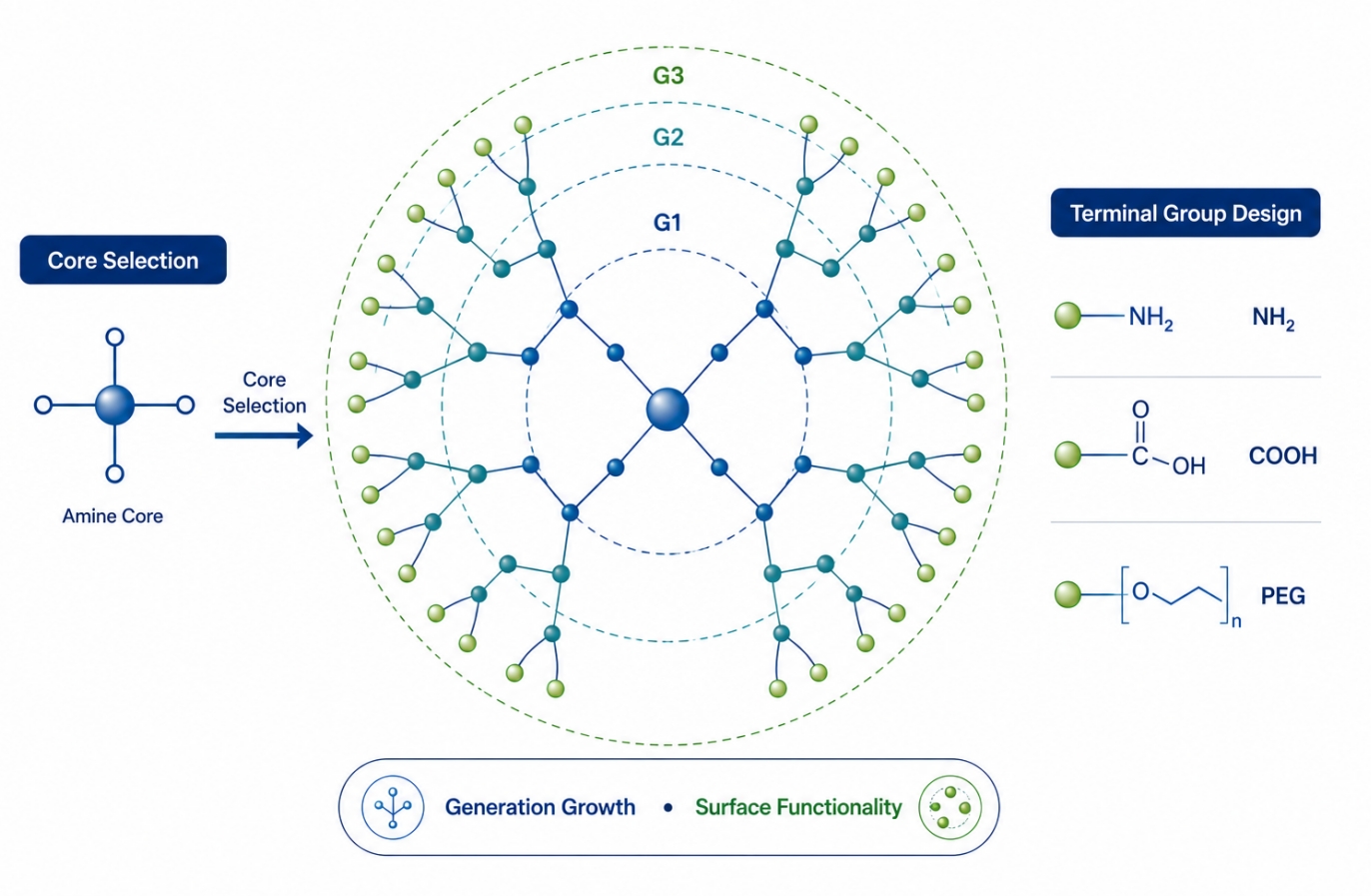
Dendrimer synthesis focuses on preparing generation-defined dendritic macromolecules with a controlled central core, branching layers, terminal groups, and multivalent surface functionality. Compared with statistically branched polymers, dendrimers require more deliberate stepwise design because each generation, end-group conversion, and purification step can influence final size, surface valency, solubility, and material performance. BOC Sciences supports PAMAM, PPI, polyester, polyether, carbosilane, phosphorus, lysine-based, peptide-like, fluorescent, hybrid, and surface-functional dendrimers for advanced material research. Related capabilities include polymer synthesis service, polymerization technologies, side and end group functionalization, polymer characterization service, and polymer modification service.
Dendrimer Architectures and Surface Designs We Can Develop
Dendrimer projects are shaped by the relationship between the core, branching unit, generation number, and terminal surface chemistry. A low-generation dendrimer may prioritize clean synthesis and reactive termini, while a higher-generation structure may require more attention to steric crowding, incomplete conversion, and purification. BOC Sciences helps clients select dendrimer types and surface designs according to structure, solubility, functionality, and analytical requirements.
PAMAM Dendrimer Synthesis
- Supports PAMAM dendrimers, amine-terminated PAMAM, hydroxyl-modified PAMAM, carboxyl-modified PAMAM, and surface-functional PAMAM.
- Structures may be built through stepwise Michael addition, amidation, terminal conversion, or post-functionalization strategies.
- Key factors include generation number, amine density, surface group conversion, defect structures, solubility, and purification.
- Suitable for multivalent functional materials, surface modification, adsorption, nanostructures, composites, and interface research.
PPI and Polyamine Dendrimer Synthesis
- Supports PPI dendrimers, polyamine dendrimers, cationic dendritic structures, and modified polyamine-terminated systems.
- Development reviews polyamine core design, generation growth, terminal amine number, protonation behavior, and storage conditions.
- Surface groups may be modified with acetyl, carboxyl, PEG, fluorescent, ionic, clickable, or crosslinkable groups.
- Suitable for surface binding, dispersion stabilization, ionic materials, composite interfaces, and multivalent interaction studies.
Polyester and Polyether Dendrimer Synthesis
- Supports polyester dendrimers, polyether dendrimers, hydroxyl-terminated dendrimers, and flexible dendritic structures.
- Routes may involve esterification, etherification, condensation, protecting group chemistry, or dendron coupling.
- Development considers hydroxyl density, ester stability, molecular weight, thermal behavior, solubility, and defect control.
- Suitable for coatings, crosslinking precursors, soft materials, functional films, and degradable material research.
Carbosilane and Phosphorus Dendrimer Synthesis
- Supports silicon-containing, phosphorus-containing, and hybrid organic-inorganic dendrimer structures for functional materials.
- These systems can support thermal, interfacial, coating, catalytic, and nanocomposite material research.
- Key factors include core stability, branching unit reactivity, terminal conversion, solvent compatibility, and thermal behavior.
- Suitable for advanced materials, catalyst supports, composite interfaces, surface modification, and functional thin films.
Dendron Synthesis and Core Coupling
- Supports dendron building block synthesis, convergent dendrimer preparation, and dendron-to-core coupling projects.
- Suitable when dendron structure should be verified before attachment to a multifunctional core.
- Development evaluates dendron generation, focal point reactivity, coupling efficiency, steric hindrance, and purification.
- Can connect with monomer synthesis service when dendron precursors or branching units are needed.
Surface-functional Dendrimer Synthesis
- Supports amino, hydroxyl, carboxyl, azide, alkyne, thiol, maleimide, PEG, silane, fluorescent, ionic, or crosslinkable termini.
- Surface groups may be introduced by end-group conversion, click chemistry, PEGylation, amidation, esterification, silanization, or post-modification.
- Key factors include surface group density, terminal conversion, charge, solubility, reactivity, and storage stability.
- Suitable for surface immobilization, sensing, crosslinking, self-assembly, nanomaterials, and multivalent interfaces.
Fluorescent and Responsive Dendrimer Synthesis
- Supports fluorescent, chromophore-containing, pH-responsive, light-responsive, redox-responsive, or ion-responsive dendrimers.
- Functional units may be introduced through the core, branching layers, terminal groups, or post-synthesis coupling.
- Development considers labeling density, signal stability, photostability, response window, purification, and group retention.
- Suitable for sensing materials, visualization systems, responsive interfaces, functional films, and advanced polymer research.
Hybrid and Multivalent Dendrimer Systems
- Supports dendrimer-polymer conjugates, dendrimer-coated particles, crosslinking precursors, and multivalent functional scaffolds.
- Designs may combine dendrimers with polymer chains, nanoparticles, substrates, PEG spacers, or reactive linkers.
- Key factors include valency, surface accessibility, coupling efficiency, particle behavior, solubility, and characterization.
- Suitable for composites, dispersions, interface engineering, self-assembled systems, and high-functionality materials.
Need a Dendrimer with Defined Generation and Surface Groups?
Share your target core, dendrimer generation, branching unit, terminal groups, functionalization needs, sample quantity, preferred synthesis route, sample format, and intended material application. BOC Sciences can evaluate dendrimer feasibility and prepare a tailored synthesis proposal.
From Core Selection to Generation-controlled Dendrimer Delivery
Dendrimer synthesis requires attention to details that are less critical in many linear polymer projects. Each growth step must preserve reactive sites, maintain solubility, reduce incomplete branches, and keep the next modification step feasible. BOC Sciences supports dendrimer projects through structure planning, generation growth, end-group conversion, purification, and multi-method analytical verification.
1Dendrimer Architecture and Feasibility Assessment
- Evaluates target dendrimer core, generation, branching unit, terminal groups, solubility, sample format, and application direction.
- Determines whether divergent, convergent, orthogonal, dendron coupling, or post-functionalization routes are suitable.
- Identifies incomplete growth, generation defects, low terminal conversion, steric hindrance, purification difficulty, and verification risks.
- Provides an initial project information checklist and preliminary synthesis route suggestions.
2Core, Branching Unit and Generation Design
- Reviews multifunctional cores, branching monomers, dendron building blocks, focal points, and protecting group strategies.
- Designs G0, G1, G2, G3, or higher-generation structures with planned terminal group density.
- Considers core functionality, branching efficiency, protection-deprotection compatibility, generation growth, and solubility.
- Selects structural paths according to target molecular size, terminal group number, and functional material needs.
3Divergent and Convergent Route Selection
- Uses divergent growth when branches should be built outward from a multifunctional core.
- Uses convergent dendron synthesis when dendron intermediates require structural confirmation before core coupling.
- Compares coupling efficiency, defect control, steric hindrance, purification difficulty, and scale feasibility.
- For complex surface-functional systems, combined routes or orthogonal growth strategies may be considered.
4Surface Functionalization and End-group Conversion
- Supports amino, hydroxyl, carboxyl, azide, alkyne, thiol, PEG, silane, fluorescent, ionic, and crosslinkable terminal groups.
- Uses click chemistry, amidation, esterification, PEGylation, acetylation, quaternization, silane coupling, or photoreactive modification.
- Reviews terminal conversion, surface accessibility, charge, solubility, reaction selectivity, and storage stability.
- Useful for reactive surfaces, sensing systems, crosslinkers, particle functionalization, and multivalent scaffolds.
5Defect Control and Purification Strategy
- Addresses incomplete generation growth, missing branches, partially converted termini, excess reagents, and low-generation impurities.
- Selects dialysis, precipitation, column separation, ultrafiltration, preparative HPLC, or freeze drying according to dendrimer properties.
- Reviews dendrimer size, charge, solubility, surface groups, and separation difficulty before purification.
- Can connect with polymer isolation and purification when tailored cleanup is needed.
6Dendrimer Characterization and Valency Analysis
- Supports NMR, MALDI-TOF, ESI-MS, GPC/SEC, HPLC, FTIR, UV-Vis, elemental analysis, DLS, Zeta, DSC, and TGA.
- Evaluates generation growth, molecular weight, terminal conversion, size, charge, thermal behavior, and purity.
- Selects analytical combinations according to dendrimer generation, chemistry, solubility, and sample complexity.
- Uses complementary methods because a single technique may not fully confirm complex dendritic structures.
7Functional Dendrimer Sample Format Preparation
- Delivers dendrimers as powder, solid, solution, dispersion, surface-functional sample, particle precursor, coating precursor, or crosslinking precursor.
- Provides storage guidance for amino, ionic, PEGylated, fluorescent, silane-terminated, or reactive dendrimers when needed.
- Reviews moisture, light, oxidation, pH, salt form, concentration, and solvent compatibility during sample handling.
- Supports downstream immobilization, particle functionalization, film formation, or network formation.
8Follow-up Modification and Material Integration Support
- Supports dendrimer-polymer conjugation, dendrimer-coated particles, dendrimer-functionalized surfaces, self-assembly, and composite material development.
- Adjusts generation, terminal groups, charge, solubility, spacer design, or surface functionality based on characterization.
- Can connect with polymer nanoparticle synthesis, micelle, hydrogel, or characterization workflows.
- Delivers samples with synthesis summaries, purification notes, characterization data, and technical observations.
How Dendrimer Generation, Surface Groups and Size Can Be Verified
Dendrimer analysis should confirm more than the presence of a functional group. Generation growth, terminal group conversion, molecular size, residual defects, charge, aggregation tendency, and purity can all influence downstream material behavior. BOC Sciences selects characterization methods according to dendrimer type, generation level, solubility, surface functionality, and intended sample format.
| Dendrimer Type | Common Synthesis Route | Key Evaluation Items | Typical Characterization |
|---|---|---|---|
| PAMAM Dendrimers | Divergent growth, surface modification | Generation, amine density, terminal conversion | NMR, MALDI-TOF, GPC/SEC, titration |
| PPI Dendrimers | Divergent polyamine growth, end modification | Amine groups, charge, generation defects | NMR, MS, DLS, Zeta |
| Polyester Dendrimers | Esterification, dendron coupling | Hydroxyl groups, ester stability, thermal behavior | NMR, FTIR, DSC, TGA |
| Polyether Dendrimers | Etherification, convergent dendron route | End groups, solubility, molecular size | NMR, GPC/SEC, MALDI-TOF |
| Carbosilane Dendrimers | Hydrosilylation, silane chemistry | Si-containing branches, surface groups | NMR, FTIR, elemental analysis |
| Phosphorus Dendrimers | Phosphorus-based branching, surface conversion | P-containing core/branches, terminal groups | NMR, FTIR, elemental analysis |
| Fluorescent Dendrimers | Dye coupling, functional core or termini | Label density, photostability, purity | UV-Vis, fluorescence, NMR |
| PEGylated Dendrimers | PEG coupling, surface modification | PEG density, solubility, size | NMR, DLS, GPC/SEC |
| Surface-reactive Dendrimers | Click, silane, thiol, azide, alkyne routes | Reactive group availability, stability | FTIR, NMR, titration |
| Hybrid Dendrimer Systems | Dendrimer-polymer coupling, particle functionalization | Valency, morphology, charge, dispersion | DLS, Zeta, SEM/TEM |
Why Choose BOC Sciences for Dendrimer Synthesis
- Generation-controlled Architecture Design: BOC Sciences designs dendrimer structures around core functionality, branching units, generation number, terminal group density, molecular size, and intended surface function.
- Divergent and Convergent Synthesis Support: Projects can be developed through divergent growth, convergent dendron synthesis, dendron-core coupling, orthogonal growth, surface modification, or combined synthetic strategies.
- Diverse Dendrimer Chemistry Capability: BOC Sciences supports PAMAM, PPI, polyester, polyether, carbosilane, phosphorus, lysine-based, peptide-like, hybrid, fluorescent, and surface-reactive dendrimer systems.
- Surface Functional Group Engineering: Amino, hydroxyl, carboxyl, azide, alkyne, thiol, PEG, fluorescent, ionic, silane, maleimide, and crosslinkable terminal groups can be introduced or modified when feasible.
- Defect-aware Growth and Conversion Control: Incomplete generation growth, missing branches, partially converted terminal groups, steric crowding, low-generation impurities, and excess reagents are evaluated during route design and optimization.
- Purification Strategy for Dendritic Structures: Purification methods such as precipitation, dialysis, ultrafiltration, column separation, preparative HPLC, extraction, and freeze drying can be selected according to dendrimer size, charge, solubility, and terminal groups.
- Multi-method Structural Verification: BOC Sciences combines NMR, MALDI-TOF, ESI-MS, GPC/SEC, HPLC, FTIR, UV-Vis, fluorescence, elemental analysis, DLS, Zeta potential, DSC, and TGA according to project requirements.
- Application-oriented Sample Delivery: Dendrimers can be prepared as powders, solids, solutions, dispersions, surface-reactive intermediates, particle precursors, coating precursors, crosslinking precursors, or functional material building blocks when feasible.
From Dendrimer Concept to Functional Macromolecule Delivery
A dendrimer project usually progresses through a sequence of structure-sensitive decisions: the core must support planned growth, each generation must be verified, and terminal groups must remain accessible for later function. BOC Sciences applies a staged workflow to evaluate feasibility, reduce structural defects, select purification methods, and deliver dendritic samples with useful technical documentation.

1Requirement Communication and Dendrimer Target Definition
The project begins by confirming the target dendrimer core, generation, branching unit, surface groups, functionalization needs, sample quantity, and application direction. BOC Sciences also clarifies the preferred sample form, such as powder, solid, solution, dispersion, particle precursor, coating precursor, or crosslinking precursor.

2Core and Generation Feasibility Assessment
Multifunctional cores, branching monomers, dendron building blocks, protecting groups, terminal functionality, and solubility are reviewed before synthesis. The assessment determines whether divergent growth, convergent dendron synthesis, dendron coupling, or a hybrid route is more suitable while identifying generation defects, steric hindrance, low terminal conversion, and purification risks.

3Dendrimer Growth Strategy Design
BOC Sciences designs the generation-growth sequence, protection-deprotection steps, coupling reactions, activation strategy, terminal conversion, and purification plan. Reaction sequence, excess reagent strategy, solvent, temperature, reaction time, and intermediate verification are defined. Characterization methods are selected to confirm generation growth, terminal group number, molecular size, and surface charge.

4Small-scale Synthesis and Generation Optimization
Small-scale synthesis is performed to evaluate generation-growth efficiency, terminal group conversion, defect structures, solubility, and byproduct formation. Depending on early results, reagent ratio, reaction time, protecting group strategy, coupling conditions, purification method, or surface modification route may be adjusted to match the target generation and functional surface.

5Purification, Characterization and Defect Review
The dendrimer is purified according to charge, size, solubility, terminal groups, and impurity profile. Characterization may include NMR, MALDI-TOF, GPC/SEC, HPLC, FTIR, DLS, Zeta potential, elemental analysis, DSC, or TGA. Results are reviewed against generation target, terminal conversion, purity, size, and storage stability.

6Sample Delivery and Follow-up Functional Support
BOC Sciences delivers dendrimer samples with available synthesis summaries, purification notes, characterization data, and technical recommendations. Follow-up support may include surface functionalization, PEGylation, fluorescent labeling, particle coating, crosslinking, self-assembly, composite integration, or additional route refinement for continued functional material development.
Where Dendrimers Support Advanced Material Design
Dendrimers offer a combination of controlled generation, dense terminal groups, nanoscale size, and multivalent surface chemistry. These features make them useful when materials need many functional sites arranged around a defined molecular scaffold. BOC Sciences prepares dendrimers for interface materials, particles, coatings, sensing systems, networks, composites, and advanced functional polymer research.
Multivalent Functional Materials
- Dendrimers provide dense terminal groups that can support multivalent interactions and concentrated reactive sites.
- Generation, surface group density, charge, spacer length, and terminal group accessibility are key design factors.
- Functional surfaces can be selected according to binding, coupling, adsorption, or interface needs.
- Suitable for reactive platforms, adsorbents, interface materials, and multi-site material design.
- Structure and surface group verification are important before downstream application testing.
Nanoparticles, Micelles and Self-assembled Systems
- Dendrimers can be used as components of nanoparticles, micelles, dispersions, and hybrid particle systems.
- Important parameters include molecular size, surface charge, terminal groups, aggregation behavior, and morphology.
- DLS, Zeta potential, and microscopy can help evaluate assembled or particle-containing systems.
- Can connect with polymer micelle synthesis for self-assembled material projects.
- Suitable for nanoscale polymer materials, dispersions, and hybrid functional particles.
Coatings, Films and Surface Modification
- Surface-reactive dendrimers can support coatings, thin films, surface immobilization, and interface modification.
- Silane, hydroxyl, amino, epoxy, thiol, carboxyl, or crosslinkable termini may be selected.
- Terminal group density can influence adhesion, surface energy, crosslinking, and interfacial behavior.
- Can connect with polymer structure morphology analysis when surface or film morphology matters.
- Suitable for functional coatings, surface primers, adhesion layers, and interface-controlled films.
Catalyst Supports and Functional Scaffolds
- Dendrimers can function as ligands, metal-binding platforms, multivalent scaffolds, or catalyst supports.
- Core chemistry, terminal coordination sites, steric accessibility, and scaffold stability should be considered.
- Surface group design can influence binding capacity, distribution of active sites, and material compatibility.
- Suitable for catalytic materials, adsorbent platforms, functional scaffolds, and hybrid composites.
- Characterization should verify both dendrimer structure and active functional site availability.
Sensors, Fluorescent and Responsive Materials
- Fluorescent, photoresponsive, pH-responsive, ion-responsive, or redox-responsive dendrimers can support functional materials.
- Label density, signal stability, photostability, response window, solubility, and purification are important.
- Functional groups may be positioned at the core, branching layer, or terminal surface.
- Suitable for sensing films, visualization materials, responsive interfaces, and smart polymer systems.
- UV-Vis, fluorescence, NMR, or surface analysis may be selected according to response type.
Hydrogels and Crosslinked Networks
- Multi-terminal dendrimers can act as crosslinking nodes, network precursors, or multifunctional crosslinkers.
- Terminal reactivity, spacer length, crosslink density, gelation window, swelling, and mechanical behavior matter.
- Acrylate, thiol, amine, azide, alkyne, epoxy, or other reactive termini may be used.
- Can connect with polymer hydrogel synthesis for network-focused projects.
- Suitable for soft materials, crosslinked films, gels, and functional network systems.
Composite and Interface Materials
- Dendrimer terminal groups can improve filler interaction, particle surfaces, polymer matrix compatibility, and interface design.
- Surface charge, terminal group type, solvent compatibility, dispersion stability, and morphology should be evaluated.
- Dendrimers may function as compatibilizers, surface modifiers, interfacial additives, or coupling platforms.
- Can connect with polymer physical and mechanical analysis for property evaluation.
- Suitable for composite materials, filled polymer systems, and interface engineering research.
Electronic, Optical and Advanced Polymer Materials
- Silicon, phosphorus, aromatic, fluorescent, or conjugated dendrimers can support advanced material studies.
- Thermal stability, optical behavior, film formation, morphology, charge-related behavior, and structural regularity may matter.
- Functional dendrimers can contribute to coatings, optical films, nanostructures, and polymer additive systems.
- Can connect with polymer thermal analysis for temperature-related evaluation.
- Suitable for advanced polymer materials requiring precise surface functionality and defined molecular architecture.
Ready to Develop a Generation-controlled Dendrimer?
Send your target dendrimer type, core structure, generation number, terminal group requirements, sample quantity, and application direction. BOC Sciences can evaluate feasibility and prepare a practical dendrimer synthesis plan.
Frequently Asked Questions
-
How is dendrimer synthesis different from hyperbranched polymer synthesis?
Dendrimer synthesis usually builds a more regular, generation-defined branched structure through stepwise growth or dendron coupling. Hyperbranched polymers are typically more statistical and may have broader structural distributions. Dendrimer projects focus more strongly on core design, generation number, surface group density, defect control, purification, and detailed structural verification.
-
What information is needed to start a dendrimer synthesis project?
Please provide the target dendrimer type, core structure, desired generation, branching unit, terminal groups, functionality level, sample quantity, preferred sample format, solvent restrictions, intended application, and required characterization. If available, share literature procedures, dendron structures, reference products, or downstream functionalization requirements for route evaluation.
-
Should a dendrimer be synthesized by divergent or convergent strategy?
Divergent synthesis grows branches outward from a multifunctional core and can be efficient for building generations. Convergent synthesis prepares dendrons first and then couples them to a core, which may simplify intermediate verification in some systems. The better route depends on generation target, steric hindrance, purity needs, and coupling feasibility.
-
Can dendrimer terminal groups be customized?
Yes. Dendrimer terminal groups can often be modified to amino, hydroxyl, carboxyl, azide, alkyne, thiol, PEG, fluorescent, ionic, silane, or crosslinkable groups. Feasibility depends on terminal group accessibility, reaction selectivity, solubility, charge, purification method, and whether the modified dendrimer remains stable during storage or downstream use.
-
What are common challenges in higher-generation dendrimers?
Higher-generation dendrimers may show steric crowding, incomplete terminal conversion, missing branches, broader impurity profiles, low solubility, difficult purification, or aggregation. These challenges are managed through stepwise verification, excess reagent control, protecting group strategy, intermediate purification, careful solvent selection, and a characterization plan matched to dendrimer size and chemistry.
-
How can dendrimer generation and surface functionality be verified?
Verification may involve NMR, MALDI-TOF, ESI-MS, GPC/SEC, HPLC, FTIR, elemental analysis, titration, DLS, Zeta potential, UV-Vis, fluorescence, DSC, or TGA. No single method fits every dendrimer, so several complementary techniques are often selected to evaluate generation growth, terminal conversion, size, charge, purity, and stability.
-
Can dendrimers be used as crosslinkers or surface modifiers?
Yes. Dendrimers with reactive terminal groups can be designed as multifunctional crosslinkers, coating additives, surface modifiers, interface layers, or particle-functionalization agents. Important design factors include terminal group density, spacer length, solubility, charge, coupling efficiency, substrate compatibility, gelation behavior, and the ability to verify surface or network formation.
-
What deliverables are included in a dendrimer synthesis service?
Deliverables may include dendrimer or dendron samples, synthesis condition summaries, purification notes, terminal group information, characterization data, and technical observations. Depending on the project, samples may be delivered as powder, solid, solution, dispersion, particle precursor, coating precursor, crosslinking precursor, or functional intermediate for further material development.