Functional Polymer Synthesis
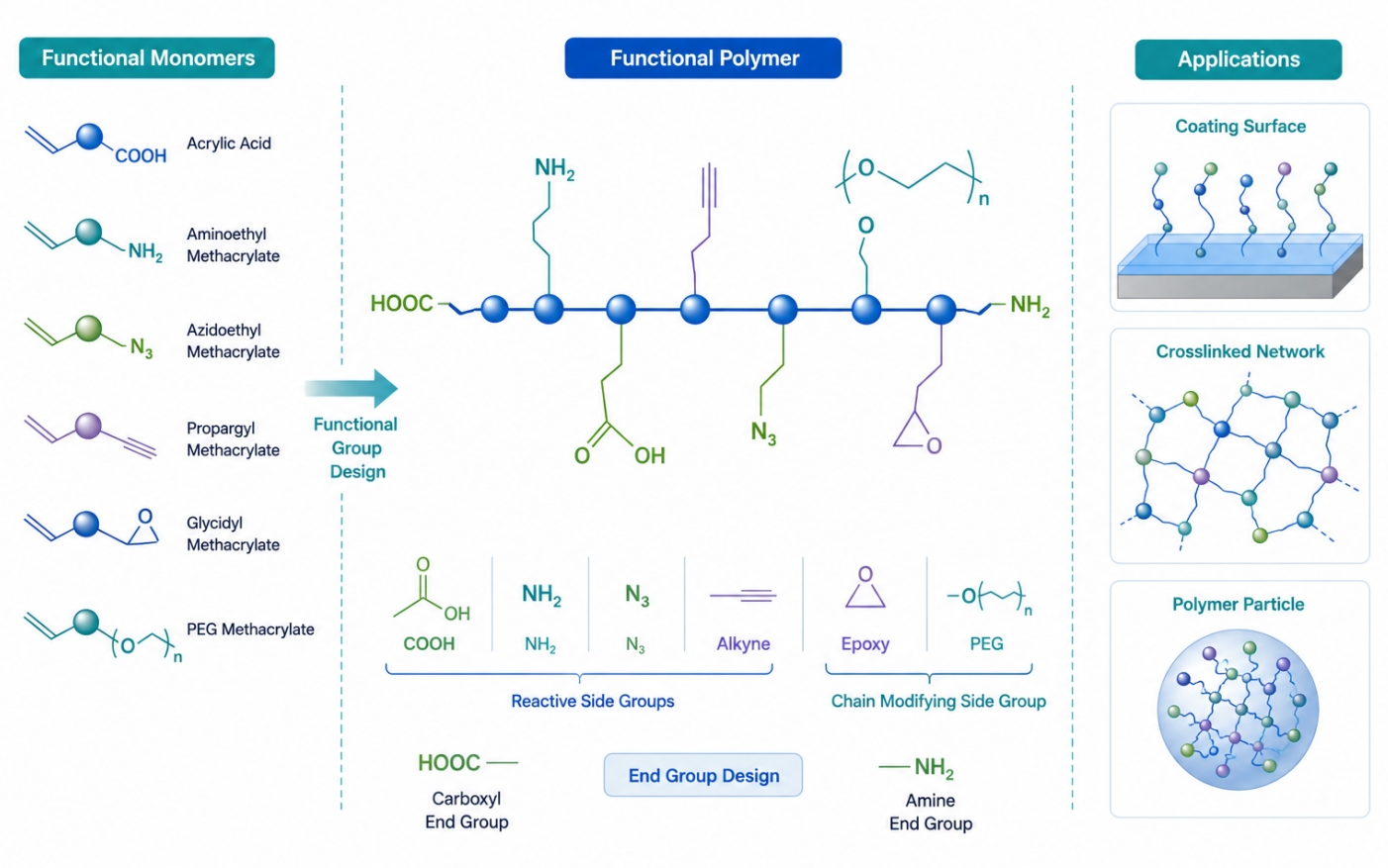
Functional polymer synthesis focuses on preparing polymer materials with defined chemical functions, reactive sites, or application-oriented molecular features. These functions may be introduced through functional monomers, reactive end groups, side-chain modification, block design, post-polymerization transformation, or combined synthetic strategies. BOC Sciences supports the development of carboxyl, hydroxyl, amino, thiol, azide, alkyne, epoxy, silane, PEGylated, fluorescent, ionic, crosslinkable, and stimuli-responsive polymers for coatings, surfaces, dispersions, hydrogels, adhesives, self-assembled systems, composites, and advanced material research. For each functional polymer project, BOC Sciences reviews the target functional groups, polymer backbone, synthesis route, purification strategy, and characterization requirements to support reliable preparation of reactive, modifiable, or application-oriented polymer samples.
Functional Polymer Types and Reactive Designs We Support
Functional polymers are defined by what their chemical groups are expected to do after synthesis: react, bind, crosslink, disperse, respond, fluoresce, self-assemble, or modify an interface. BOC Sciences designs each project around the target functional group, its position in the polymer structure, its compatibility with polymerization conditions, and the analytical methods needed to confirm that the intended functionality has been retained.
Carboxyl and Hydroxyl Functional Polymer Synthesis
- Supports polymers containing carboxyl, hydroxyl, carboxylate, or related hydrogen-bonding functional groups.
- Functional groups may be introduced by functional monomer polymerization, copolymerization, end-group design, or post-modification.
- Development considers acid value, hydroxyl value, hydrophilicity, reactivity, hydrogen bonding, and crosslinking potential.
- Suitable for coatings, adhesives, dispersants, adsorbents, hydrogel precursors, and surface modification materials.
Amino and Thiol Functional Polymer Synthesis
- Supports polymers bearing amino, quaternary ammonium, thiol, sulfide, or related reactive sulfur-containing groups.
- These groups can support coupling, adsorption, metal coordination, surface attachment, crosslinking, or click-type reactions.
- Key factors include pH sensitivity, oxidation stability, reaction selectivity, storage conditions, and purification strategy.
- Suitable for functional surfaces, ionic materials, adsorbents, composite interfaces, and reactive polymer systems.
Azide, Alkyne and Clickable Polymer Synthesis
- Supports polymers containing azide, alkyne, maleimide, norbornene, alkene, thiol, or other clickable groups.
- Clickable functionality may be introduced through functional monomers, end-group conversion, or side-chain modification.
- Development evaluates click group retention, reaction selectivity, residual catalyst, end-group conversion, and coupling capacity.
- Suitable for modular functionalization, surface grafting, crosslinking, self-assembly, and functional interface construction.
Epoxy and Silane Functional Polymer Synthesis
- Supports polymers containing epoxy, silane, alkoxysilane, or hydrolysis-condensation reactive sites.
- These groups are useful for surface attachment, inorganic-organic interfaces, coating crosslinking, and filler compatibility.
- Key concerns include moisture sensitivity, storage stability, hydrolysis, condensation, side reactions, and sample handling.
- Suitable for adhesives, coatings, interface modification, hybrid materials, and functional film development.
PEGylated and Hydrophilic Functional Polymer Synthesis
- Supports polymers containing PEG, polyether, zwitterionic, charged, or hydrophilic side-chain and end-group structures.
- Routes may involve PEG monomers, PEG macroinitiators, PEG end groups, or post-polymerization PEGylation.
- Development considers water solubility, amphiphilicity, end-group activity, molecular weight, and self-assembly behavior.
- Suitable for dispersants, soft materials, surface modification, hydrogel precursors, and amphiphilic polymer systems.
Fluorescent and Chromophore-containing Polymer Synthesis
- Supports polymers containing fluorescent labels, dyes, chromophores, photoresponsive groups, or detectable functional tags.
- Functional units may be introduced through dye monomers, end labeling, side-chain coupling, or post-polymerization modification.
- Key factors include photostability, dye compatibility, labeling density, solubility, signal response, and purification difficulty.
- Suitable for sensing materials, visualization tools, responsive films, and functional polymer research.
Ionic and Stimuli-responsive Polymer Synthesis
- Supports pH-, temperature-, light-, redox-, ionic strength-, and solvent-responsive polymer systems.
- Examples include cationic, anionic, zwitterionic, PNIPAM-like, photoresponsive, or reversible-interaction polymers.
- Development evaluates response window, transition behavior, ion sensitivity, solubility, molecular weight, and functionality level.
- Suitable for smart coatings, sensors, dispersions, soft materials, and adjustable interface systems.
Crosslinkable and Network-forming Polymer Synthesis
- Supports polymers containing acrylate, methacrylate, epoxy, hydroxyl, carboxyl, silane, alkene, thiol, or thermal/UV-reactive groups.
- Crosslinking may be designed for thermal curing, UV curing, click crosslinking, moisture curing, or network formation.
- Key factors include crosslinking site density, gelation risk, storage stability, processing window, and final sample format.
- Suitable for coatings, hydrogels, elastomers, films, adhesives, and soft network materials.
Need a Polymer with Specific Reactive or Functional Groups?
Share your target functional group, polymer backbone, molecular weight range, desired functionality level, sample quantity, preferred synthesis route, sample format, and intended application. BOC Sciences can evaluate functional polymer feasibility and prepare a tailored synthesis proposal.
From Functional Group Selection to Polymer Sample Delivery
A functional polymer project succeeds only when the desired chemical group remains compatible with synthesis, purification, storage, and downstream use. BOC Sciences reviews whether functionality should be introduced before, during, or after polymerization, then designs a service path that connects reactive group selection with molecular weight control, sample formatting, and function-focused characterization.
1Functional Requirement and Feasibility Assessment
- Evaluates target functional groups, reactive sites, polymer backbone, molecular weight, sample format, and application needs.
- Determines whether functionality is best introduced by direct polymerization, copolymerization, end-group design, side-chain modification, or post-modification.
- Identifies risks such as group deactivation, side reactions, poor solubility, difficult purification, or storage instability.
- Provides a project information checklist and initial technical recommendations before synthesis starts.
2Functional Monomer and Polymer Precursor Design
- Assesses functional monomers, protecting group options, macroinitiators, end-functional precursors, and modifiable polymer backbones.
- Reviews monomer reactivity, functionality tolerance, inhibitor content, water sensitivity, storage needs, and reaction compatibility.
- Can connect with monomer synthesis service when unavailable functional monomers are required.
- Focuses on functional group position, target loading, reactivity, and compatibility with final material use.
3Polymerization Route Selection
- Selects radical, RAFT, ATRP, NMP, ROP, ROMP, ionic, emulsion, or condensation routes according to functionality and backbone target.
- Designs initiators, catalysts, chain transfer agents, protecting groups, solvents, temperature, and reaction time.
- Evaluates how functional groups affect polymerization activity, chain growth, dispersity, and end-group fidelity.
- Uses post-polymerization functionalization when direct functional monomer polymerization presents avoidable risk.
4Side-chain and End-group Functionalization Support
- Supports functional group introduction at side chains, chain ends, blocks, graft chains, or crosslinking sites.
- May use click chemistry, esterification, amidation, thiol-ene reaction, epoxy ring opening, silanization, or substitution.
- Reviews degree of functionalization, end-group conversion, selectivity, residual small molecules, and purification strategy.
- Useful when direct polymerization cannot preserve sensitive or highly reactive functional groups.
5Functionality Level and Molecular Weight Control
- Supports tuning of functional group content, degree of functionalization, Mn, Mw, dispersity, and chain structure.
- Adjusts monomer ratio, conversion, reaction time, chain transfer agent, catalyst, and modification conditions.
- Uses NMR, FTIR, GPC/SEC, titration, or elemental analysis to verify functionality and molecular features.
- Provides feasibility guidance based on functional group stability, target loading, and polymerization mechanism.
6Purification and Stability-focused Sample Preparation
- Provides polymer isolation and purification through precipitation, dialysis, extraction, column separation, ultrafiltration, centrifugation, filtration, or drying.
- Removes or reduces residual monomers, catalysts, coupling reagents, protecting group byproducts, salts, oligomers, and small molecules.
- Recommends light protection, moisture control, inert atmosphere, or low-temperature handling when functionality requires care.
- Prepares powder, solid, solution, dispersion, latex, film precursor, coating precursor, or crosslinking precursor when feasible.
7Functional Polymer Characterization
- Supports GPC/SEC, NMR, FTIR, DSC, TGA, elemental analysis, titration, fluorescence, DLS, Zeta, contact angle, or surface analysis.
- Selects characterization methods according to functional group type, sample format, and material application target.
- Evaluates structure, functional group content, reactivity, thermal behavior, particle size, surface properties, and stability.
- Prioritizes analytical methods that directly support synthesis decisions and downstream material evaluation.
8Follow-up Modification and Application-oriented Support
- Supports further crosslinking, grafting, surface immobilization, self-assembly, particle preparation, hydrogel development, or composite evaluation.
- Adjusts functional group content, backbone structure, molecular weight, or sample format based on characterization results.
- Can connect with polymer micelle, nanoparticle, hydrogel, surface, or coating-related material development.
- Delivers samples, synthesis summaries, purification notes, characterization data, and technical observations.
How Functional Polymer Properties Can Be Verified
Functional polymer characterization must answer two questions at the same time: whether the polymer backbone was prepared as expected and whether the intended chemical function remains present, accessible, and reactive. BOC Sciences recommends analytical combinations based on the functional group, expected loading, sample solubility, thermal behavior, particle form, surface interaction, or downstream reaction needs.
| Functional Polymer Type | Common Design Route | Key Evaluation Items | Typical Characterization |
|---|---|---|---|
| Carboxyl/Hydroxyl Functional Polymers | Functional monomer, copolymerization, end-group design | Acid value, hydroxyl value, solubility, reactivity | NMR, FTIR, titration, GPC/SEC |
| Amino/Thiol Functional Polymers | Protected monomer, post-modification, end-functional polymer | Amine value, thiol stability, oxidation risk | NMR, FTIR, elemental analysis |
| Azide/Alkyne Clickable Polymers | End-group conversion, functional monomer, side-chain modification | Click group retention, conversion, purity | NMR, FTIR, GPC/SEC |
| Epoxy/Silane Functional Polymers | Functional monomer, post-functionalization, coupling | Hydrolysis risk, epoxy value, surface reactivity | FTIR, NMR, titration |
| PEGylated/Hydrophilic Polymers | PEG monomer, PEG macroinitiator, post-PEGylation | Water solubility, amphiphilicity, end groups | NMR, GPC/SEC, DLS |
| Fluorescent Functional Polymers | Dye monomer, end-labeling, side-chain coupling | Label density, fluorescence response, stability | UV-Vis, fluorescence, NMR |
| Ionic/Zwitterionic Polymers | Charged monomer, quaternization, salt-form adjustment | Charge density, solubility, Zeta potential | NMR, titration, Zeta |
| Stimuli-responsive Polymers | Responsive monomer, block design, copolymerization | Response window, transition behavior, reversibility | DSC, DLS, turbidity, rheology |
| Crosslinkable Polymers | Acrylate, epoxy, silane, alkene, thiol, thermal/UV groups | Crosslink density, gelation, storage stability | Rheology, FTIR, swelling test |
| Specialty Functional Polymers | Project-specific route | Reactivity, purity, processability, performance | Project-specific analytical package |
Why Functional Polymer Projects Need Chemistry-specific Planning
- Function-first Polymer Design: BOC Sciences designs polymer structures around target functional groups, reactive sites, location, functionality level, and application requirements.
- Direct Polymerization and Post-modification Options: Projects may use functional monomer polymerization, protected monomers, end-group design, side-chain modification, or post-polymerization transformation.
- Reactive Group Compatibility Review: Carboxyl, amino, thiol, azide, alkyne, epoxy, silane, PEG, ionic, fluorescent, and responsive groups are reviewed for stability and reaction compatibility.
- Molecular Weight and Functionality Balance: Services consider Mn, Mw, dispersity, functional group content, solubility, processability, sample format, and material behavior together.
- Purification Strategy for Functional Polymers: Purification planning addresses residual monomers, catalysts, coupling reagents, protecting group byproducts, salts, oligomers, and unreacted functional molecules.
- Application-oriented Sample Format: Samples can be prepared as powder, solution, dispersion, latex, film precursor, coating precursor, crosslinking precursor, or hydrogel precursor when feasible.
- Structure and Reactivity Verification: GPC/SEC, NMR, FTIR, titration, elemental analysis, fluorescence, DLS, Zeta potential, thermal analysis, and surface testing can support technical decisions.
From Functional Target Definition to Reactive Polymer Delivery
Functional polymer development requires coordinated decisions about functional group stability, polymer backbone design, synthesis route, purification strategy, and final sample format. BOC Sciences follows a structured workflow to help clients define the target function, evaluate chemistry compatibility, optimize functional polymer preparation, and deliver samples with relevant characterization data.

1Requirement Communication and Functional Target Definition
- Confirm the target functional groups, polymer backbone, functionality location, molecular weight range, functionality level, sample quantity, and intended application.
- Define the preferred sample format, such as powder, solid, solution, dispersion, latex, film precursor, crosslinking precursor, or gel precursor.
- Clarify whether follow-up crosslinking, grafting, surface immobilization, self-assembly, or pre-application material processing is required.

2Functional Group Compatibility Assessment
- Evaluate the stability of the target functional groups during polymerization, purification, storage, and downstream reactions.
- Determine whether protecting groups, mild polymerization conditions, post-polymerization modification, or an alternative functional route is needed.
- Identify risks such as side reactions, group deactivation, solubility change, oxidation, hydrolysis, or photodegradation.

3Synthesis Route and Modification Strategy Design
- Design a suitable route based on functional monomer polymerization, copolymerization, end-group conversion, side-chain modification, or combined strategies.
- Select the polymerization method, initiator system, catalyst, solvent, reaction temperature, reaction time, and purification approach.
- Plan the necessary characterization methods to verify functional group introduction, functionality level, and reactive group availability.

4Small-scale Synthesis and Functionality Optimization
- Perform small-scale synthesis or modification to evaluate conversion, functional group retention, molecular weight, solubility, and byproduct formation.
- Adjust monomer ratio, functionalization reagent, reaction time, catalyst system, temperature, solvent, or purification method based on results.
- Confirm the target functionality level, sample format, and feasibility for downstream material application or further development.

5Purification, Characterization and Stability Review
- Select purification methods according to polymer solubility, functional group stability, impurity profile, and final sample requirements.
- Verify the sample using GPC/SEC, NMR, FTIR, titration, elemental analysis, DSC, TGA, fluorescence analysis, DLS, or Zeta potential testing.
- Review the results against functionality level, reactivity, storage stability, sample format, and intended application targets.

6Sample Delivery and Follow-up Support
- Deliver functional polymer samples together with synthesis condition summaries, functionalization notes, purification information, characterization data, and technical recommendations.
- Support follow-up adjustment of functional group content, molecular weight, crosslinking behavior, hydrogel preparation, surface modification, particle preparation, or composite validation.
- Provide route refinement suggestions for continued material development, follow-up modification, or application-oriented polymer sample optimization.
Where Functional Polymers Enable Material Performance
Functional polymers help translate molecular design into observable material behavior. A reactive group can support bonding or crosslinking, an ionic group can tune dispersion or charge, a fluorescent unit can enable detection, and a responsive segment can change behavior under external conditions. BOC Sciences prepares functional polymers for coatings, hydrogels, sensors, dispersions, adhesives, self-assembled materials, and advanced industrial systems.
Coatings, Films and Surface Modification
- Functional polymers can support coating resins, reactive films, surface attachment, and interface-control materials.
- Adhesion, film formation, surface energy, crosslinking behavior, water resistance, and responsiveness can be considered.
- Epoxy, silane, hydroxyl, carboxyl, ionic, or responsive groups may be selected according to surface needs.
- Can connect with polymer structure morphology analysis when surface or film morphology matters.
- Suitable for functional coatings, thin films, surface treatments, and interface-modified materials.
Crosslinked Networks and Hydrogels
- Crosslinkable polymers can serve as precursors for hydrogels, elastomers, films, and soft networks.
- Design factors include crosslinking site density, gelation window, swelling behavior, mechanics, and functional response.
- Acrylate, thiol, alkene, epoxy, silane, azide, or alkyne groups may be used for network formation.
- Can connect with polymer hydrogel synthesis for hydrogel-focused projects.
- Suitable for soft materials, responsive gels, and crosslinked functional polymer systems.
Clickable and Modular Functional Materials
- Clickable polymers support modular coupling, grafting, surface immobilization, crosslinking, and post-functionalization.
- Common groups include azide, alkyne, maleimide, alkene, norbornene, and thiol functionalities.
- Important considerations include click efficiency, catalyst residue, group retention, and removal of small molecules.
- Suitable for functional interfaces, assembled materials, grafted polymers, and modular material construction.
- Characterization should confirm both polymer structure and reactive group availability.
Dispersants, Stabilizers and Interface Additives
- Ionic, PEGylated, carboxyl, amino, or amphiphilic polymers can improve dispersion and interface behavior.
- Hydrophilic-hydrophobic balance, charge density, adsorption, particle size stability, and solvent compatibility are important.
- Functional polymers may support pigments, fillers, nanoparticles, emulsions, and composite material systems.
- Zeta potential, DLS, surface analysis, and morphology testing may support dispersion evaluation.
- Suitable for coatings, inks, colloids, filled materials, and waterborne systems.
Sensors, Fluorescent and Responsive Materials
- Fluorescent, chromophore-containing, pH-responsive, thermo-responsive, photoresponsive, or redox-responsive polymers can be prepared.
- Signal behavior, response window, label density, reversibility, photostability, and solubility should be evaluated.
- Suitable for sensing films, visualization materials, smart polymer systems, and responsive interfaces.
- UV-Vis, fluorescence, DLS, turbidity, or thermal testing may be used depending on response type.
- Useful for materials requiring both structural control and detectable function.
Adhesives, Sealants and Reactive Binders
- Reactive polymers can support adhesive, sealant, binder, and formulation screening projects.
- Epoxy, hydroxyl, carboxyl, silane, thiol, or crosslinkable groups can tune curing and adhesion behavior.
- Tg, viscosity, substrate compatibility, functionality level, storage stability, and curing conditions should be considered.
- Can connect with polymer physical and mechanical analysis for performance testing.
- Suitable for reactive binders, coatings, sealants, and material formulation development.
Self-assembled and Amphiphilic Polymer Systems
- PEG, ionic, hydrophobic side-chain, or block-functional polymers can support self-assembly and dispersion systems.
- Hydrophilic-hydrophobic balance, molecular weight, functionality position, particle size, PDI, and stability matter.
- Functional groups may support further coupling, crosslinking, surface modification, or responsiveness after assembly.
- Can connect with polymer micelle synthesis for micelle-oriented projects.
- Suitable for colloidal materials, polymer nanoparticles, soft nanostructures, and amphiphilic systems.
Electronics, Packaging and Composite Materials
- Functional polymers can support advanced films, packaging materials, composite interfaces, and electronic material research.
- Thermal stability, morphology, film formation, mechanical behavior, interface compatibility, and group durability may matter.
- Functional groups can improve filler interaction, substrate adhesion, surface behavior, or dielectric-related material design.
- Can connect with polymer thermal analysis for temperature-related evaluation.
- Suitable for advanced industrial materials and application-oriented polymer development.
Ready to Develop a Function-focused Polymer Material?
Send your target polymer backbone, required functional groups, desired functionality level, molecular weight range, sample format, and application direction. BOC Sciences can evaluate feasibility and prepare a practical functional polymer synthesis plan.
Frequently Asked Questions
-
What is Functional Polymer?
A functional polymer is a polymer designed with specific chemical groups or molecular features that provide a targeted function beyond the basic polymer backbone. These functions may include reactivity, crosslinking ability, surface attachment, ionic behavior, fluorescence, hydrophilicity, self-assembly, or stimuli responsiveness. Functional groups can be introduced through functional monomers, end-group design, side-chain modification, copolymerization, or post-polymerization modification.
-
How should I decide whether a functional group should be introduced during polymerization or after polymerization?
The decision depends on functional group stability, monomer reactivity, polymerization conditions, desired functionality level, and purification needs. Some groups tolerate direct polymerization, while others may inhibit chain growth or degrade. Post-polymerization modification is often preferred when the functionality is sensitive, highly reactive, or easier to verify after backbone synthesis.
-
Can BOC Sciences prepare polymers with clickable groups such as azide or alkyne?
Yes. Clickable polymers can be designed with azide, alkyne, alkene, norbornene, maleimide, thiol, or related reactive groups. These groups may be introduced through functional monomers, end-group conversion, or side-chain modification. Feasibility depends on polymer backbone, group stability, target loading, purification method, and downstream coupling requirements.
-
What information is needed for a Functional Polymer Synthesis project?
Please provide the target polymer backbone, desired functional groups, preferred location of functionality, molecular weight range, functionality level, sample quantity, solvent restrictions, sample format, intended application, and required characterization. If available, share functional monomer structures, literature methods, previous synthesis results, or downstream reaction conditions.
-
How can functional group content be measured?
Functional group content may be estimated by NMR, FTIR, elemental analysis, titration, UV-Vis, fluorescence analysis, or reaction-based assays, depending on the group. GPC/SEC can provide molecular weight information but usually does not quantify functionality alone. Multiple methods may be needed when groups overlap spectroscopically or occur at low loading.
-
Can functional polymers be designed for crosslinking or network formation?
Yes. Crosslinkable polymers can include acrylate, methacrylate, epoxy, silane, hydroxyl, carboxyl, thiol, alkene, azide, alkyne, or thermally reactive groups. Design factors include crosslinking density, processing window, storage stability, gelation risk, solvent compatibility, and final material format such as film, coating, hydrogel precursor, or elastomer precursor.
-
Can functional polymers be delivered as solutions, dispersions or precursors?
Depending on polymer chemistry and stability, functional polymers may be delivered as powder, solid, solution, dispersion, latex, film precursor, coating precursor, crosslinking precursor, or hydrogel precursor. The format should be discussed early because solvent, concentration, drying, redispersion, and storage conditions can affect functional group reactivity and material performance.
-
How are functional polymers different from general custom polymers?
General custom polymers may focus on backbone, molecular weight, or composition, while functional polymers are designed around specific chemical functions or material responses. These may include reactive groups, ionic groups, fluorescent labels, crosslinkable sites, responsive units, or surface-active segments. Characterization must verify both polymer structure and functionality-related performance.