Graft Polymer Synthesis
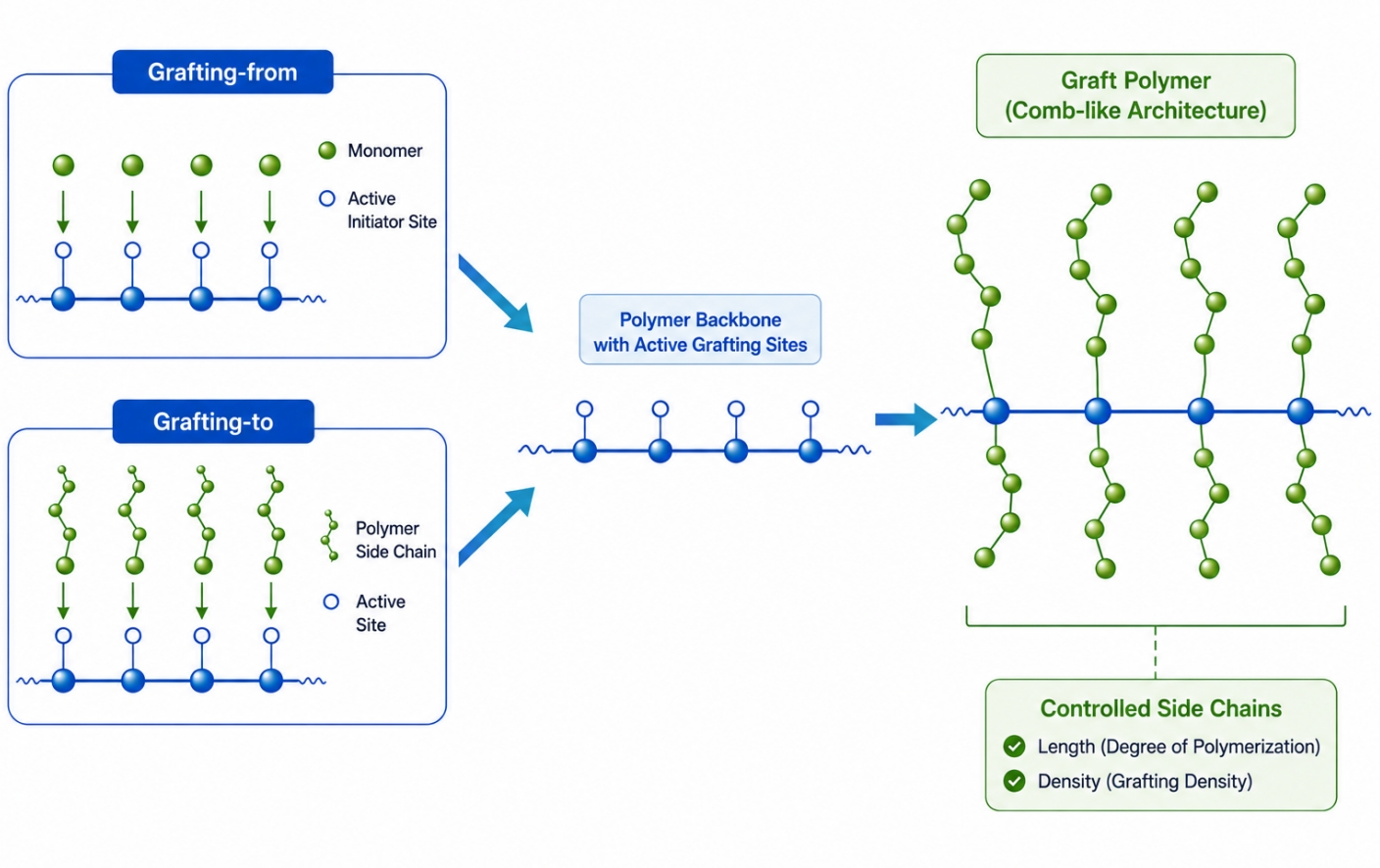
Graft polymer synthesis is a custom polymer architecture service used to prepare polymers with side chains covalently attached to a backbone polymer, particle surface, film, or functional substrate. By controlling the backbone structure, grafting sites, side-chain chemistry, grafting density, side-chain length, and functional group distribution, graft polymers can be designed to tune surface behavior, dispersion stability, interfacial compatibility, solubility, rheology, self-assembly, and material performance. BOC Sciences provides customized support for graft copolymers, comb-like polymers, polymer brushes, surface-grafted polymers, amphiphilic graft polymers, functional graft polymers, biodegradable graft polymers, and hybrid graft architectures. Our service integrates polymerization technologies, polymer characterization service, and polymer modification service to help clients move from graft architecture design to small-scale synthesis, purification, structural verification, and final sample delivery.
Graft Polymer Structures and Synthesis Routes We Support
Graft polymer projects often begin with a question about how a backbone, side chain, or material surface can be connected without losing solubility, reactivity, or function. BOC Sciences supports several grafting approaches, including growth from active sites, coupling of preformed chains, macromonomer polymerization, and surface-initiated grafting. Each route is evaluated according to grafting density, side-chain definition, steric hindrance, purification feasibility, and the final material format.
Grafting-from Polymer Synthesis
- Supports side-chain growth from initiating or active sites installed on a polymer backbone or surface.
- Suitable for higher grafting density, polymer brush preparation, and surface-grafted material development.
- Routes may involve controlled radical polymerization, ring-opening polymerization, ionic polymerization, or radical approaches.
- Development focuses on initiating site density, side-chain length control, backbone stability, and side reactions.
Grafting-to Polymer Synthesis
- Supports coupling of preformed side-chain polymers to reactive sites on a backbone or material surface.
- Suitable when side-chain molecular weight, composition, and end-group structure need to be defined before grafting.
- Coupling methods may include click chemistry, esterification, amidation, thiol-ene reaction, or azide-alkyne reaction.
- Key concerns include steric hindrance, coupling efficiency, end-group conversion, and removal of unreacted chains.
Grafting-through / Macromonomer Route
- Supports polymerization of macromonomers bearing polymer side chains and polymerizable terminal groups.
- Suitable for comb-like polymers, brush-like polymers, and graft copolymers with more defined side-chain structures.
- Development evaluates macromonomer reactivity, feed ratio, backbone growth, graft distribution, and molecular weight distribution.
- Useful when pre-defined side chains must be incorporated into a growing polymer backbone.
Polymer Brush Synthesis
- Supports dense side-chain structures, brush-like polymers, and surface polymer brush systems.
- Polymer brushes may be developed through grafting-from, grafting-through, or surface-initiated strategies.
- Key factors include grafting density, side-chain length, brush thickness, swelling behavior, and surface performance.
- Suitable for surface modification, dispersion stabilization, functional coatings, and responsive interface materials.
Surface-grafted Polymer Synthesis
- Supports polymer grafting on particles, microspheres, films, flat substrates, and functional material surfaces.
- Used for surface modification, interface control, particle stabilization, composite compatibility, and functional coating development.
- Development considers surface activation, initiating site introduction, grafting efficiency, coverage, and layer stability.
- Characterization may include morphology, surface charge, particle size, contact angle, and surface chemistry analysis.
Functional Graft Polymer Synthesis
- Supports graft polymers with carboxyl, hydroxyl, amino, thiol, azide, alkyne, epoxy, silane, PEG, fluorescent, or responsive groups.
- Functional side chains may be introduced through functional backbones, functional side-chain polymers, or post-grafting modification.
- Development evaluates functional group retention, location distribution, reaction compatibility, purification, and later reactivity.
- Suitable for adsorption, sensing, crosslinking, surface modification, interface control, and functional material development.
Amphiphilic Graft Polymer Synthesis
- Supports graft polymers containing hydrophilic and hydrophobic side-chain segments for amphiphilic material design.
- Suitable for self-assembly, micelle precursors, nanoparticle systems, dispersion stabilization, and interface-active materials.
- Key factors include hydrophilic-hydrophobic balance, side-chain ratio, solubility, aggregation behavior, and particle stability.
- Can be connected with polymer micelle synthesis for self-assembly-focused projects.
Biodegradable and Hybrid Graft Polymers
- Supports graft polymers containing PLA, PCL, PLGA, polycarbonates, PEG, polysiloxane, or organic-inorganic hybrid segments.
- Routes may involve ROP grafting, coupling chemistry, end-group transformation, or combined polymerization strategies.
- Development considers degradable side chains, thermal behavior, hybrid interface stability, and functional group compatibility.
- Suitable for soft materials, composite interfaces, functional coatings, and advanced polymer material research.
Need a Custom Graft Polymer with Controlled Side Chains?
Share your backbone polymer, side-chain monomer or polymer, target grafting density, side-chain length, functional group requirements, sample quantity, preferred grafting strategy, and intended application. BOC Sciences can evaluate grafting feasibility and prepare a customized synthesis proposal.
Technical Service Modules for Graft Polymer Development
Graft polymer development requires more than attaching one polymer chain to another. The backbone must carry accessible grafting sites, the side chain must remain compatible with the reaction conditions, and the final structure must be verifiable after purification. BOC Sciences supports each stage of this process, from early feasibility review to sample delivery and analytical interpretation.
1Graft Polymer Architecture and Feasibility Assessment
- Evaluates whether the target graft polymer is better suited to grafting-from, grafting-to, or grafting-through routes.
- Reviews backbone structure, side-chain chemistry, grafting sites, functional groups, and intended material application.
- Identifies risks such as steric hindrance, low grafting efficiency, backbone degradation, crosslinking, or difficult purification.
- Provides a project information checklist and preliminary synthesis route suggestions before experimental work begins.
2Backbone Polymer and Grafting Site Evaluation
- Assesses backbone composition, molecular weight, solubility, reactive sites, end groups, stability, and purity.
- Determines whether initiating groups, coupling groups, or polymerizable side-chain handles need to be introduced.
- Reviews grafting site density, site accessibility, distribution uniformity, and backbone treatment conditions.
- Can support side and end group functionalization when backbone activation is required.
3Grafting Strategy Selection
- Selects grafting-from, grafting-to, grafting-through, surface grafting, or combined strategies according to target structure.
- Designs initiator systems, coupling reactions, macromonomer structures, polymerization routes, solvents, temperature, and purification.
- Compares expected grafting density, side-chain control, characterization convenience, and purification difficulty.
- May use RAFT Polymerization, ATRP, ROP, ROMP, free radical, ionic, or coupling-based approaches.
4Side-chain Length and Grafting Density Optimization
- Adjusts grafting structure through initiating site density, monomer-to-backbone ratio, macromonomer feed, reaction time, and conversion.
- Evaluates side-chain length, grafting density, side-chain distribution, molecular weight change, and solubility shift.
- Optimizes polymer brush thickness, comb-like structure, branching degree, or surface coverage when relevant.
- Adjusts conditions when grafting efficiency is low, byproducts are excessive, or sample handling becomes difficult.
5Functional Group and Surface Chemistry Design
- Supports carboxyl, amino, hydroxyl, thiol, azide, alkyne, epoxy, silane, PEG, fluorescent, ionic, or responsive graft structures.
- Designs side chains or grafted layers to provide hydrophilicity, hydrophobicity, reactivity, crosslinkability, or surface activity.
- Reviews functional group stability, accessibility, location distribution, and downstream reaction potential.
- Suitable for adsorption materials, surface modification, dispersion stabilization, crosslinking, and interface-functional polymers.
6Polymer Brush and Surface Grafting Support
- Supports polymer chain growth or attachment from flat surfaces, particles, films, microspheres, or functional substrates.
- Evaluates surface activation, initiating group introduction, grafted layer thickness, surface coverage, and graft stability.
- Uses AFM, SEM/TEM, DLS, Zeta potential, contact angle, or spectroscopy to evaluate grafting effects when applicable.
- Suitable for polymer brushes, surface-functionalized particles, coating interfaces, and particle stabilization projects.
7Purification and Sample Format Preparation
- Provides polymer isolation and purification using precipitation, dialysis, extraction, column separation, ultrafiltration, centrifugation, filtration, or drying.
- Removes or reduces unreacted side chains, macromonomers, residual monomers, catalysts, coupling reagents, salts, and small molecules.
- Prepares samples as powder, solid, solution, dispersion, surface-grafted material, particle, film, or gel when feasible.
- Communicates how purification may affect grafting density, yield, sample morphology, and final characterization results.
8Characterization and Technical Delivery
- Supports GPC/SEC, NMR, FTIR, DSC, TGA, elemental analysis, AFM, SEM/TEM, DLS, Zeta potential, contact angle, rheology, and mechanical testing.
- Connects with polymer thermal analysis, morphology analysis, chemical analysis, and physical testing when needed.
- Delivers graft polymer samples, synthesis summaries, grafting results, purification notes, analytical data, and technical observations.
- Recommends characterization combinations according to graft route, sample format, architecture, and project objective.
Graft Polymer Architecture and Characterization Strategy
Because graft polymers contain a backbone-side-chain architecture rather than a single linear chain, verification often requires several complementary techniques. Molecular analysis can confirm chemical incorporation, while morphology, particle, and surface tests help evaluate brush formation, surface coverage, dispersion behavior, or grafted layer properties. BOC Sciences selects characterization methods according to whether the sample is soluble, surface-bound, particle-based, crosslinked, or delivered as a film.
| Graft Polymer Type | Suitable Synthesis Routes | Key Control Items | Typical Characterization |
|---|---|---|---|
| Backbone-grafted Copolymers | Grafting-from, grafting-to | Grafting density, side-chain length, backbone stability | NMR, GPC/SEC, FTIR |
| Comb-like Polymers | Macromonomer route, grafting-through | Macromonomer conversion, side-chain distribution | GPC/SEC, NMR, DSC |
| Polymer Brushes | Grafting-from, surface-initiated polymerization | Brush thickness, grafting density, chain length | AFM, ellipsometry, FTIR |
| Surface-grafted Particles | Surface grafting, grafting-from, grafting-to | Particle size, Zeta potential, surface coverage | DLS, Zeta, SEM/TEM |
| Functional Graft Polymers | Functional side-chain grafting, post-modification | Functional group content, reactivity, purity | NMR, FTIR, elemental analysis |
| Amphiphilic Graft Polymers | Grafting-through, grafting-to, controlled polymerization | Hydrophilic-hydrophobic balance, self-assembly | DLS, Zeta, NMR |
| Biodegradable Graft Polymers | ROP grafting, biodegradable side-chain coupling | Side-chain degradation, thermal behavior | GPC/SEC, DSC, TGA |
| Hybrid Graft Polymers | Click coupling, surface grafting, modification | Coupling efficiency, interface stability | FTIR, SEM/TEM, thermal analysis |
| Crosslinkable Graft Polymers | Functional side chains, grafting and crosslinking | Crosslink density, gel fraction, swelling | Rheology, swelling test |
| Specialty Graft Polymers | Project-specific route | Solubility, architecture, processability | Project-specific analytical package |
Why Choose BOC Sciences for Graft Polymer Projects
- Architecture-focused Graft Polymer Design: BOC Sciences supports backbone, side-chain, grafting site, grafting density, polymer brush, surface grafting, and functional side-chain design.
- Multiple Grafting Strategies Available: Projects may use grafting-from, grafting-to, grafting-through, macromonomer, surface grafting, or combined strategies.
- Grafting Density and Side-chain Control: Services focus on grafting site density, side-chain length, grafting efficiency, brush thickness, and molecular weight change.
- Functional and Surface Chemistry Support: Hydrophilic, hydrophobic, reactive, ionic, fluorescent, PEG-containing, crosslinkable, biodegradable, or responsive graft structures can be considered.
- Surface and Particle Grafting Capability: BOC Sciences supports grafting development on particles, microspheres, films, flat surfaces, and functional substrates.
- Integrated Purification and Characterization: Synthesis can be combined with purification, sample processing, GPC/SEC, NMR, FTIR, DSC, TGA, AFM, SEM/TEM, DLS, and Zeta analysis.
- Transparent Technical Communication: Potential issues such as low grafting efficiency, steric hindrance, crosslinking, difficult purification, limited structural verification, and sample-format constraints are discussed clearly.
From Graft Architecture Definition to Sample Delivery
A graft polymer project often moves through several decision points: the backbone may need activation, the side chain may require end-group preparation, and the grafted product may demand more than one analytical method. BOC Sciences follows a staged workflow so feasibility, grafting performance, purification, and sample format are reviewed before the final material is delivered.

1Requirement Communication and Graft Architecture Definition
The project begins by defining the graft polymer type, backbone polymer, side-chain monomer or polymer, preferred grafting route, target grafting density, side-chain length, functional groups, sample quantity, and intended application. BOC Sciences also confirms the expected sample format, such as powder, solution, dispersion, surface-grafted material, particle, film, or gel.

2Backbone, Side-chain and Grafting Site Assessment
Backbone polymers, side-chain polymers, monomers, or macromonomers are reviewed for purity, molecular weight, functional groups, solubility, and stability. The assessment determines whether initiating sites, end groups, coupling groups, or polymerizable handles must be introduced, while identifying risks such as insufficient grafting sites, steric hindrance, chain incompatibility, or backbone degradation.

3Grafting Strategy and Experimental Design
BOC Sciences selects a grafting-from, grafting-to, grafting-through, surface grafting, or combined strategy according to the target structure. The experimental plan defines initiator chemistry, coupling reaction, macromonomer feed, polymerization method, solvent, temperature, reaction time, and purification approach. A characterization plan is also prepared to verify grafting and structural changes.

4Small-scale Synthesis and Grafting Optimization
Small-scale grafting is performed to evaluate grafting efficiency, molecular weight change, solubility, residual side-chain polymer, byproduct formation, and sample morphology. Based on preliminary results, grafting site level, side-chain ratio, reaction time, temperature, catalyst system, coupling reagent, monomer conversion, or purification method may be adjusted to improve target matching.

5Purification, Characterization and Quality Review
The graft polymer is purified and processed according to solubility, side-chain content, byproduct profile, and final sample format. Characterization may include GPC/SEC, NMR, FTIR, DSC, TGA, AFM, SEM/TEM, DLS, Zeta potential, contact angle, rheology, or mechanical testing. Results are reviewed against grafting density, side-chain structure, and application requirements.

6Sample Delivery and Follow-up Support
BOC Sciences delivers graft polymer samples together with available synthesis summaries, grafting observations, purification notes, analytical results, and technical recommendations. Follow-up support may include grafting density adjustment, side-chain optimization, surface functionalization, self-assembly evaluation, particle preparation, composite compatibility testing, larger-scale preparation discussion, or related architecture refinement.
Application-driven Uses of Graft Polymers
Graft polymers are especially useful when a material needs both a backbone property and a side-chain function. The backbone may provide mechanical integrity, processability, or anchoring ability, while side chains can tune solubility, surface activity, steric stabilization, compatibility, or responsiveness. This structure makes graft polymers valuable in surface engineering, dispersions, coatings, composites, soft materials, and advanced functional systems.
Polymer Brushes and Surface Modification
- Supports surface polymer brushes, brush-like polymers, and functional grafted layers.
- Used to tune wettability, friction, surface energy, fouling resistance, responsiveness, and interfacial interactions.
- Key parameters include brush thickness, grafting density, surface coverage, stability, and morphology.
- Suitable for functional surfaces, coated substrates, particles, and interface-controlled material systems.
- Surface analysis can be selected according to substrate type and grafted layer thickness.
Compatibilizers and Interface Materials
- Graft polymers can improve compatibility between polymer phases, fillers, pigments, fibers, or inorganic particles.
- Backbone and side-chain chemistry can be selected to interact with different material domains.
- Key factors include interface localization, molecular weight, side-chain length, and grafting density.
- Suitable for polymer blends, composites, filler modification, and interfacial reinforcement studies.
- Functional groups may be introduced to improve interaction with substrates or dispersed phases.
Dispersants and Colloidal Stabilizers
- Graft polymers can improve dispersion stability through solvophilic side chains, charge, or steric hindrance.
- Suitable for pigments, nanoparticles, polymer particles, fillers, and colloidal material systems.
- Side-chain length, grafting density, solvent compatibility, particle size, and Zeta potential are key factors.
- Can support waterborne, solvent-based, or specialty dispersion development depending on polymer compatibility.
- Stability testing can be combined with particle size and surface charge analysis.
Coatings, Films and Adhesive Materials
- Supports graft polymers for coating resins, film-forming materials, adhesives, and surface-active polymers.
- Side chains can tune film formation, adhesion, flexibility, surface enrichment, Tg, and crosslinkability.
- Functional side chains may provide hydrophilicity, hydrophobicity, reactivity, or interface-specific behavior.
- Suitable for formulation screening, surface treatment, adhesive systems, and functional coating development.
- Thermal, morphology, and mechanical evaluation can be included when relevant.
Functional Particles and Nanocomposites
- Supports polymer grafting on microspheres, nanoparticles, fillers, and composite material interfaces.
- Grafted layers can improve dispersion, surface functionality, interfacial compatibility, and matrix interaction.
- Key parameters include particle size, morphology, graft layer thickness, surface charge, and stability.
- Can connect with polymer nanoparticle synthesis for particle-focused development.
- Suitable for functional fillers, colloidal materials, composite additives, and surface-engineered particles.
Self-assembled and Amphiphilic Materials
- Amphiphilic graft polymers can support self-assembly, micelle-like structures, and responsive aggregation behavior.
- Hydrophilic-hydrophobic balance, side-chain ratio, molecular weight, and solubility influence assembly behavior.
- Particle size, PDI, Zeta potential, and morphology can be evaluated for assembled systems.
- Suitable for soft nanomaterials, colloidal systems, and amphiphilic polymer research.
- Follow-up assembly support can be considered after graft polymer preparation.
Hydrogels and Crosslinked Networks
- Supports graft polymers containing hydrophilic, crosslinkable, degradable, or responsive side chains.
- Graft architecture can influence swelling behavior, network structure, mechanics, and functional response.
- Key parameters include grafting density, crosslink density, gel fraction, solubility, and side-chain functionality.
- Can connect with polymer hydrogel synthesis for hydrogel-focused projects.
- Suitable for soft materials, absorbent systems, crosslinked networks, and functional gels.
Electronics, Packaging and Advanced Materials
- Graft polymers can support functional films, packaging materials, electronic materials, and nanocomposite interfaces.
- Side-chain design may influence thermal stability, morphology, film formation, dielectric behavior, and mechanical properties.
- Grafted structures can improve compatibility between polymer matrices, fillers, coatings, and functional substrates.
- Can connect with polymer physical and mechanical analysis for property testing.
- Suitable for advanced industrial polymer materials and application-oriented screening.
Ready to Start a Graft Polymer Synthesis Project?
Send your backbone structure, side-chain information, desired grafting density, functional group needs, target sample format, and application direction. BOC Sciences can evaluate feasibility and prepare a practical graft polymer synthesis plan.
Frequently Asked Questions
-
What is Graft Polymer Synthesis?
Graft Polymer Synthesis prepares polymers with side chains covalently attached to a backbone polymer or material surface. The service focuses on selecting a suitable grafting strategy, controlling grafting density and side-chain length, managing functional groups, purifying the product, and verifying the graft structure through appropriate characterization methods.
-
What is the difference between grafting-from, grafting-to and grafting-through?
Grafting-from grows side chains from initiating sites on a backbone or surface. Grafting-to attaches preformed side chains to reactive sites. Grafting-through polymerizes macromonomers bearing polymer side chains. The best route depends on target grafting density, side-chain definition, steric hindrance, purification needs, and available functional groups.
-
What information should I provide before starting a project?
Please provide the backbone polymer structure, side-chain monomer or polymer information, desired grafting strategy, target grafting density, side-chain length, functional group requirements, sample quantity, preferred sample format, solvent restrictions, required characterization, and intended application. Existing literature methods or prior sample data are also helpful.
-
Can BOC Sciences synthesize polymer brushes?
Yes. Polymer brushes can be prepared through grafting-from, grafting-through, or surface-initiated strategies when the backbone or surface can support sufficient grafting sites. Important factors include grafting density, side-chain length, brush thickness, surface coverage, solvent compatibility, and the availability of suitable characterization methods.
-
Can graft polymers be prepared on particles or surfaces?
Yes. Surface-grafted polymers may be prepared on particles, microspheres, films, planar surfaces, or functional substrates when appropriate activation or coupling chemistry is available. Feasibility depends on surface chemistry, stability, grafting-site accessibility, solvent tolerance, purification method, and the ability to verify surface changes after grafting.
-
How is grafting density controlled?
Grafting density can be adjusted by changing the number of initiating or coupling sites, backbone functionalization level, macromonomer feed ratio, monomer conversion, reaction time, and purification conditions. The achievable density depends on steric effects, side-chain size, reaction efficiency, and whether the selected route is grafting-from, grafting-to, or grafting-through.
-
What characterization data can be provided?
Common characterization may include GPC/SEC, NMR, FTIR, DSC, TGA, elemental analysis, AFM, SEM/TEM, DLS, Zeta potential, contact angle, rheology, or mechanical testing. The analytical package depends on whether the graft polymer is soluble, surface-bound, particle-based, crosslinked, or delivered as a film or dispersion.
-
What are common risks in Graft Polymer Synthesis?
Common risks include low grafting efficiency, steric hindrance, broad side-chain distribution, incomplete coupling, backbone degradation, crosslinking, difficult purification, poor solubility, or limited structural verification. These risks can be managed through feasibility assessment, small-scale trials, route optimization, intermediate characterization, and clear sample-format planning.