Hyperbranched Polymer Synthesis
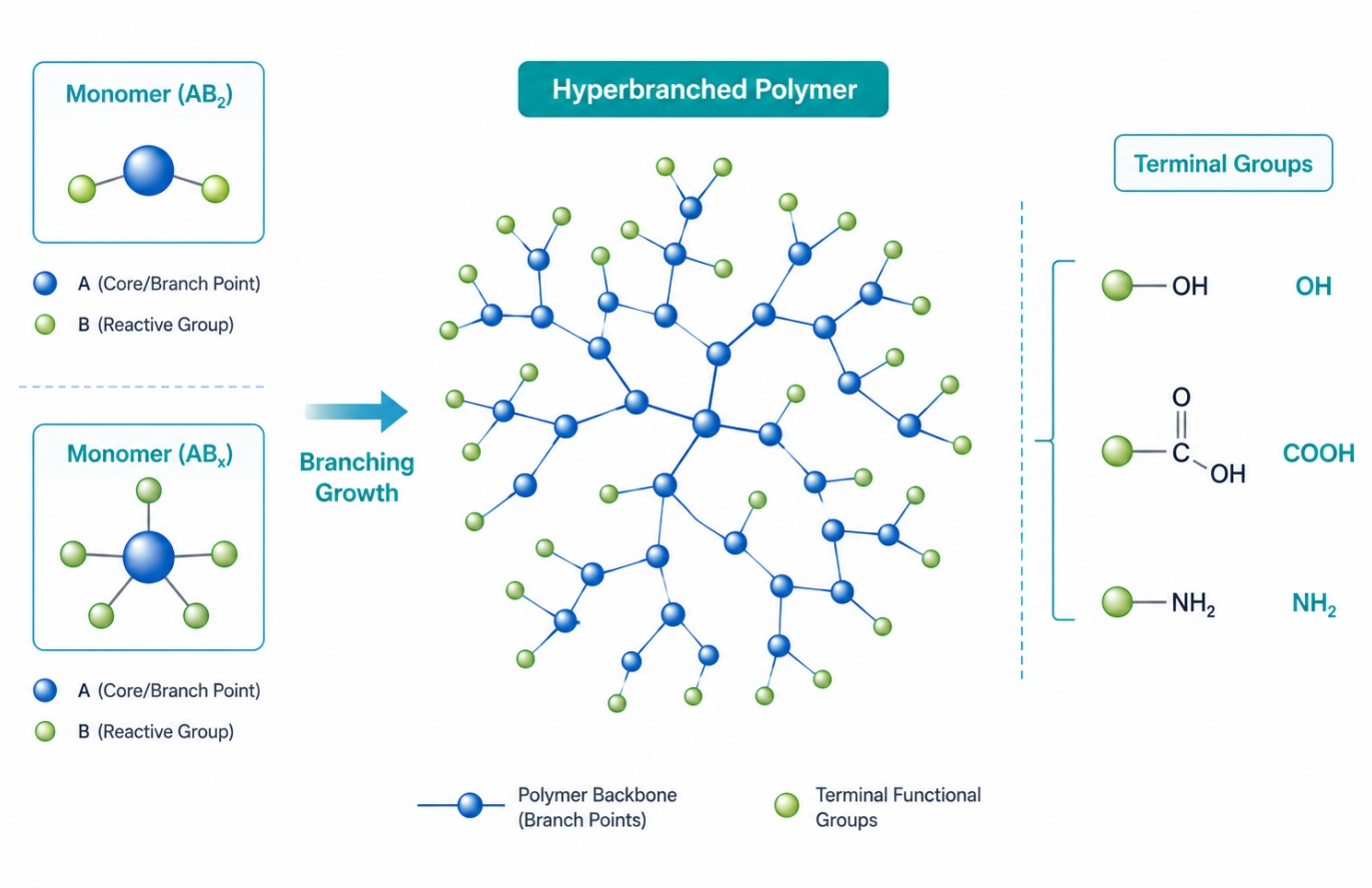
Hyperbranched polymer synthesis is a specialized polymer architecture service for preparing highly branched macromolecules with three-dimensional structures, dense terminal groups, and tunable material properties. Unlike dendrimers, which are usually prepared through highly regular generation-by-generation growth, hyperbranched polymers are often developed through more practical polymerization or condensation strategies that can provide multi-functional, processable, and application-oriented branched materials. BOC Sciences supports hyperbranched polyesters, polyethers, polyamides, polyurethanes, polytriazoles, functional hyperbranched polymers, biodegradable hyperbranched polymers, amphiphilic systems, and hybrid branched architectures. For each hyperbranched polymer project, BOC Sciences reviews monomer functionality, reaction selectivity, branching feasibility, terminal group targets, purification strategy, and characterization needs to help clients obtain material-ready branched polymer samples.
Hyperbranched Polymer Structures We Can Develop
Hyperbranched polymer design begins with how many reactive groups a monomer carries, how selectively those groups react, and whether the growing structure remains soluble before excessive crosslinking occurs. BOC Sciences supports different backbone chemistries and terminal group designs, helping clients select a synthesis route that balances branching efficiency, end-group density, molecular weight, processability, and final material function.
AB2 and ABx Monomer-based Hyperbranched Polymer Synthesis
- Supports hyperbranched polymer preparation from AB2, ABx, and related multifunctional monomers.
- Suitable for creating branched structures with high terminal group density and efficient synthetic access.
- Development evaluates monomer selectivity, reaction window, branching degree, molecular weight growth, and gelation risk.
- Useful for materials requiring multi-functional surfaces, compact architecture, and adjustable solubility.
Hyperbranched Polyester Synthesis
- Supports hyperbranched polyesters involving hydroxyl, carboxyl, ester, or multifunctional core structures.
- Routes may include AB2 monomers, A2+B3 condensation, polyol-based growth, or controlled esterification.
- Key parameters include hydroxyl value, acid value, esterification degree, molecular weight, thermal behavior, and solubility.
- Suitable for coatings, crosslinking precursors, additives, soft materials, and functional polymer development.
Hyperbranched Polyether Synthesis
- Supports branched polyethers prepared from epoxide, glycidol, etherification, or ring-opening-related routes.
- Suitable for hydrophilic, flexible, multi-hydroxyl, or post-functionalization-ready polymer structures.
- Development considers moisture control, ring-opening selectivity, terminal groups, solubility, and molecular weight distribution.
- Useful for dispersants, soft materials, adsorbents, surface modification, and crosslinkable precursors.
Hyperbranched Polyamide and Polyurethane Synthesis
- Supports hyperbranched polymers containing amide, urethane, urea, or hydrogen-bonding structural units.
- Routes may use polyamines, polyacids, polyols, isocyanates, ABx monomers, or step-growth strategies.
- Key concerns include reaction selectivity, terminal group density, hydrogen bonding, thermal behavior, and side reactions.
- Suitable for coatings, adhesives, soft materials, interface materials, and composite development.
Click-based Hyperbranched Polymer Synthesis
- Supports hyperbranched structures built through azide-alkyne, thiol-ene, epoxy-amine, or related coupling reactions.
- Suitable for functional monomers, multi-terminal structures, and post-functionalization-oriented polymer design.
- Development reviews reaction selectivity, functional group conversion, residual small molecules, metal residues, and purification.
- Useful for polytriazole systems, functional networks, and branched materials requiring modular chemistry.
Functional Hyperbranched Polymer Synthesis
- Supports hydroxyl, carboxyl, amino, epoxy, azide, alkyne, thiol, silane, PEG, ionic, fluorescent, or responsive terminal groups.
- Functionalities may be introduced by monomer selection, direct polymerization, end-capping, or post-polymerization modification.
- Development evaluates terminal group accessibility, functional group retention, reaction compatibility, and storage stability.
- Suitable for crosslinking, surface modification, adsorption, dispersion stabilization, coatings, and functional materials.
Biodegradable Hyperbranched Polymer Synthesis
- Supports hyperbranched polymers containing ester, carbonate, anhydride, ether, or other designable degradable linkages.
- Routes may involve ring-opening, condensation, core-initiated growth, or degradable monomer strategies.
- Key factors include backbone chemistry, terminal groups, molecular weight, thermal behavior, sample stability, and degradation behavior.
- Suitable for material research, films, fibers, particles, soft materials, and hydrogel precursor development.
Hybrid and Surface-active Hyperbranched Polymers
- Supports organic-inorganic hybrid, silane-terminated, PEGylated, ionic, or amphiphilic hyperbranched polymer systems.
- Suitable for interface control, pigment dispersion, filler compatibility, coating modification, and nanocomposite development.
- Development considers surface activity, terminal group distribution, solvent compatibility, thermal behavior, and morphology.
- Useful for packaging materials, functional films, composite additives, and advanced interface materials.
Need a Highly Branched Polymer with Tunable Terminal Groups?
Share your target backbone, monomer functionality, desired terminal groups, molecular weight range, branching requirements, sample quantity, preferred synthesis route, and intended application. BOC Sciences can evaluate hyperbranched polymer feasibility and prepare a tailored synthesis proposal.
Technical Pathways for Highly Branched Polymer Design
Developing a hyperbranched polymer requires careful control of reactivity before the structure becomes insoluble or overly crosslinked. The same functional groups that create branching can also cause gelation, side reactions, or purification challenges. BOC Sciences helps clients evaluate monomer functionality, adjust reaction conditions, tune terminal groups, and select characterization methods that match the intended material function.
1Hyperbranched Architecture and Feasibility Assessment
- Evaluates whether the target structure is suitable for AB2, ABx, A2+B3, click, condensation, ring-opening, or combined routes.
- Reviews monomer functionality, terminal group targets, solubility, molecular weight expectation, and application requirements.
- Identifies gelation, over-crosslinking, broad distribution, poor solubility, side reactions, and structure verification risks.
- Provides an initial technical route concept and project information checklist before synthesis begins.
2Monomer Functionality and Reaction Selectivity Evaluation
- Assesses monomer functionality, reaction selectivity, purity, water sensitivity, inhibitor content, storage conditions, and compatibility.
- Reviews reaction rates and selectivity between A and B functional groups in multifunctional systems.
- Evaluates AB2/ABx monomer quality, A2+B3 feed ratio, multifunctional core behavior, and practical reaction window.
- Can connect with monomer synthesis service when project-specific monomers are required.
3Branching Degree and Molecular Weight Control
- Supports project-based tuning of branching degree, terminal group density, Mn, Mw, dispersity, and solution size.
- Adjusts monomer ratio, reaction time, temperature, catalyst, core molecule, end-capping agent, and dilution conditions.
- Uses GPC/SEC, NMR, terminal group analysis, and rheology data to interpret structural changes.
- Provides realistic optimization while recognizing that hyperbranched polymers are usually not perfectly monodisperse.
4Gelation Risk and Crosslinking Control
- Evaluates gelation, excessive crosslinking, and insoluble product formation in multifunctional monomer systems.
- Controls reaction concentration, monomer feeding, functional group ratio, reaction time, conversion, and termination strategy.
- Uses small-scale validation and staged sampling for highly reactive A2+B3 or multifunctional systems.
- Focuses on obtaining soluble, processable products that remain suitable for purification and characterization.
5Terminal Group and Post-functionalization Design
- Supports hydroxyl, carboxyl, amino, epoxy, thiol, azide, alkyne, silane, PEG, ionic, fluorescent, or responsive groups.
- Uses end-capping, terminal group conversion, post-modification, or copolymerization to adjust functional surfaces.
- Reviews terminal group accessibility, functionality retention, reaction compatibility, storage behavior, and purification difficulty.
- Can support side and end group functionalization when additional modification is needed.
6Small-scale Synthesis and Route Optimization
- Performs exploratory synthesis to evaluate conversion, molecular weight growth, branching behavior, solubility, and byproducts.
- Adjusts monomer ratio, catalyst, solvent, temperature, reaction time, dilution, or termination method based on results.
- Reviews reproducibility, purification feasibility, terminal group retention, and final sample form before further preparation.
- Suitable for method development, material screening, and early-stage functional polymer evaluation.
7Purification and Sample Format Preparation
- Provides polymer isolation and purification by precipitation, dialysis, extraction, ultrafiltration, centrifugation, filtration, column separation, or drying.
- Removes or reduces residual monomers, oligomers, catalysts, salts, coupling reagents, crosslinked byproducts, and small molecules.
- Prepares samples as powder, solid, solution, dispersion, coating precursor, crosslinking precursor, film, or gel precursor when feasible.
- Explains how purification may affect yield, molecular weight distribution, terminal group content, and sample morphology.
8Characterization and Technical Delivery
- Supports GPC/SEC, NMR, FTIR, DSC, TGA, elemental analysis, end-group titration, rheology, DLS, Zeta potential, and morphology testing.
- Connects with polymer thermal analysis, morphology analysis, chemical analysis, and physical testing when needed.
- Delivers polymer samples, synthesis summaries, terminal group information, purification notes, analytical data, and technical observations.
- Recommends analytical combinations according to backbone type, terminal groups, solubility, and final application.
How Hyperbranched Polymer Features Can Be Evaluated
Hyperbranched polymers are usually evaluated through a combination of structure, terminal group, thermal, and material-property measurements. A single test rarely explains the full architecture because molecular weight distribution, branching features, functional group density, and solubility can vary together. BOC Sciences selects characterization methods according to backbone chemistry, terminal group target, sample format, and the intended use of the branched polymer.
| Hyperbranched Polymer Type | Suitable Synthesis Routes | Key Control Items | Typical Characterization |
|---|---|---|---|
| AB2/ABx Hyperbranched Polymers | Self-polycondensation, click polymerization | Branching degree, gelation risk, Mn | NMR, GPC/SEC, FTIR |
| Hyperbranched Polyesters | AB2 monomers, A2+B3 condensation | Hydroxyl value, acid value, thermal behavior | NMR, FTIR, DSC, TGA |
| Hyperbranched Polyethers | Epoxide/glycidol routes, ring-opening | End groups, solubility, molecular weight | NMR, GPC/SEC, FTIR |
| Hyperbranched Polyamides | Polyamine/polyacid routes, ABx monomers | Amide formation, hydrogen bonding, viscosity | FTIR, NMR, thermal analysis |
| Hyperbranched Polyurethanes | Polyol/isocyanate routes, step-growth | NCO/OH balance, branching, gelation | FTIR, DSC, TGA |
| Hyperbranched Polytriazoles | Azide-alkyne click polymerization | Conversion, residual groups, metal residue | NMR, FTIR, elemental analysis |
| Functional Hyperbranched Polymers | End-group conversion, post-modification | Terminal group density, reactivity | NMR, FTIR, titration |
| Biodegradable Hyperbranched Polymers | ROP, condensation, degradable monomers | Backbone structure, end groups, thermal behavior | GPC/SEC, DSC, TGA |
| Amphiphilic Hyperbranched Polymers | PEGylation, hydrophobic modification | Solubility, aggregation, particle size | DLS, Zeta, NMR |
| Specialty Hyperbranched Polymers | Project-specific route | Processability, purity, morphology | Project-specific analytical package |
Why Hyperbranched Polymer Projects Need Branching-aware Support

- Reaction Design for Multifunctional Monomers: BOC Sciences evaluates AB2, ABx, A2+B3, click-reactive, ring-opening, condensation, polyurethane, polyester, and polyether systems according to functional group selectivity and reaction window.
- Branching Degree and Terminal Group Planning: Projects consider branching degree, terminal group density, molecular weight range, solubility, viscosity, and the practical accessibility of functional end groups.
- Gelation and Insoluble Byproduct Control: Multifunctional reactions are reviewed for gelation, excessive crosslinking, fast viscosity increase, insoluble fractions, and loss of processability during synthesis.
- Backbone and End-group Flexibility: Hyperbranched polyesters, polyethers, polyamides, polyurethanes, polytriazoles, biodegradable backbones, PEGylated structures, ionic groups, silane groups, and responsive termini can be considered.
- Application-oriented Property Tuning: Branching structure and terminal groups can be adjusted for coatings, crosslinkable resins, dispersants, additives, soft materials, composite compatibilizers, surface modifiers, and interface materials.
- Purification Strategy for Branched Architectures: Purification planning addresses residual monomers, oligomers, catalysts, coupling reagents, salts, low-molecular fractions, and partially crosslinked byproducts that may affect final performance.
- Structure-focused Characterization Support: BOC Sciences combines GPC/SEC, NMR, FTIR, DSC, TGA, elemental analysis, end-group titration, rheology, DLS, Zeta potential, and morphology testing according to project needs.
From Monomer Functionality to Branched Polymer Delivery
A hyperbranched polymer workflow must keep reactivity, solubility, branching development, and sample handling in balance. Early-stage decisions about monomer functionality and reaction stoichiometry can determine whether the final material remains soluble and useful. BOC Sciences follows a staged workflow to evaluate risks, optimize small-scale synthesis, and deliver branched polymer samples with meaningful analytical support.

1Requirement Communication and Branching Target Definition
The project begins by confirming the target hyperbranched structure, backbone type, monomer functionality, desired terminal groups, molecular weight range, sample quantity, and intended application. BOC Sciences also reviews the required format, such as powder, solid, solution, dispersion, coating precursor, crosslinking precursor, film, or gel precursor.

2Monomer and Reaction Route Feasibility Assessment
AB2, ABx, A2+B3, multifunctional core, click monomer, or cyclic monomer systems are assessed for reaction suitability. BOC Sciences reviews whether condensation, click polymerization, ring-opening, polyurethane, polyester, polyether, or combined chemistry is appropriate, while identifying gelation, poor selectivity, monomer instability, low solubility, or purification risks.

3Hyperbranched Polymerization Strategy Design
BOC Sciences designs the monomer ratio, catalyst system, solvent, concentration, temperature, reaction time, termination method, and terminal group adjustment strategy. For functional hyperbranched polymers, the plan may include end-capping, terminal group conversion, copolymerization, or post-modification. A characterization plan is also prepared to verify branching-related features.

4Small-scale Synthesis and Branching Optimization
Small-scale synthesis is performed to evaluate conversion, molecular weight growth, branching behavior, terminal group retention, solubility, viscosity, and byproduct formation. Depending on the results, monomer feed, catalyst level, reaction concentration, temperature, reaction time, dilution, or termination method may be adjusted to improve processability and target matching.

5Purification, Characterization and Quality Review
The hyperbranched polymer is purified according to solubility, molecular weight, terminal group type, and byproduct profile. Characterization may include GPC/SEC, NMR, FTIR, DSC, TGA, elemental analysis, end-group titration, rheology, DLS, Zeta potential, or morphology testing. Results are reviewed against branching, terminal group, and material-use targets.

6Sample Delivery and Follow-up Support
BOC Sciences delivers hyperbranched polymer samples together with available synthesis summaries, purification notes, characterization data, and technical recommendations. Follow-up support may include terminal group modification, molecular weight adjustment, coating precursor development, crosslinked network design, composite compatibility evaluation, self-assembly testing, or larger-scale preparation discussion.
Where Hyperbranched Polymers Create Material Advantages
Hyperbranched polymers are useful when a material needs many functional groups without relying on a strictly linear chain. Their compact branched architecture can influence viscosity, solubility, surface interaction, crosslinking behavior, and filler compatibility. This makes them valuable in coatings, adhesives, dispersants, composite materials, soft networks, functional interfaces, amphiphilic systems, and advanced industrial polymer research.
Low-viscosity Additives and Rheology Modifiers
- Hyperbranched structures can show different solution and flow behavior from comparable linear polymers.
- Molecular weight, branching degree, terminal groups, and solvent compatibility can influence viscosity response.
- Suitable for low-viscosity additives, rheology modifiers, lubricity-related materials, and processing studies.
- Rheology testing can be included when flow behavior is central to material evaluation.
- Useful for formulation studies requiring compact macromolecules with many terminal groups.
Coatings, Films and Crosslinkable Resins
- Multi-terminal hyperbranched polymers can support coating resin, film, and crosslinking precursor development.
- Hydroxyl value, acid value, epoxy value, Tg, thermal behavior, and film formation may be considered.
- Terminal group density can influence curing behavior, surface performance, and network formation.
- Suitable for functional coatings, protective films, surface modification, and low-viscosity resin systems.
- Thermal and mechanical testing can support application-oriented material evaluation.
Adhesives, Sealants and Soft Materials
- Hyperbranched polyesters, polyurethanes, and polyethers can support adhesive and soft material research.
- Terminal reactivity, hydrogen bonding, flexibility, Tg, adhesion behavior, and processability are key factors.
- Molecular weight and end-group chemistry can be tuned to adjust material response.
- Suitable for sealants, adhesive components, elastic materials, and soft polymer matrices.
- Can connect with polymer physical and mechanical analysis for property testing.
Dispersants and Composite Compatibilizers
- High terminal group density can help improve interaction with pigments, fillers, fibers, or nanoparticles.
- Hydrophilic-hydrophobic balance, terminal group type, adsorption behavior, and particle stabilization are important.
- Hyperbranched polymers may act as dispersants, compatibilizers, or interface-modifying additives.
- Suitable for nanocomposites, filler modification, pigment dispersion, and mixed polymer systems.
- Particle size and morphology testing can be selected when dispersion behavior is important.
Functional Surfaces and Interface Materials
- Hyperbranched polymers can provide dense functional sites for surface reaction or interface modification.
- Terminal group accessibility, grafting ability, surface energy, and stability influence performance.
- Suitable for functional films, adsorption materials, surface layers, coatings, and interface additives.
- Can connect with polymer structure morphology analysis when morphology verification is needed.
- Useful for materials requiring compact branched structures with reactive surfaces.
Self-assembled and Amphiphilic Materials
- Amphiphilic hyperbranched polymers can support self-assembly, nanoaggregates, and micelle-like structures.
- Hydrophilic-hydrophobic balance, terminal group modification, molecular weight, particle size, and stability matter.
- Suitable for soft nanomaterials, colloidal systems, and amphiphilic polymer research.
- Can connect with polymer micelle synthesis for assembly-focused projects.
- DLS, Zeta potential, and morphology analysis can help evaluate assembled structures.
Biodegradable and Soft Network Precursors
- Ester, carbonate, anhydride, or ether-containing hyperbranched polymers can support degradable material design.
- Backbone chemistry, terminal groups, molecular weight, thermal behavior, and crosslinkability are key factors.
- Suitable for material research, films, particles, soft networks, and hydrogel precursor development.
- Can connect with polymer hydrogel synthesis for network-focused projects.
- Project descriptions focus on material development and avoid unsupported clinical-use claims.
Electronics, Packaging and Advanced Materials
- Hyperbranched polymers can support functional films, packaging materials, electronic materials, and nanocomposites.
- Thermal stability, dielectric-related behavior, film formation, morphology, and mechanical properties may be relevant.
- Branched structures can help tune processability, interface interaction, and filler compatibility.
- Can connect with polymer nanoparticle synthesis for particle-based material systems.
- Suitable for advanced polymer materials and application-oriented screening.
Ready to Develop a Hyperbranched Polymer Architecture?
Send your target backbone, monomer functionality, desired terminal groups, molecular weight range, branching requirements, sample format, and application direction. BOC Sciences can evaluate feasibility and prepare a practical hyperbranched polymer synthesis plan.
Frequently Asked Questions
-
What is Hyperbranched Polymer Synthesis?
Hyperbranched Polymer Synthesis prepares highly branched macromolecules with a three-dimensional architecture and many terminal groups. The service focuses on monomer functionality, branching degree, molecular weight, solubility, end-group design, purification, and structural verification. Hyperbranched polymers are less regular than dendrimers but often easier to prepare.
-
How are hyperbranched polymers different from dendrimers?
Dendrimers are usually built through stepwise generation growth and have highly regular, near-monodisperse structures. Hyperbranched polymers are typically more statistically branched, often prepared in fewer synthetic steps, and may have broader distributions. They are useful when high terminal group density and practical synthesis efficiency are more important than perfect structural uniformity.
-
Which monomer designs are suitable for hyperbranched polymer synthesis?
Suitable designs may include AB2, ABx, A2+B3, multifunctional core-based monomers, click-reactive monomers, epoxides, glycidyl compounds, polyols, polyacids, polyamines, or isocyanate-containing systems. Feasibility depends on functional group selectivity, purity, solubility, reaction rate, gelation risk, and the desired terminal group profile.
-
Can the terminal group density be adjusted?
Terminal group density can often be influenced through monomer functionality, reaction conversion, end-capping, post-functionalization, stoichiometry, and route selection. However, actual accessibility and measurable functional group content may differ from theoretical values, especially in dense branched structures, so analytical confirmation is recommended when terminal groups are important.
-
What causes gelation in hyperbranched polymer synthesis?
Gelation may occur when multifunctional monomers react too extensively and form an insoluble network rather than a soluble branched polymer. It can be influenced by monomer functionality, concentration, stoichiometry, catalyst activity, conversion, and reaction time. Small-scale trials and staged sampling help manage this risk before larger preparation.
-
Can hyperbranched polymers be made with biodegradable backbones?
Yes. Hyperbranched polymers with ester, carbonate, anhydride, ether, or other designable degradable linkages may be developed when monomers and reaction conditions are compatible. Common project goals include films, particles, soft materials, network precursors, and material research samples. Thermal behavior, molecular weight, terminal groups, and stability should be evaluated.
-
How are hyperbranched polymers purified after synthesis?
Purification may involve precipitation, dialysis, extraction, filtration, ultrafiltration, centrifugation, column separation, freeze drying, or vacuum drying. The best method depends on polymer solubility, molecular weight, residual monomers, catalysts, salts, oligomers, and crosslinked byproducts. Purification planning is important because branched polymers may retain small molecules or low-molecular fractions.