
Emulsion Polymerization
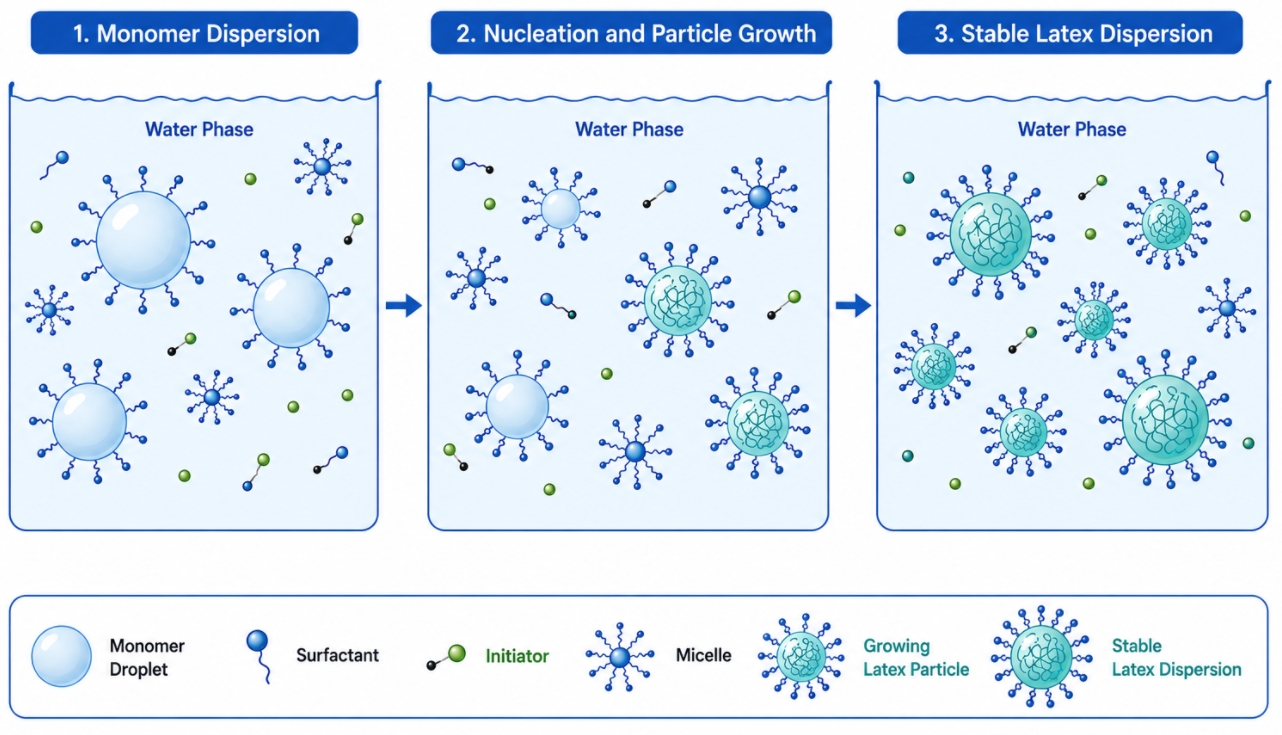
Emulsion polymerization is a water-based polymerization technology used to prepare latex polymers, polymer particles, waterborne dispersions, coating resins, adhesive binders, and functional colloidal polymer systems. In a typical emulsion polymerization project, monomers, surfactants, protective colloids, initiators, buffers, and reaction conditions must be carefully coordinated to control particle nucleation, particle growth, molecular structure, solids content, viscosity, residual monomer level, and long-term dispersion stability. BOC Sciences provides customized Emulsion Polymerization services for clients who need stable latex dispersions, functional polymer particles, waterborne polymer materials, or application-oriented polymer formulations. Our service covers monomer and formulation assessment, reaction route design, particle size control, latex stability optimization, post-treatment, and analytical verification. By combining polymerization technologies, polymer synthesis service, and polymer characterization service, BOC Sciences helps clients develop practical, reproducible, and technically sound emulsion polymerization strategies for material research and industrial development.
Emulsion Polymerization Solutions Offered by BOC Sciences
BOC Sciences provides multiple emulsion polymerization routes to support latex particle preparation, waterborne dispersion development, functional polymer particle design, and application-oriented formulation research. Different emulsion polymerization strategies offer different advantages in particle size control, solids content, particle morphology, surface chemistry, and process stability. Our technical team helps clients select a suitable route based on monomer composition, target particle size, desired colloidal stability, surfactant preference, reaction scale, and final application requirements.
Conventional Emulsion Polymerization
- Supports aqueous polymerization of acrylates, methacrylates, styrenics, vinyl acetate, and selected functional vinyl monomers.
- Suitable for waterborne polymer dispersions, latex polymers, coating resins, binders, and adhesive polymer systems.
- Formulation design considers monomer emulsification, initiator selection, surfactant level, reaction temperature, solids content, and particle size distribution.
- Can be used with acrylic monomers, styrenic monomers, vinyl monomers, and suitable aqueous initiator systems.
Seeded Emulsion Polymerization
- Uses preformed seed particles to guide subsequent particle growth, particle size distribution, and staged polymer structure development.
- Suitable for latex particle size control, core-shell particles, surface-functional particles, and multi-stage emulsion polymerization projects.
- Process design considers seed particle size, seed concentration, second-stage monomer feeding, coagulum control, and final particle morphology.
- Recommended for projects requiring improved particle uniformity, layered particle structures, or controlled latex growth behavior.
Semi-batch Emulsion Polymerization
- Controls reaction rate and copolymer composition by gradually feeding monomers, initiators, surfactants, or pre-emulsified monomer mixtures.
- Suitable for heat control, higher solids content, improved composition management, and application-driven latex formulation optimization.
- Parameter design includes feeding rate, temperature, conversion, viscosity, particle growth, surfactant demand, and colloidal stability.
- Useful for copolymer latexes, coating resin development, adhesive binders, and formulations sensitive to monomer composition drift.
Surfactant-free Emulsion Polymerization
- Supports latex or particle systems where reduced external surfactant content is preferred for surface chemistry or downstream evaluation.
- Suitable for research-grade polymer particles, cleaner particle surfaces, and systems sensitive to surfactant migration or interference.
- Route development considers ionic initiators, functional monomers, particle nucleation behavior, surface charge, and achievable solids content.
- Stability limitations are assessed carefully because surfactant-free systems may have narrower formulation windows than conventional latexes.
Miniemulsion and Microemulsion Polymerization
- Supports polymer particle development from nanoscale monomer droplets or highly dispersed monomer systems.
- Suitable for hydrophobic monomers, functional additives, encapsulation-oriented materials, and nanoscale polymer dispersion research.
- Method development considers high-shear emulsification, co-stabilizer selection, droplet size, particle size distribution, and system stability.
- Can be connected with polymer nanoparticle synthesis for particle-focused material development.
Functional Latex and Polymer Particle Development
- Supports latex polymers containing carboxyl, hydroxyl, amino, epoxy, silane, crosslinkable, fluorescent, or responsive functional groups.
- Suitable for functional microspheres, surface-modified particles, coating resins, adhesive polymers, and composite dispersion systems.
- Development focuses on functional monomer ratio, particle surface charge, particle size, crosslinking level, residual monomer, and application compatibility.
- Can be connected with polymer microsphere synthesis and polymer modification workflows when needed.
Need a Stable Latex or Waterborne Polymer Dispersion?
Share your monomer system, target particle size, solids content, surfactant preference, pH range, application requirements, and stability expectations. BOC Sciences can help evaluate your emulsion polymerization strategy and develop a customized service plan.
Core Services for Emulsion Polymerization Development
BOC Sciences provides practical emulsion polymerization development services covering formulation feasibility, latex particle design, particle size control, monomer feeding strategy, functional latex preparation, stability optimization, post-treatment, and analytical verification. Each project is evaluated according to the monomer system, target latex properties, sample format, and intended material application.
1Emulsion Polymerization Feasibility Assessment
- Evaluates monomer structure, water solubility, reactivity, inhibitors, functional groups, volatility, and handling requirements.
- Compares conventional, seeded, semi-batch, surfactant-free, miniemulsion, and microemulsion polymerization routes.
- Reviews surfactants, protective colloids, initiators, buffers, pH range, reaction temperature, and solids content targets.
- Identifies possible risks such as coagulation, phase separation, broad particle size, limited solids, or difficult purification.
2Latex Particle Size and Distribution Control
- Adjusts particle size through surfactant level, initiator concentration, seed amount, monomer feeding, and shear conditions.
- Supports nano- to micron-scale latex particle systems according to application and characterization requirements.
- Evaluates particle size distribution, PDI, Zeta potential, colloidal stability, and coagulum formation.
- Optimizes particle nucleation and growth behavior to improve latex uniformity and reproducibility.
3Monomer Formulation and Feeding Strategy Design
- Supports monomer combination, copolymer ratio, functional monomer level, crosslinker selection, and formulation adjustment.
- Designs batch, semi-batch, pre-emulsified monomer feeding, or multi-stage feeding strategies.
- Controls composition drift, heat release, conversion, solids content, viscosity, and particle growth.
- Suitable for copolymer latexes, core-shell particles, waterborne coating resins, and adhesive polymer systems.
4Functional Latex and Copolymer Development
- Supports carboxyl, hydroxyl, amino, epoxy, silane, PEG, crosslinkable, fluorescent, or responsive latex systems.
- Prepares functional particles, core-shell latexes, crosslinked latexes, and surface-functional polymer particles.
- Evaluates functional monomer placement, reaction compatibility, surface charge, and post-modification feasibility.
- Can connect with polymer modification service for further material functionalization.
5Emulsion Stability and Post-treatment Optimization
- Optimizes pH, ionic strength, surfactant system, protective colloid, solids content, and storage conditions.
- Addresses coagulum, residual monomer, foam, viscosity drift, filtration, drying, and redispersion concerns.
- Supports dialysis, centrifugation, filtration, freeze drying, spray drying, or demulsification when appropriate.
- Evaluates storage stability, dilution stability, centrifugal stability, and freeze-thaw performance according to project needs.
6Characterization and Technical Delivery
- Supports particle size, PDI, Zeta potential, solids content, pH, viscosity, residual monomer, morphology, and thermal analysis.
- Provides GPC/SEC, NMR, FTIR, DSC, TGA, SEM/TEM, DLS, and application-relevant analytical support.
- Delivers latex samples, dried polymer samples, experimental summaries, formulation notes, testing data, and optimization suggestions.
- Can connect with polymer thermal analysis and morphology analysis for deeper evaluation.
Quality Control and Characterization of Emulsion Polymerization Products
Emulsion polymerization products are commonly evaluated by both polymer chemistry parameters and colloidal formulation parameters. Particle size, surface charge, solids content, residual monomer, molecular structure, thermal behavior, viscosity, and stability all influence whether a latex dispersion can meet research or application requirements. BOC Sciences provides characterization support to help clients understand latex quality, polymer structure, and process reproducibility.
| Test Category | Test Item | Purpose & Significance | Typical Method |
|---|---|---|---|
| Particle and Colloid Properties | Particle Size and PDI | Evaluate particle size distribution and dispersion uniformity | DLS, laser diffraction |
| Zeta Potential | Assess colloidal stability and surface charge behavior | Zeta potential analyzer | |
| Morphology | Observe particle shape, aggregation, and core-shell features | SEM, TEM, optical microscopy | |
| Formulation Properties | Solids Content | Determine polymer concentration and formulation consistency | Gravimetric analysis |
| pH | Monitor latex stability and application compatibility | pH meter | |
| Viscosity | Evaluate processability, coating behavior, and storage changes | Rotational rheometer or viscometer | |
| Chemical and Structural Analysis | Residual Monomer | Assess polymerization conversion and post-treatment requirements | GC, HPLC |
| Polymer Composition | Confirm copolymer composition and functional groups | NMR, FTIR | |
| Molecular and Thermal Properties | Molecular Weight | Evaluate polymer chain growth and molecular weight distribution | GPC/SEC |
| Tg and Thermal Stability | Support coating, film, adhesive, or material performance evaluation | DSC, TGA | |
| Stability Evaluation | Storage Stability | Observe sedimentation, creaming, coagulation, or viscosity drift | Accelerated or real-time storage test |
| Freeze-thaw or Dilution Stability | Assess robustness under handling or application conditions | Freeze-thaw cycles, dilution test |
Key Benefits of Our Emulsion Polymerization Services
- Waterborne Polymer Development Capability: BOC Sciences supports latex polymers, waterborne dispersions, polymer particles, coating resins, adhesive binders, and functional aqueous polymer systems.
- Particle Size and Colloid Stability Control: Particle size, distribution, and dispersion stability can be tuned through surfactant level, initiator type, seed amount, monomer feeding, pH, and solids content.
- Flexible Emulsion Polymerization Strategies: Services cover conventional emulsion, seeded emulsion, semi-batch emulsion, surfactant-free emulsion, miniemulsion, and microemulsion polymerization routes.
- Functional Latex Design: Latex systems can be designed with carboxyl, hydroxyl, amino, epoxy, silane, crosslinkable, fluorescent, or responsive functional groups.
- Integrated Characterization Support: Projects can include DLS, Zeta potential, SEM/TEM, solids content, pH, viscosity, residual monomer, GPC, NMR, FTIR, DSC, and TGA.
- Application-oriented Formulation Thinking: Emulsion polymerization strategies are adjusted according to coating, adhesive, particle, dispersion, composite, textile, or surface treatment requirements.
- Transparent Risk Communication: Potential issues such as coagulation, demulsification, broad particle size, residual monomer, low conversion, drying difficulty, and storage instability are discussed before and during development.
Emulsion Polymerization Service Process Overview
BOC Sciences follows a structured workflow for custom emulsion polymerization projects. The process begins with application requirements and formulation feasibility, then proceeds through polymerization route design, small-scale reaction testing, latex characterization, stability review, and technical delivery. This workflow helps clients obtain useful latex or polymer samples while understanding formulation limits, particle behavior, and optimization opportunities.

1Requirement Communication and Application Definition
The project starts with a discussion of monomer composition, target polymer type, particle size range, solids content, pH, viscosity, functional group requirements, sample format, and intended application. For coating or adhesive projects, additional factors such as film formation, Tg, flexibility, adhesion, water resistance, and formulation compatibility may also be reviewed.

2Monomer and Formulation Assessment
BOC Sciences evaluates monomer solubility, reactivity, inhibitor content, volatility, functional group compatibility, and copolymerization behavior. The formulation assessment also reviews surfactants, protective colloids, initiators, buffers, chain transfer agents, crosslinkers, and pH control requirements. When needed, pre-emulsification, seed preparation, oxygen control, or special feeding strategies are considered.

3Emulsion Polymerization Strategy Design
A suitable emulsion polymerization route is selected from conventional, seeded, semi-batch, surfactant-free, miniemulsion, or microemulsion strategies. The experimental plan defines monomer feeding, initiator feeding, surfactant dosage, reaction temperature, stirring conditions, target solids content, particle size control, coagulum control, residual monomer control, and post-treatment approach.

4Small-scale Polymerization and Parameter Optimization
Small-scale emulsion polymerization is performed to observe polymerization rate, conversion, particle size, viscosity, coagulum formation, and latex stability. Based on preliminary results, surfactant level, initiator amount, feeding rate, pH, temperature, solids content, and agitation conditions can be adjusted. For core-shell or multi-stage latexes, stage ratio and feeding sequence are optimized.

5Latex Characterization and Stability Review
Latex samples are characterized for particle size, PDI, Zeta potential, solids content, pH, viscosity, residual monomer, molecular weight, morphology, and thermal behavior when applicable. Stability review may include observation of sedimentation, creaming, demulsification, coagulation, foaming, dilution behavior, freeze-thaw behavior, and viscosity drift under defined storage or handling conditions.

6Technical Delivery and Follow-up Support
After project completion, BOC Sciences delivers latex dispersion or dried polymer samples together with available experimental summaries, formulation notes, post-treatment information, characterization data, and optimization suggestions. Follow-up support may include stability improvement, particle size adjustment, functionalization, scale-up feasibility discussion, or preparation of related particle or hydrogel materials.
Applications of Emulsion Polymerization
Emulsion Polymerization is widely used when polymer materials need to be prepared in waterborne, dispersed, particle-based, or film-forming formats. The technology can support coating resins, adhesives, binders, functional particles, microspheres, latex model systems, crosslinked networks, and surface treatment materials. BOC Sciences helps clients connect formulation design with particle properties, polymer composition, stability, and application-oriented performance requirements.
Waterborne Coatings and Film-forming Resins
- Supports waterborne acrylic latexes, styrene-acrylic latexes, vinyl acetate-acrylic systems, and functional coating resins.
- Formulation design can consider Tg, particle size, solids content, viscosity, film formation, adhesion, and water resistance.
- Suitable for coating resin research, surface treatment materials, and waterborne polymer formulation development.
- Functional monomers and crosslinking components can be introduced when compatible with the emulsion system.
- Performance-oriented evaluation can be linked with thermal, physical, and morphology characterization.
Adhesives and Binders
- Supports latex polymers for pressure-sensitive adhesives, binders, paper coatings, textile binders, and composite materials.
- Key formulation factors include viscosity, solids content, particle size, flexibility, tack, cohesion, and storage stability.
- Monomer composition and crosslinking strategy can be adjusted according to target adhesive behavior.
- Semi-batch emulsion polymerization is useful when composition control and heat management are important.
- Latex stability and post-treatment options are reviewed according to handling and application requirements.
Functional Polymer Particles
- Prepares latex particles containing carboxyl, hydroxyl, amino, epoxy, silane, fluorescent, or responsive functional groups.
- Suitable for adsorption, surface modification, dispersion stabilization, composite materials, and analytical research.
- Particle size, surface charge, functional monomer level, and post-modification compatibility are considered during design.
- Seeded or surfactant-free routes may be considered for surface-sensitive particle systems.
- Characterization may include DLS, Zeta potential, FTIR, SEM/TEM, and stability evaluation.
Polymer Microspheres and Nanoparticles
- Supports micron- and nanoscale polymer particle preparation through emulsion, seeded emulsion, or miniemulsion strategies.
- Particle size, distribution, morphology, surface charge, and sample format can be adjusted according to project needs.
- Suitable for model particles, functional particles, dispersion systems, and materials research.
- Drying and redispersion behavior should be evaluated because particle properties may change after isolation.
- Can be connected with particle characterization, surface modification, or application-specific evaluation.
Latex for Composite and Filler Systems
- Supports latex systems designed for combination with inorganic fillers, pigments, fibers, nanoparticles, or other polymer components.
- Formulation design considers filler dispersion, latex stability, interfacial compatibility, viscosity, and film properties.
- Suitable for composite coatings, filled polymer materials, surface-modified fillers, and interface-enhanced systems.
- Functional latex particles can improve compatibility between dispersed phases and polymer matrices.
- Stability review helps reduce coagulation, sedimentation, or poor mixing during composite preparation.
Hydrogels and Crosslinked Latex Networks
- Supports crosslinked latex particles, swellable polymer particles, hydrogel precursors, and network-forming latex systems.
- Crosslinking density, swelling behavior, particle stability, and mechanical properties are considered during formulation design.
- Suitable for absorbent materials, soft polymer networks, functional gels, and water-compatible polymer systems.
- Can be connected with polymer hydrogel synthesis for hydrogel-focused development.
- Analytical support may include swelling behavior, thermal analysis, morphology observation, and mechanical evaluation.
Packaging, Textile and Surface Treatment Materials
- Supports waterborne latex systems for paper treatment, textile finishing, packaging coatings, film modification, and surface protection.
- Formulation development may consider film formation, flexibility, water resistance, surface energy, and processing compatibility.
- Functional monomers can be selected to introduce adhesion, crosslinking, hydrophilicity, or surface activity.
- Emulsion stability and solids content are important for coating, dipping, spraying, or finishing processes.
- Project design remains application-oriented without making unsupported performance guarantees.
Research-grade Latex Model Systems
- Prepares latex systems for studying particle nucleation, colloidal stability, surface chemistry, and polymerization behavior.
- Supports controlled particle size, surface charge, monomer composition, and repeatable preparation conditions.
- Suitable for universities, research institutes, and material development teams conducting method or mechanism studies.
- Surfactant-free or seeded methods may be considered when surface properties or particle uniformity are important.
- Characterization packages can be selected according to the research question and sample requirements.
Ready to Develop a Custom Emulsion Polymer?
Send your monomer composition, target particle size, solids content, latex stability requirements, and intended application. BOC Sciences can help evaluate feasibility and prepare a custom latex polymerization proposal.
Frequently Asked Questions
-
What is Emulsion Polymerization used for?
Emulsion Polymerization is used to prepare latex polymers, waterborne polymer dispersions, polymer particles, coatings, adhesives, binders, and functional aqueous polymer systems. It is especially useful when the final material needs to remain in a waterborne dispersion format or when particle size, colloidal stability, and film-forming behavior are important.
-
What information should I provide before starting an emulsion polymerization project?
Useful starting information includes monomer composition, target polymer type, desired particle size, solids content, pH range, surfactant preference, initiator preference, functional group requirement, target quantity, and intended application. If available, please also provide viscosity requirements, stability expectations, sample format, and any limitations on solvents, additives, or post-treatment.
-
Which monomers are commonly used in Emulsion Polymerization?
Common monomers include acrylates, methacrylates, styrenics, vinyl acetate, and selected functional vinyl monomers. Feasibility depends on monomer reactivity, water solubility, inhibitor content, volatility, functional group compatibility, and copolymerization behavior. Some monomers may require pre-emulsification, staged feeding, special surfactants, or additional stabilization strategies.
-
Can BOC Sciences control latex particle size?
Latex particle size can often be adjusted by changing surfactant level, initiator concentration, seed particle amount, monomer feeding strategy, stirring conditions, solids content, and reaction temperature. The achievable size range depends on the monomer system, polymerization route, target solids content, and required stability of the final dispersion.
-
What is the difference between batch and semi-batch emulsion polymerization?
In batch emulsion polymerization, most formulation components are charged at the beginning of the reaction. In semi-batch emulsion polymerization, monomer, initiator, surfactant, or pre-emulsion can be added gradually. Semi-batch operation may help control heat release, composition drift, particle growth, viscosity, and latex stability.
-
Can you provide surfactant-free emulsion polymerization?
Yes, surfactant-free emulsion polymerization may be considered when surface cleanliness, particle surface chemistry, or downstream evaluation is sensitive to surfactant residues. However, surfactant-free systems may have stricter limits on solids content, particle stability, and formulation flexibility, so feasibility should be assessed before experimental development.
-
Can you prepare functional latex particles?
Yes. Functional monomers can be introduced to prepare latex particles with carboxyl, hydroxyl, amino, epoxy, silane, crosslinkable, fluorescent, or responsive groups. The final feasibility depends on monomer compatibility, polymerization route, functional group stability, surface distribution, particle size requirements, and the need for post-polymerization modification or purification.
-
What characterization data can be provided for latex samples?
Common characterization data may include particle size, PDI, Zeta potential, solids content, pH, viscosity, residual monomer, GPC/SEC molecular weight, NMR, FTIR, DSC, TGA, SEM, TEM, and stability observations. The final analytical package is selected according to sample type, project goals, and application requirements.
-
Can I receive the product as a latex dispersion or dry polymer?
Depending on the polymer and project requirements, samples may be delivered as latex dispersions, purified dispersions, or dried polymers. Some latex systems are difficult to dry and redisperse without changing particle size, morphology, or stability. The preferred sample format should be discussed before selecting post-treatment conditions.
-
What are common risks in Emulsion Polymerization projects?
Common risks include coagulation, broad particle size distribution, low conversion, high residual monomer, viscosity increase, foaming, poor storage stability, sedimentation, demulsification, and difficulty in drying or redispersing the polymer. These risks can be reduced through staged feasibility assessment, formulation optimization, controlled feeding, and appropriate characterization.