
Star Polymer Synthesis
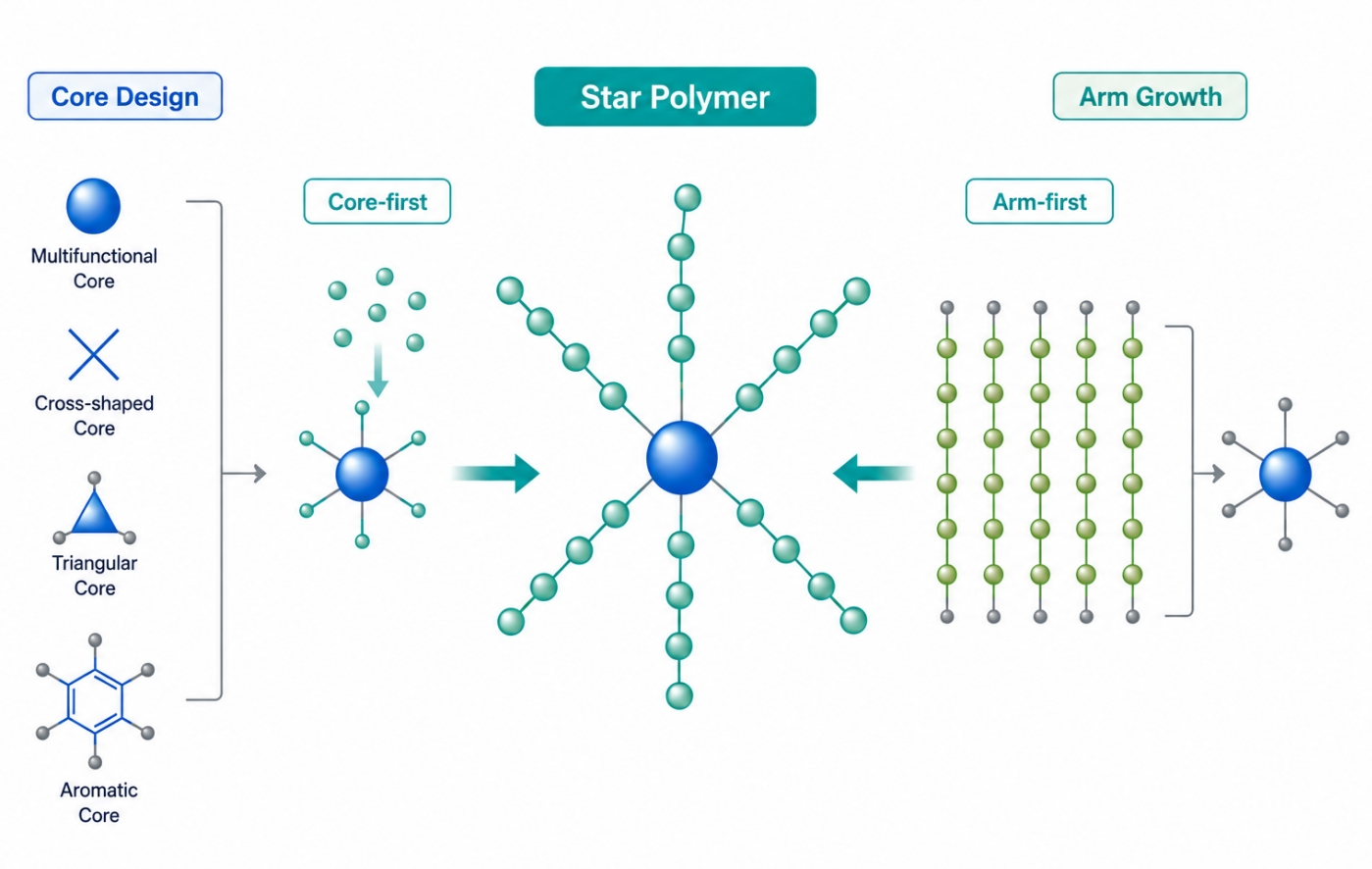
Star polymer synthesis is an architecture-controlled polymer synthesis service focused on preparing branched polymers with multiple polymer arms connected to a central core. By adjusting core chemistry, arm number, arm length, arm composition, molecular weight, dispersity, and terminal functionality, star-shaped polymers can be designed for soft materials, self-assembly, rheology modification, coatings, functional additives, degradable materials, and advanced polymer research. BOC Sciences supports core-first, arm-first, coupling-onto, multifunctional initiator, core-crosslinked, star block copolymer, functional star polymer, and biodegradable star polymer synthesis. Our service integrates polymer synthesis service, polymerization technologies, and polymer characterization service to help clients evaluate star architecture feasibility, design core and arm structures, optimize small-scale synthesis, purify target products, and verify multi-arm polymer features with suitable analytical methods.
Star-shaped Polymer Architectures We Can Develop
Star polymer projects are usually defined by the relationship between the core and the arms. A suitable synthesis plan must consider whether the arms should grow outward from a multifunctional core, whether preformed arms should be coupled later, or whether a crosslinked core should be formed after arm preparation. BOC Sciences helps clients choose a practical architecture based on arm number, arm composition, functional groups, solubility, and verification needs.
Core-first Star Polymer Synthesis
- Supports star polymer preparation from multifunctional cores, multifunctional initiators, or core-bearing initiating sites.
- Suitable when arm number is mainly defined by core functionality and outward chain growth is preferred.
- Routes may include RAFT, ATRP, ROP, living ionic polymerization, or other compatible controlled polymerization strategies.
- Development focuses on core initiation efficiency, arm growth uniformity, molecular weight control, and core stability.
Arm-first Star Polymer Synthesis
- Supports preparation of linear polymer arms before coupling, crosslinking, or core formation.
- Suitable for core-crosslinked star polymers and projects requiring arm-chain characterization before star formation.
- Key factors include arm end-group activity, crosslinker selection, arm incorporation efficiency, and removal of residual arms.
- Useful when well-defined arm precursors are important for interpreting final star polymer structure.
Coupling-onto Star Polymer Synthesis
- Supports attachment of preformed polymer arms to multifunctional cores through selective coupling reactions.
- Suitable when arm composition and molecular weight should be defined before connection to the core.
- Coupling methods may include click chemistry, esterification, amidation, silanization, or other compatible reactions.
- Development evaluates coupling efficiency, steric hindrance, end-group conversion, purification, and architecture verification.
Multi-arm PEG and Polyether Star Polymers
- Supports multi-arm PEG, polyether, and hydrophilic star polymer development for soft material research.
- Suitable for aqueous systems, crosslinking precursors, surface modification, and functional material design.
- Important factors include arm number, end-group functionality, solubility, molecular weight, and further reactivity.
- Can connect with PEG derivative selection, functionalization planning, and hydrogel precursor development.
Star Block Copolymer Synthesis
- Supports star-shaped polymers whose arms contain block copolymer structures, such as star-(A-b-B)n.
- Routes may use core-first chain extension, arm-first block arm preparation, or coupling-based strategies.
- Development focuses on block ratio, arm number, chain extension efficiency, self-assembly, and phase behavior.
- Can connect with block copolymer synthesis for block-architecture-focused projects.
Functional Star Polymer Synthesis
- Supports star polymers bearing carboxyl, hydroxyl, amino, azide, alkyne, thiol, epoxy, silane, fluorescent, or responsive groups.
- Functional groups may be introduced through the core, arms, terminal groups, or post-polymerization modification.
- Development considers functional group retention, arm-end conversion, core accessibility, purification, and later reactivity.
- Suitable for crosslinking, surface modification, adsorption, interface materials, and functional polymer research.
Biodegradable Star Polymer Synthesis
- Supports PLA, PLGA, PCL, polycarbonate, polyanhydride, and polyether-based star polymer systems.
- Routes may include multifunctional core-initiated ROP, biodegradable arm coupling, or combined polymerization strategies.
- Key factors include monomer purity, moisture control, arm length, terminal groups, thermal behavior, and degradation behavior.
- Suitable for material research, films, fibers, particles, soft materials, and hydrogel precursor development.
Core-crosslinked Star Polymer Synthesis
- Supports star polymers formed from linear arms and a crosslinked central core.
- Routes may involve arm-first RAFT, ATRP, controlled radical polymerization, or compatible crosslinker strategies.
- Development evaluates core crosslinking density, arm retention, star fraction, residual linear arms, and purification difficulty.
- Suitable for compact star architectures, functional soft materials, and structure-property relationship studies.
Need a Star Polymer with Defined Arm Number and Core Structure?
Share your target core structure, arm number, arm composition, molecular weight range, end-group requirements, preferred synthesis route, sample quantity, and intended application. BOC Sciences can evaluate star polymer feasibility and prepare a tailored synthesis proposal.
Technical Pathways for Building Multi-arm Polymer Structures
A star polymer project depends on several linked decisions: the core must support multiple arms, the arm chemistry must match the polymerization route, and the final architecture must be distinguishable from linear precursors or byproducts. BOC Sciences provides a staged service model to evaluate these variables before synthesis and to refine route choices after small-scale results are reviewed.
1Star Polymer Architecture and Feasibility Assessment
- Evaluates whether the target star structure is better suited to core-first, arm-first, coupling-onto, or core-crosslinked routes.
- Reviews core functionality, arm chemistry, monomer compatibility, end-group activity, solubility, and intended material application.
- Identifies risks such as uneven arm growth, low coupling efficiency, core side reactions, purification difficulty, or verification limits.
- Provides an initial project information checklist and practical synthesis route suggestions before experimental work begins.
2Core, Initiator and Arm Design
- Evaluates multifunctional cores, multi-arm initiators, macroinitiators, linear arm precursors, and crosslinker options.
- Designs arm number, arm length, arm composition, core chemistry, terminal functionality, and symmetric or asymmetric structures.
- Reviews core initiation efficiency, number of active sites, arm growth uniformity, and end-group preservation.
- Helps align polymer architecture with desired solubility, rheology, self-assembly, or functional material behavior.
3Core-first and Arm-first Route Selection
- Compares core-first and arm-first strategies according to monomer type, arm-chain definition, and purification requirements.
- Core-first routes are useful when polymer arms should grow outward from a multifunctional core.
- Arm-first routes are useful when linear arm precursors must be characterized before star formation.
- Route selection considers residual linear arms, coupling efficiency, architecture control, and analytical verification difficulty.
4Polymerization Method and Chain Growth Control
- Selects RAFT Polymerization, ATRP, NMP, ROP, living anionic, living cationic, or combined strategies according to arm chemistry.
- Designs initiators, chain transfer agents, catalysts, solvents, temperature, reaction time, and feed ratios.
- Evaluates arm-chain growth, dispersity, chain-end fidelity, core stability, and side reaction control.
- For star block copolymers, stepwise chain extension and intermediate characterization may be included.
5Arm Number, Arm Length and Molecular Weight Optimization
- Supports project-based adjustment of arm number, arm length, Mn, Mw, dispersity, and hydrodynamic size.
- Tunes core functionality, monomer-to-initiation-site ratio, conversion, reaction time, and purification strategy.
- Uses GPC/SEC, NMR, DLS, and related methods to assess molecular weight, arm composition, and solution size.
- Provides realistic optimization without making unsupported claims about exact arm number in difficult systems.
6Functional End-group and Core Chemistry Design
- Supports reactive end groups, functional cores, PEG arms, fluorescent groups, crosslinkable termini, or responsive arm structures.
- Designs star polymers for crosslinking, surface modification, grafting, coupling, self-assembly, or soft material formation.
- Evaluates functional group stability, end-group conversion, core accessibility, storage behavior, and purification feasibility.
- Can support side and end group functionalization when further modification is required.
7Purification and Sample Format Preparation
- Provides polymer isolation and purification by precipitation, dialysis, extraction, column separation, ultrafiltration, centrifugation, or drying.
- Removes or reduces residual linear arms, unreacted macromolecules, oligomers, core-crosslinked byproducts, catalysts, and small molecules.
- Prepares samples as powder, solid, solution, dispersion, micelle precursor, crosslinking precursor, or film when feasible.
- Explains how purification may affect star fraction, sample yield, structure integrity, and analytical interpretation.
8Characterization and Technical Delivery
- Supports GPC/SEC, NMR, FTIR, DSC, TGA, DLS, Zeta potential, AFM, SEM/TEM, rheology, and mechanical testing.
- Connects with polymer thermal analysis, morphology analysis, chemical analysis, and physical testing when needed.
- Delivers star polymer samples, synthesis summaries, purification notes, structure-focused data, and technical observations.
- Recommends characterization combinations according to star route, architecture, sample format, and application objective.
How Star Polymer Structure Can Be Verified
Star polymer verification is more complex than confirming monomer conversion. The analysis often needs to distinguish star products from residual linear arms, core-crosslinked byproducts, or incompletely coupled intermediates. BOC Sciences selects analytical combinations based on the synthesis route, solubility, expected molecular size, functional groups, and whether the sample is intended for solution, film, dispersion, or network-forming applications.
| Star Polymer Type | Suitable Synthesis Routes | Key Control Items | Typical Characterization |
|---|---|---|---|
| Core-first Star Polymers | Multifunctional initiator, ATRP, RAFT, ROP | Core functionality, arm growth, Mn, dispersity | GPC/SEC, NMR, FTIR |
| Arm-first Star Polymers | Linear arm synthesis, crosslinking, coupling | Arm conversion, star yield, linear arm residue | GPC/SEC, NMR, purification analysis |
| Coupling-onto Star Polymers | Click coupling, esterification, amidation | Coupling efficiency, steric hindrance, purity | NMR, GPC/SEC, FTIR |
| Multi-arm PEG Stars | PEG derivatives, multifunctional core, coupling | Arm number, end groups, solubility | NMR, GPC/SEC, MALDI if suitable |
| Star Block Copolymers | Sequential polymerization, chain extension | Block ratio, arm uniformity, phase behavior | GPC/SEC, NMR, DSC |
| Functional Star Polymers | Functional core, functional arms, post-modification | Functional group content, reactivity, stability | NMR, FTIR, elemental analysis |
| Biodegradable Star Polymers | ROP, PEG-initiated ROP, degradable arm coupling | Arm length, end groups, thermal behavior | GPC/SEC, DSC, TGA |
| Core-crosslinked Stars | Arm-first RAFT/ATRP, crosslinker route | Core crosslinking, arm retention, star fraction | GPC/SEC, DLS, NMR |
| Self-assembling Star Polymers | Amphiphilic star design, block star route | Particle size, PDI, stability | DLS, Zeta, TEM/SEM |
| Specialty Star Polymers | Project-specific synthesis route | Solubility, architecture, processability | Project-specific analytical package |
Why Star Polymer Projects Require Architecture-aware Support

- Star Architecture Design: BOC Sciences supports core chemistry, arm number, arm length, arm composition, terminal groups, and functional core planning.
- Multiple Star Polymer Routes: Projects may use core-first, arm-first, coupling-onto, core-crosslinked, multifunctional initiator, or combined synthesis routes.
- Controlled Polymerization Integration: Suitable arm-growth strategies may involve controlled radical polymerization, ring-opening polymerization, living ionic polymerization, or route combinations.
- Arm Number and Molecular Weight Optimization: Services focus on arm length, Mn, Mw, dispersity, hydrodynamic size, star fraction, and residual linear arm reduction.
- Functional and Biodegradable Star Polymer Design: Degradable arms, PEG arms, functional termini, crosslinking precursors, responsive structures, and soft-material precursors can be considered.
- Purification and Structural Verification: Synthesis can be combined with linear-arm removal, sample preparation, GPC/SEC, NMR, DLS, DSC, TGA, and morphology analysis.
- Transparent Risk Communication: BOC Sciences communicates coupling efficiency limits, uneven arm growth, core side reactions, purification challenges, and structural proof limitations clearly.
From Core Design to Multi-arm Polymer Delivery
Developing a star polymer usually requires a sequence of decisions rather than a single reaction setup. The core, arms, chain-end chemistry, purification method, and analytical tools must be considered together. BOC Sciences follows a staged workflow so the star architecture can be evaluated before synthesis, refined during small-scale trials, and reviewed with structure-focused data before delivery.

1Requirement Communication and Star Architecture Definition
The project begins by defining the target star structure, desired arm number, arm composition, core chemistry, molecular weight range, terminal groups, sample quantity, and intended application. BOC Sciences also confirms the desired material format, such as powder, solid, solution, dispersion, micelle precursor, film, or crosslinking precursor.

2Core, Arm and Route Feasibility Assessment
Core structures, multifunctional initiators, linear arm precursors, monomers, crosslinkers, and coupling partners are reviewed for purity, reactivity, solubility, functional group compatibility, and storage requirements. The assessment identifies a feasible core-first, arm-first, coupling-onto, or core-crosslinked route while flagging risks such as inactive end groups, poor compatibility, or purification difficulty.

3Star Polymerization Strategy Design
BOC Sciences designs the core, arm-growth route, initiator system, chain transfer agent, catalyst, monomer ratio, solvent, temperature, reaction time, and purification method. For star block or functional star polymers, the plan may include chain extension, end-group conversion, coupling, post-modification, or intermediate purification, along with an analytical strategy for architecture verification.

4Small-scale Synthesis and Architecture Optimization
Small-scale synthesis is performed to evaluate monomer conversion, arm growth, star product formation, dispersity, solubility, and byproduct generation. Depending on the outcome, core-to-arm ratio, reaction time, temperature, catalyst loading, crosslinker level, solvent system, or purification approach may be adjusted to improve star fraction and sample quality.

5Purification, Characterization and Quality Review
Star polymer samples are purified according to their solubility, molecular size, byproduct profile, and intended format. Characterization may include GPC/SEC, NMR, FTIR, DLS, Zeta potential, DSC, TGA, AFM, SEM/TEM, rheology, or mechanical analysis. Results are reviewed against target arm number, molecular weight, functionality, and application needs.

6Sample Delivery and Follow-up Support
BOC Sciences delivers star polymer samples together with available synthesis summaries, purification notes, analytical data, and technical recommendations. Follow-up support may include arm length adjustment, end-group functionalization, block arm design, self-assembly testing, particle preparation, hydrogel precursor development, soft material evaluation, or larger-scale preparation discussion.
Where Star-shaped Polymers Add Material Value
Star-shaped polymers can offer material behavior that is difficult to access with comparable linear chains. Their compact multi-arm structure can influence viscosity, chain mobility, assembly behavior, terminal functionality, and network formation. These features make star polymers useful in rheology control, soft materials, micelles, hydrogels, coatings, compatibilizers, degradable materials, and advanced functional polymer systems.
Low-viscosity and Rheology-modified Materials
- Star polymers can show different solution and rheological behavior compared with similar linear polymers.
- Arm number, arm length, molecular weight, and core structure can influence hydrodynamic volume and flow behavior.
- Suitable for low-viscosity polymer systems, rheology modifiers, lubricity-related materials, and processing studies.
- Rheological testing can be included when flow behavior is a key project requirement.
- Useful for evaluating how branching architecture affects material handling and formulation behavior.
Thermoplastic Elastomers and Soft Materials
- Supports star block polymers and soft-hard arm structures for elastomeric material research.
- Phase separation, Tg, arm composition, core chemistry, and arm length can affect mechanical response.
- Suitable for flexible materials, soft polymer matrices, physically associated networks, and elastic precursors.
- Mechanical and thermal testing may be used to connect structure with material performance.
- Useful for structure-property studies involving nonlinear polymer architecture.
Micelles and Self-assembled Materials
- Amphiphilic star polymers can support micelles, nanoaggregates, and self-assembled soft material systems.
- Hydrophilic-hydrophobic balance, arm ratio, end groups, molecular weight, and solvent compatibility are important.
- Particle size, PDI, Zeta potential, and morphology can be evaluated for assembled systems.
- Can connect with polymer micelle synthesis for self-assembly-focused projects.
- Suitable for colloidal polymer materials and nanoscale structure studies.
Hydrogels and Crosslinked Networks
- Multi-arm star polymers can serve as crosslinking precursors for hydrogels and network materials.
- Terminal functionality, arm length, arm number, and core structure can influence network formation.
- Key evaluation items include swelling behavior, crosslink density, mechanical response, and gel fraction.
- Can connect with polymer hydrogel synthesis for hydrogel-focused projects.
- Suitable for soft materials, functional gels, and crosslinked polymer network research.
Coatings, Films and Surface-active Materials
- Star polymers can support coating, film, surface modification, and interface-control material development.
- Film formation, surface energy, terminal functionality, solubility, thermal behavior, and mechanics may be considered.
- Star architecture may help tune flow, surface enrichment, and functional group density.
- Suitable for functional coatings, low-viscosity resin studies, and surface-active polymer materials.
- Thermal and morphology analysis can be selected according to application needs.
Functional Additives and Compatibilizers
- Multi-arm structures and functional end groups can support additive and compatibilizer development.
- Core chemistry, arm composition, and terminal groups may influence filler dispersion or phase interaction.
- Suitable for polymer blends, composite materials, filler modification, and interface stabilization studies.
- Functional arms can be designed to interact with selected surfaces, fillers, or polymer domains.
- Useful for material systems requiring compact architecture and multiple interaction sites.
Biodegradable Star Polymer Materials
- Supports star polymers containing PLA, PCL, PLGA, polycarbonate, PEG, or related degradable segments.
- Arm length, core chemistry, crystallinity, hydrophilicity, and terminal groups can affect degradation behavior.
- Suitable for material research, films, fibers, particles, soft materials, and in vitro studies.
- Can connect with biodegradable polymers and related material resources.
- Project descriptions focus on material development and avoid unsupported clinical-use claims.
Electronics, Nanostructures and Advanced Materials
- Star polymers can support nanostructured materials, functional films, templates, and composite interfaces.
- Important properties include thermal stability, morphology, solubility, film formation, and interfacial compatibility.
- Multi-arm architecture may provide compact molecular geometry and multiple functional sites.
- Can connect with polymer physical and mechanical analysis for property testing.
- Suitable for advanced polymer materials and application-oriented structure screening.
Ready to Design a Multi-arm Polymer Architecture?
Send your target core, desired arm number, arm composition, molecular weight range, end-group needs, sample quantity, and application direction. BOC Sciences can evaluate feasibility and prepare a practical star polymer synthesis plan.
Frequently Asked Questions
-
What is Star Polymer Synthesis?
Star Polymer Synthesis prepares branched polymers containing several polymer arms connected to a central core. The service focuses on core structure, arm number, arm length, molecular weight, dispersity, end groups, purification, and architecture verification. Star polymers can show different solution, rheological, and material behavior from comparable linear polymers.
-
What is the difference between core-first and arm-first synthesis?
In core-first synthesis, polymer arms grow outward from a multifunctional core or initiator. In arm-first synthesis, linear polymer arms are prepared first and then coupled or crosslinked to form the star structure. The better route depends on target arm number, arm definition, chain-end activity, purification needs, and characterization strategy.
-
What information should I provide before starting a project?
Please provide the target star architecture, desired arm number, monomer or arm polymer information, core structure if available, molecular weight range, dispersity requirement, functional group needs, sample quantity, preferred format, solvent restrictions, intended application, and required characterization. Literature references or previous synthesis attempts are also helpful.
-
Can BOC Sciences control arm number and arm length?
Arm number and arm length can often be adjusted through core functionality, initiator design, monomer-to-initiation-site ratio, reaction time, conversion, and purification strategy. However, exact arm number may be difficult to prove for some systems, so realistic feasibility and suitable characterization methods should be discussed before synthesis.
-
Which polymerization methods can be used for star polymers?
Star polymers may be prepared using RAFT, ATRP, NMP, ring-opening polymerization, living anionic polymerization, living cationic polymerization, coupling chemistry, or combined strategies. The selected method depends on monomer compatibility, core structure, desired arm composition, end-group fidelity, functional group tolerance, and sample application.
-
Can star block copolymers or biodegradable star polymers be prepared?
Yes. Star block copolymers, amphiphilic star polymers, and biodegradable star polymers may be developed when monomers, core structures, and chain-end chemistry are compatible. Common design elements may include PEG, PLA, PCL, PLGA, polycarbonate, polyacrylate, or polystyrene segments, depending on project goals and synthesis feasibility.
-
What characterization data can be provided?
Common characterization may include GPC/SEC, NMR, FTIR, DSC, TGA, DLS, Zeta potential, AFM, SEM/TEM, rheology, or mechanical testing. The final analytical package depends on whether the star polymer is soluble, self-assembling, crosslinked, functionalized, or delivered as a film, dispersion, precursor, or solid sample.