Block Copolymer Synthesis
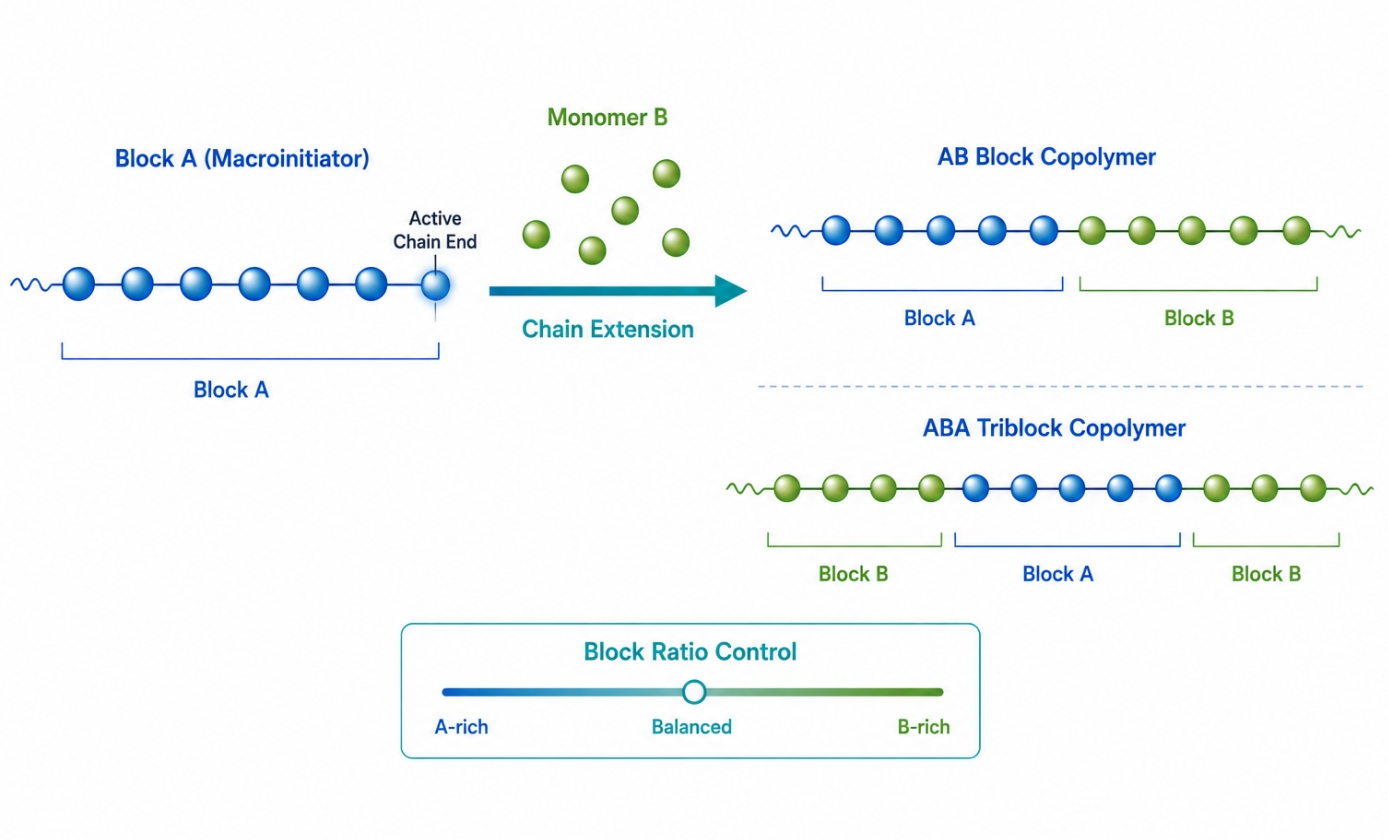
Block copolymer synthesis is a structure-controlled polymer synthesis service used to prepare copolymers containing two or more chemically distinct polymer segments arranged in a defined sequence. By adjusting block sequence, block ratio, molecular weight, dispersity, end-group structure, and functional group placement, block copolymers can be designed for self-assembly, phase separation, interface modification, soft materials, degradable polymer systems, micelle precursors, and advanced functional materials. BOC Sciences provides customized block copolymer synthesis support for AB, ABA, ABC, multiblock, amphiphilic, biodegradable, functional, crosslinkable, and hybrid block copolymer systems. Our service integrates polymerization technologies, polymer characterization service, and polymer micelle synthesis support to help clients move from target architecture design to chain extension, purification, characterization, and final sample delivery.
Tailored Block Copolymer Structures We Can Prepare
BOC Sciences supports block copolymer synthesis projects involving defined block sequences, controlled block ratios, functional segments, degradable backbones, amphiphilic architectures, and advanced hybrid polymer structures. Each project is designed according to monomer compatibility, chain-end activity, macroinitiator or macro-CTA feasibility, molecular weight target, purification strategy, and the intended material application.
AB Diblock Copolymer Synthesis
- Supports preparation of AB-type block copolymers containing two chemically distinct polymer segments.
- Routes may involve chain extension, macroinitiator methods, macro-CTA strategies, ROP, or living polymerization.
- Development focuses on first-block chain-end activity, second-monomer compatibility, block ratio, molecular weight, and purification.
- Suitable for amphiphilic polymers, interface modifiers, micelle precursors, self-assembly systems, and phase-separated materials.
ABA Triblock Copolymer Synthesis
- Supports symmetric or asymmetric ABA triblock copolymers with controlled middle and terminal block structures.
- Routes may use bifunctional initiators, sequential polymerization, ring-opening polymerization, or controlled radical strategies.
- Key factors include middle-block length, end-block ratio, chain extension efficiency, solubility, and phase behavior.
- Suitable for thermoplastic elastomers, soft materials, gel precursors, films, and structure-property relationship studies.
ABC and Multiblock Copolymer Synthesis
- Supports ABC triblock, multiblock, and sequence-defined copolymer systems requiring multiple chemically distinct segments.
- Synthesis may require stepwise chain extension, mechanism combination, intermediate purification, or end-group transformation.
- Development evaluates block sequence, stepwise conversion, chain-end preservation, solubility, and structural verification.
- Suitable for multifunctional polymers, phase-separated systems, responsive materials, and complex architecture development.
Amphiphilic Block Copolymer Synthesis
- Supports block copolymers combining hydrophilic and hydrophobic segments for self-assembly and dispersion systems.
- Common structures may include PEG-based, polyester-based, polyacrylate-based, or polystyrene-containing block copolymers.
- Design factors include hydrophilic-hydrophobic balance, molecular weight, block ratio, solubility, and assembly stability.
- Suitable for micelles, polymer nanoparticles, vesicle-like assemblies, dispersions, and amphiphilic material studies.
Biodegradable Block Copolymer Synthesis
- Supports biodegradable block copolymers based on PLA, PLGA, PCL, polycarbonates, polyanhydrides, polyethers, and related segments.
- Routes may include ROP, PEG-initiated polymerization, macroinitiator chain extension, or combined polymerization strategies.
- Key factors include monomer purity, moisture control, block ratio, molecular weight, end groups, and thermal behavior.
- Suitable for material research, films, fibers, particles, hydrogel precursors, and degradable functional polymer systems.
Functional Block Copolymer Synthesis
- Supports block copolymers containing carboxyl, hydroxyl, amino, azide, alkyne, thiol, epoxy, silane, fluorescent, or responsive units.
- Functional groups may be introduced by functional monomer polymerization, end-group design, or post-polymerization modification planning.
- Development considers functional group location, stability, reaction compatibility, block-specific role, and purification feasibility.
- Suitable for grafting, crosslinking, surface modification, self-assembly, conjugation-ready materials, and functional polymer design.
Block Copolymer Micelle Precursor Synthesis
- Supports amphiphilic block copolymer precursors designed for micelle and nanoscale self-assembly studies.
- Design focuses on hydrophilic segment, hydrophobic segment, block ratio, end groups, and assembly-relevant functionality.
- Key evaluation items include expected particle size, PDI, dispersion stability, solubility, and processing conditions.
- Suitable for micelle precursor preparation, nanoparticle development, colloidal polymer systems, and self-assembled materials.
Hybrid and Architecture-controlled Block Copolymers
- Supports linear-branched, star-block, graft-block, and organic-inorganic hybrid block copolymer design when feasible.
- Routes may combine controlled polymerization, click coupling, end-group conversion, polymer modification, or post-functionalization.
- Development evaluates architecture complexity, coupling efficiency, solubility, purification difficulty, and analytical verification.
- Suitable for interface materials, nanostructures, composite materials, and high-functionality polymer systems.
Need a Custom Block Copolymer with Defined Architecture?
Share your monomer combination, target block sequence, desired block ratio, molecular weight range, dispersity requirement, functional group needs, sample quantity, and intended application. BOC Sciences can evaluate chain extension feasibility and prepare a customized block copolymer synthesis proposal.
Technical Service Modules for Controlled Block Formation
BOC Sciences provides practical block copolymer synthesis services covering architecture design, monomer and macroinitiator assessment, controlled route selection, chain extension optimization, molecular weight control, functional block design, purification, characterization, and technical delivery. Each service module is planned to support feasible block formation and reliable structural verification.
1Block Copolymer Design and Feasibility Assessment
- Evaluates whether AB, ABA, ABC, multiblock, amphiphilic, biodegradable, or functional block structures are synthetically feasible.
- Reviews each block's monomer chemistry, polymerization mechanism, reaction conditions, solubility, and compatibility with other blocks.
- Identifies risks such as chain-end loss, failed chain extension, poor solubility, block mismatch, or difficult verification.
- Provides an initial synthesis route concept and project information checklist before experimental work begins.
2Monomer and Macroinitiator Compatibility Evaluation
- Evaluates monomer purity, inhibitor content, moisture sensitivity, functional groups, solubility, and storage conditions.
- Assesses whether a first-block polymer can serve as a macroinitiator, macro-CTA, or chain-extendable intermediate.
- Reviews chain-end activity, end-group stability, block-to-block compatibility, and intermediate purification needs.
- Supports feasibility analysis for PEG, PLA, PCL, PS, PMA, PAA, and other common block combinations.
3Controlled Polymerization Route Selection
- Selects suitable routes using RAFT Polymerization, ATRP Polymerization, NMP, ROP, ROMP, living ionic, or combined strategies.
- Designs initiator systems, macroinitiators, chain transfer agents, catalysts, solvents, temperature, and chain extension conditions.
- Evaluates end-group conversion, click coupling, or mechanism-switching strategies for cross-mechanism block structures.
- Considers reproducibility, purification feasibility, chain extension efficiency, and analytical confirmation during route planning.
4Chain Extension and Block Ratio Optimization
- Adjusts block ratio through monomer-to-macroinitiator ratio, conversion, reaction time, feeding order, and purification strategy.
- Reviews GPC/SEC curve shift, NMR block composition, residual macroinitiator, and possible homopolymer byproducts.
- Optimizes second or third block growth, molecular weight increase, dispersity, and final composition.
- Addresses incomplete chain extension, block ratio deviation, side reactions, or byproduct formation through staged optimization.
5Molecular Weight and Dispersity Control
- Supports adjustment of Mn, Mw, dispersity, block length, block ratio, chain-end structure, and overall architecture.
- Tunes initiator ratio, macro-CTA concentration, catalyst system, reaction time, temperature, solvent, and purification conditions.
- Uses GPC/SEC, NMR, and related analytical methods to evaluate chain growth and block composition.
- Provides practical feasibility guidance based on monomer system, polymerization mechanism, solubility, and target specifications.
6Functional End-group and Block-specific Design
- Supports azide, alkyne, carboxyl, amino, hydroxyl, thiol, halogen, PEG, fluorescent, ionic, crosslinkable, or responsive groups.
- Designs specific blocks to provide hydrophilicity, hydrophobicity, degradability, crosslinkability, reactivity, or self-assembly behavior.
- Can support side and end group functionalization, surface modification, grafting, or post-polymerization development.
- Evaluates functional group location, stability, chain-end retention, purification feasibility, and later modification potential.
7Purification and Sample Format Preparation
- Provides polymer isolation and purification by precipitation, dialysis, extraction, column separation, ultrafiltration, centrifugation, or drying.
- Removes or reduces residual monomers, unreacted macroinitiator, homopolymer byproducts, catalysts, chain transfer agents, and small molecules.
- Prepares samples as powder, solid, solution, dispersion, micelle precursor, film, particle, or gel when feasible.
- Explains how purification may affect block ratio, yield, molecular weight distribution, morphology, and final sample format.
8Characterization and Technical Delivery
- Supports GPC/SEC, NMR, FTIR, DSC, TGA, elemental analysis, DLS, Zeta potential, SEM/TEM, rheology, and mechanical testing.
- Connects with polymer thermal analysis, morphology analysis, physical testing, and chemical analysis when needed.
- Delivers block copolymer samples, synthesis summaries, chain extension data, purification notes, analytical results, and technical observations.
- Recommends analytical combinations according to block structure, application target, sample format, and project objective.
Verification Strategies for Block Copolymer Architecture
Block copolymer synthesis requires analytical evidence that the intended block sequence, molecular weight growth, composition, thermal behavior, and morphology have been achieved. BOC Sciences helps clients select suitable characterization methods based on block type, chain extension route, self-assembly behavior, functional group design, and final sample format.
| Block Copolymer Type | Suitable Synthesis Routes | Key Control Items | Typical Characterization |
|---|---|---|---|
| AB Diblock Copolymers | RAFT, ATRP, ROP, anionic polymerization | Block ratio, chain extension, Mn, dispersity | GPC/SEC, NMR, FTIR |
| ABA Triblock Copolymers | Bifunctional initiator, sequential polymerization, ROP | Symmetry, end-block length, phase behavior | GPC/SEC, NMR, DSC |
| ABC/Multiblock Copolymers | Sequential chain extension, combined mechanisms | Block sequence, stepwise conversion, purity | GPC/SEC, NMR, FTIR |
| Amphiphilic Block Copolymers | RAFT, ROP, ATRP, PEG macroinitiator routes | Hydrophilic-hydrophobic balance, assembly behavior | NMR, GPC/SEC, DLS |
| Biodegradable Block Copolymers | ROP, PEG-initiated ROP, macroinitiator routes | Monomer ratio, end groups, thermal behavior | NMR, GPC/SEC, DSC, TGA |
| Functional Block Copolymers | Functional monomer polymerization, end-group design | Functional group content, location, reactivity | NMR, FTIR, elemental analysis |
| Micelle-forming Block Copolymers | Amphiphilic synthesis, self-assembly precursor design | Particle size, PDI, stability | DLS, Zeta, TEM/SEM |
| Hybrid Block Copolymers | Combined polymerization, click chemistry, modification | Coupling efficiency, architecture, solubility | NMR, GPC/SEC, morphology analysis |
| Crosslinkable Block Copolymers | Functional block design, photo/thermal crosslinking | Crosslink density, swelling, gel fraction | Rheology, swelling test, mechanical analysis |
| Specialty Block Copolymers | Project-specific route | Solubility, purity, processability, structure | Project-specific analytical package |
Why Choose BOC Sciences for Block Copolymer Projects
- Architecture-focused Block Copolymer Design: BOC Sciences supports AB, ABA, ABC, multiblock, amphiphilic, functional, biodegradable, crosslinkable, and hybrid block copolymer structures.
- Chain Extension and Macroinitiator Expertise: Projects consider macroinitiator design, macro-CTA activity, chain-end stability, chain extension efficiency, and block ratio control.
- Multiple Controlled Polymerization Routes: Suitable routes may include controlled radical polymerization, ring-opening polymerization, metathesis polymerization, living ionic polymerization, and combined mechanisms.
- Molecular Weight and Block Ratio Optimization: Services support control of Mn, Mw, dispersity, block length, block ratio, end groups, and overall polymer architecture.
- Functional and Amphiphilic Polymer Design: Block copolymers can be designed for self-assembly, micelles, dispersions, crosslinking, surface modification, and functional materials.
- Integrated Purification and Characterization: Synthesis can be combined with purification, sample preparation, GPC/SEC, NMR, FTIR, DSC, TGA, DLS, Zeta potential, and morphology testing.
- Transparent Technical Communication: BOC Sciences communicates chain extension risks, homopolymer byproducts, purification difficulty, analytical limits, sample format constraints, and optimization recommendations.
From Block Architecture Definition to Sample Delivery
BOC Sciences follows a structured workflow for block copolymer synthesis projects, starting from architecture definition and monomer assessment, then proceeding through route design, chain extension, purification, characterization, and technical delivery. This process helps clients evaluate feasibility, manage chain extension risks, and obtain block copolymer samples with meaningful analytical support.

1Requirement Communication and Block Architecture Definition
The project begins by confirming the target block sequence, such as AB, ABA, ABC, multiblock, amphiphilic, biodegradable, or functional architecture. BOC Sciences reviews monomer structures, target block ratio, molecular weight range, dispersity requirement, end groups, sample quantity, intended application, and preferred sample format such as powder, solution, micelle precursor, dispersion, film, particle, or gel.

2Monomer, Macroinitiator and Route Feasibility Assessment
Each monomer and intermediate polymer is assessed for purity, reactivity, functional group compatibility, solubility, water sensitivity, oxygen sensitivity, and chain-end activity. The assessment reviews whether a macroinitiator, macro-CTA, or first-block polymer can support further chain extension, while identifying risks such as chain-end loss, incompatible conditions, difficult purification, or unclear structural verification.
3Block Copolymerization Strategy Design
BOC Sciences designs the polymerization route, block order, initiator system, catalyst system, chain transfer agent, solvent, temperature, reaction time, and purification approach. For complex architectures, the plan may include end-group conversion, sequential chain extension, coupling chemistry, mechanism combination, or intermediate purification. A characterization plan is also defined to verify block formation.

4Small-scale Synthesis and Chain Extension Optimization
Small-scale synthesis is performed to evaluate chain extension, molecular weight growth, dispersity, block ratio, conversion, solubility, and byproduct formation. Based on preliminary results, monomer-to-macroinitiator ratio, reaction time, temperature, catalyst loading, solvent, conversion target, or purification method may be adjusted to improve block formation and sample quality.

5Purification, Characterization and Quality Review
Block copolymer samples are purified according to solubility, molecular weight, byproduct profile, and final format requirements. Characterization may include GPC/SEC, NMR, FTIR, DSC, TGA, DLS, Zeta potential, TEM/SEM, rheology, or mechanical testing. Results are reviewed against the target block sequence, block ratio, and intended sample use.

6Sample Delivery and Follow-up Support
BOC Sciences delivers block copolymer samples together with available synthesis summaries, chain extension observations, purification notes, analytical data, and technical recommendations. Follow-up support may include block ratio adjustment, end-group functionalization, self-assembly testing, micelle preparation, nanoparticle development, hydrogel preparation, larger-scale synthesis discussion, or related architecture optimization.
Application-driven Uses of Block Copolymers
Block copolymers are valuable because different polymer segments can contribute distinct solubility, mechanical, thermal, interfacial, degradable, or self-assembly properties within one macromolecular structure. BOC Sciences supports block copolymer synthesis for micelles, nanoparticles, soft materials, compatibilizers, films, hydrogels, composite materials, and advanced functional polymer systems.
Micelles and Self-assembled Nanostructures
- Supports amphiphilic block copolymers for micelles, vesicle-like structures, nanostructures, and controlled self-assembly studies.
- Hydrophilic-hydrophobic balance, block ratio, molecular weight, dispersity, and solubility are key design factors.
- Self-assembly behavior can be evaluated through particle size, PDI, Zeta potential, and morphology analysis.
- Suitable for colloidal polymer materials, responsive assemblies, and nanoscale structure-property studies.
- Follow-up formulation and assembly support may be considered after block copolymer synthesis.
Polymer Nanoparticles and Vesicle-like Assemblies
- Block copolymers can be used as precursors for polymer nanoparticles and vesicle-like assemblies.
- Particle size, PDI, surface charge, morphology, block ratio, and functional group distribution can influence behavior.
- Self-assembly, nanoprecipitation, emulsion, or post-processing routes may be considered according to polymer properties.
- Can connect with polymer nanoparticle synthesis for particle-focused development.
- Suitable for polymer colloids, functional particles, and soft nanomaterial research.
Thermoplastic Elastomers and Soft Materials
- Supports hard-soft block copolymer designs for elastomeric and flexible polymer material research.
- Block ratio, phase separation, Tg, molecular weight, and chain architecture influence mechanical performance.
- ABA and multiblock structures are often considered for physically associated soft materials.
- Thermal and mechanical characterization can help evaluate structure-property relationships.
- Suitable for soft materials, films, flexible polymers, and elastomer precursor development.
Compatibilizers and Interface Materials
- Block copolymers can be designed to improve compatibility between different polymer phases or material interfaces.
- Each block may interact with a different phase, filler, surface, or polymer matrix.
- Important factors include block chemistry, molecular weight, interface localization, solubility, and dispersion stability.
- Suitable for polymer blends, composite materials, filler modification, and interface engineering studies.
- Functional blocks can be added when stronger interfacial interactions are required.
Coatings, Films and Surface Modification
- Supports block copolymers for films, coatings, surface-active polymers, and interface-modified materials.
- Surface enrichment, film formation, phase separation, adhesion, and water resistance can be considered.
- Functional blocks may provide reactivity, hydrophilicity, hydrophobicity, crosslinking, or responsive behavior.
- Characterization may include thermal analysis, morphology testing, surface evaluation, and mechanical testing.
- Suitable for coating materials, membranes, thin films, and surface modification studies.
Biodegradable Block Copolymer Materials
- Supports block copolymers containing PLA, PCL, PLGA, PEG, polycarbonates, or related biodegradable segments.
- Block ratio can influence hydrophilicity, crystallinity, thermal behavior, flexibility, and degradation behavior.
- Suitable for material research, films, fibers, particles, hydrogel precursors, and in vitro studies.
- Can connect with biodegradable AB diblock copolymers and related material resources.
- Project descriptions focus on material development and avoid unsupported clinical-use claims.
Hydrogels and Crosslinked Networks
- Supports block copolymer precursors containing hydrophilic, crosslinkable, responsive, or degradable segments.
- Network design may consider crosslinking density, swelling behavior, mechanical properties, and functional response.
- Block copolymers can help organize soft material structures before or during network formation.
- Can connect with polymer hydrogel synthesis for hydrogel-focused projects.
- Suitable for soft materials, absorbent systems, functional gels, and crosslinked polymer networks.
Electronics, Nanopatterning and Composite Materials
- Block copolymers can support nanostructured films, phase-separated templates, composite interfaces, and functional materials.
- Microphase separation, periodic structure, thermal behavior, film formation, and compatibility are important factors.
- Functional blocks may support filler dispersion, surface interaction, or domain-specific material behavior.
- Can connect with polymer physical and mechanical analysis for property testing.
- Suitable for advanced polymer materials, packaging research, and nanostructured material development.
Ready to Start a Block Copolymer Synthesis Project?
Send your target block sequence, monomer information, desired block ratio, molecular weight range, functional group needs, sample quantity, and application direction. BOC Sciences can evaluate feasibility and prepare a practical block copolymer synthesis plan.
Frequently Asked Questions
-
What is Block Copolymer Synthesis?
Block Copolymer Synthesis prepares polymers containing two or more chemically distinct polymer segments joined in a defined sequence, such as AB, ABA, ABC, or multiblock structures. The service focuses on block sequence design, chain extension, molecular weight control, block ratio adjustment, purification, and structural verification through analytical characterization.
-
What types of block copolymers can BOC Sciences synthesize?
BOC Sciences can support AB diblock, ABA triblock, ABC block, multiblock, amphiphilic, biodegradable, functional, micelle-forming, crosslinkable, and hybrid block copolymers. Feasibility depends on monomer compatibility, chain-end activity, polymerization mechanism, block sequence, target molecular weight, purification needs, and characterization requirements.
-
Which polymerization methods are used for block copolymer synthesis?
Block copolymers may be prepared using RAFT, ATRP, NMP, ring-opening polymerization, living anionic polymerization, living cationic polymerization, ROMP, or combined polymerization strategies. The best method depends on monomer type, target block sequence, required end-group fidelity, functional group compatibility, and sample application.
-
What information should I provide before starting a project?
Please provide monomer names and structures, target block sequence, desired block ratio, molecular weight range, dispersity requirement, existing macroinitiator information if available, functional group needs, target quantity, sample format, solvent restrictions, required characterization, and intended application. Literature references or existing protocols are also helpful.
-
How is block ratio controlled?
Block ratio can be adjusted by controlling macroinitiator or macro-CTA molecular weight, monomer-to-chain-end ratio, conversion, feeding order, reaction time, and purification conditions. Actual block composition should be confirmed by NMR, GPC/SEC, or other suitable analytical methods because incomplete chain extension or homopolymer byproducts may affect results.
-
Can amphiphilic block copolymers be prepared for micelle formation?
Yes. Amphiphilic block copolymers can be designed with hydrophilic and hydrophobic segments for micelle or self-assembly studies. Important factors include block length, hydrophilic-hydrophobic balance, molecular weight distribution, end groups, solvent compatibility, particle size, and stability after assembly. Follow-up micelle synthesis can also be supported.
-
What characterization data can be provided?
Common characterization may include GPC/SEC for molecular weight shifts, NMR for block composition, FTIR for functional groups, DSC for thermal transitions, TGA for thermal stability, DLS and Zeta potential for self-assembled systems, and TEM/SEM for morphology. The analytical package depends on block type and sample format.