
Critical Micelle Concentration in Polymer Micelles: Why It Matters for Self-Assembly and Stability
Critical micelle concentration, or CMC, is one of the most frequently cited parameters in polymer micelles research, yet it is also one of the most frequently oversimplified. In amphiphilic polymer systems, CMC is not just a number describing when self-assembly begins. It also serves as an entry point for discussing how polymer structure affects micelle formation, how micelles respond to dilution, why some systems remain persistent while others dissociate, and how characterization data should be interpreted in formulation research. Because polymer micelles are widely used as self-assembled carriers and functional nanostructures, understanding CMC is essential for connecting molecular design with colloidal behavior. This page focuses on what CMC means in polymer micelles, how it is measured, why it matters for stability, and how it should be interpreted together with other structural and formulation parameters. For readers who want to better understand how amphiphilic polymers form nanoscale assemblies, Polymer Micelles: A Guide to Design, Assembly, and Applications explains key design principles, assembly behavior, and material applications.
What Is Critical Micelle Concentration in Polymer Micelles?
In amphiphilic polymer systems, critical micelle concentration refers to the concentration region at which individual polymer chains begin to assemble into micellar structures in a selective solvent such as water. For polymer micelles, this transition is central because it marks the point where the system moves from predominantly dispersed unimers toward organized core-shell aggregates. Although the term is familiar from surfactant chemistry, its interpretation in polymer micelles is more nuanced because polymer chains are larger, chain exchange can be slower, and micelle formation is often shaped by both thermodynamic and kinetic factors. CMC is therefore best treated as a foundational characterization parameter rather than a complete description of micelle quality.
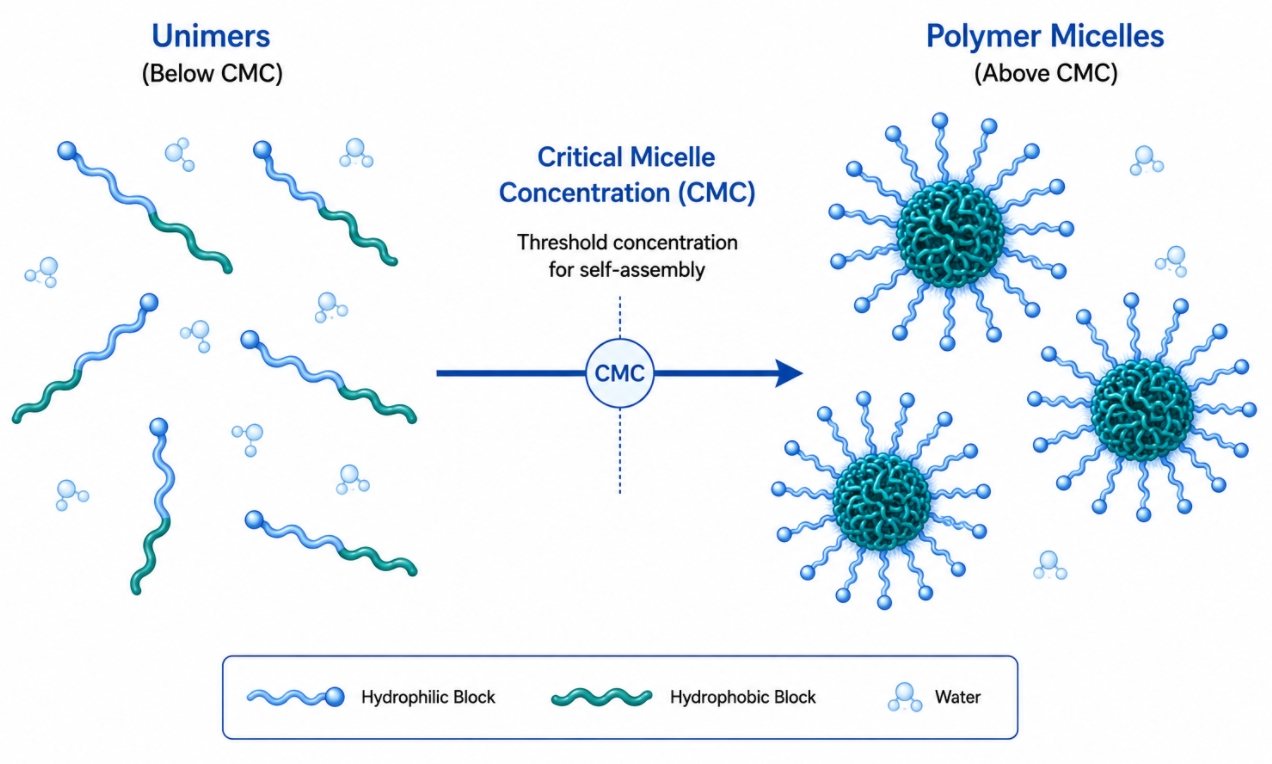 Fig. 1. Critical micelle concentration defines the onset of polymer micelle assembly (BOC Sciences Authorized).
In a polymer micelle system, CMC identifies the concentration range at which self-assembly becomes significant enough that micellar aggregates are measurably present instead of the solution being dominated by isolated polymer chains. Because the micelles arise from amphiphilic block copolymers with solvophobic and solvophilic segments, the transition reflects a balance between unfavorable polymer-water interactions, core formation, corona stabilization, and entropy changes. The result is not always a sharp boundary. In many polymer systems, the transition can be gradual, and the reported CMC depends on how the onset of assembly is experimentally detected.
Unimers, Micelles, and the Concentration-Dependent Transition
Below the CMC, polymer chains are mainly present as unimers, meaning individual dissolved macromolecules that have not assembled into stable micelles. As concentration increases, the hydrophobic segments of the polymer increasingly avoid the aqueous environment, and assembly becomes more favorable. Above the CMC, the micellar state becomes more dominant, producing a population of nanoscale aggregates with a hydrophobic core and a hydrophilic corona. In practice, however, the transition is influenced by temperature, ionic conditions, and polymer architecture, so the relationship between unimers and micelles is rarely a perfect on-off switch.
Why CMC in Polymer Micelles Is Usually Lower Than in Conventional Micelles
Polymer micelles commonly show lower CMC values than conventional surfactant micelles because the amphiphilic building blocks are larger, more strongly segregated, and covalently constrained. This usually increases the driving force for core formation and reduces the tendency of the assembled structure to dissociate immediately upon dilution. The difference is one reason why polymer micelles are often considered more persistent than conventional micelles. Still, the exact magnitude of that advantage depends heavily on block ratio, core chemistry, and the experimental method used to define the transition.
Why CMC Is a Foundational but Not Sufficient Parameter
CMC is foundational because it tells researchers when amphiphilic chains begin to favor micelle formation under a defined set of conditions. Yet it is not sufficient because many other features determine whether a polymer micelle is useful in practice. A low CMC does not automatically guarantee narrow size distribution, strong drug retention, consistent morphology, or stable behavior in complex media. It is therefore a starting point for interpretation, not a complete performance metric. Good formulation judgment requires integrating CMC with measurements of size, dispersity, structural persistence, and cargo behavior.
Why CMC Matters for Polymer Micelle Stability?
CMC matters because it is often the first parameter researchers use to estimate whether polymer micelles can remain assembled under dilution and other formulation-relevant stresses. In self-assembled systems, stability is never just about whether a micelle exists at one concentration in one medium. It is about whether that micelle persists, resists dissociation, and maintains its functional organization under changing conditions. CMC contributes to that discussion by indicating how favorable assembly is, but the relationship between CMC and real micelle stability must be interpreted with care.
CMC and Dilution Resistance in Aqueous Systems
One reason CMC is widely discussed is that it offers a first approximation of how the micelle may respond to dilution. If the concentration of amphiphilic polymer falls below the range required for stable assembly, the system may shift toward unimers or mixed populations. A lower CMC therefore usually suggests that the micellar state remains favored at lower polymer concentrations. That matters in aqueous formulation work because dilution is common during preparation, storage, downstream testing, and biological use. Even so, dilution resistance depends not only on concentration thresholds but also on how readily chains exchange between micelles and the continuous phase.
Thermodynamic Stability vs Kinetic Stability
Thermodynamic stability describes whether the micellar state is favored at equilibrium, while kinetic stability describes how slowly or quickly a micelle reorganizes or dissociates once conditions change. This distinction is crucial in polymer micelles. A system may have a low CMC and thus appear thermodynamically favorable, yet still undergo slow cargo leakage, core rearrangement, or chain exchange over time. Conversely, a metastable system may persist for long enough to be useful because the energy barrier for disassembly is large. CMC mainly speaks to the equilibrium aspect, not the full kinetic picture.
Why Low CMC Is Often Interpreted as a Stability Advantage
Low CMC is often read as a stability advantage because it suggests that the amphiphilic polymer strongly favors the assembled state. In many systems, this correlates with a more cohesive core and greater resistance to dissociation when the formulation is diluted. It is one reason polymer micelles are often highlighted in polymer micelle platform discussions. However, the stability advantage remains conditional. A low CMC indicates that micelle formation is favored, but it does not prove that every other property required for a stable functional system has also been achieved.
When a Low CMC Still Does Not Guarantee Good Micelle Performance
A low CMC can coexist with poor performance when the core is too permeable, when the cargo is mismatched to the core chemistry, or when the micelles interact unfavorably with buffers, salts, proteins, or cosolvents. Some systems remain assembled but release their payload rapidly. Others show acceptable CMC values yet broaden in size or undergo structural changes during storage. For this reason, CMC must be interpreted as one contributor to the overall stability profile. It becomes more meaningful only when compared with other evidence, such as morphology, colloidal persistence, and formulation-specific retention data.
What Polymer Design Factors Influence CMC?
CMC is not a fixed intrinsic constant independent of polymer design. It emerges from the overall balance of segment chemistry, molecular weight, chain architecture, intermolecular interaction, and solvent response. Small changes in polymer structure can shift the concentration at which assembly begins, and the same broad class of polymer may behave very differently when block ratio or segment identity is adjusted. For that reason, understanding how design variables influence CMC is central to rational micelle engineering.
Hydrophilic-Hydrophobic Balance and Block Ratio
The balance between hydrophilic and hydrophobic segments is one of the most direct determinants of CMC. If the hydrophilic fraction is too dominant, the polymer may remain too soluble as individual chains, making micelle formation less favorable and shifting CMC upward. If the hydrophobic segment is more dominant, the incentive to reduce polymer-water contact increases, often lowering CMC. Block ratio therefore governs whether self-assembly occurs readily or only at higher concentration. This is why the design of block copolymers is central to CMC control in amphiphilic micelle systems.
Hydrophobic Block Length and Core Cohesion
Increasing hydrophobic block length often lowers CMC because it promotes stronger segregation from water and encourages formation of a more cohesive core. A stronger core usually means a greater energetic penalty for remaining as unimers, so the assembled state becomes favorable at lower concentration. However, longer hydrophobic segments can also increase particle size, slow equilibration, or create broader distributions if the assembly process becomes too sluggish. Lower CMC is therefore often accompanied by new formulation trade-offs that need to be managed rather than assumed to be automatically beneficial.
Molecular Weight and Chain Architecture Effects
Total molecular weight, block asymmetry, and chain topology all affect CMC. Larger amphiphilic polymers frequently show lower CMC because assembly provides a greater reduction in unfavorable solvent exposure per chain. Diblock, triblock, grafted, and branched architectures can each alter how the polymer packs into a micellar structure, how much strain exists at the interface, and how dense the corona becomes. Architecture therefore influences not just whether micelles form, but how cooperative that formation is. Systems with similar chemistry but different topology may show very different CMC values and transition behavior.
Core Chemistry, Segment Rigidity, and Intermolecular Interactions
Hydrophobicity alone does not determine CMC. Core chemistry also matters because segment rigidity, crystallization tendency, aromatic stacking, hydrogen bonding, and dipolar interactions can strengthen or weaken the assembled state. Some polymers form relatively soft cores that are easy to reorganize, while others form tighter domains with greater internal cohesion. The micelle structure is therefore shaped not just by overall solvophobicity, but by the specific way the core-forming segment packs and interacts. Materials related to biodegradable polymers and other amphiphilic building blocks can therefore differ significantly in CMC even when they seem broadly similar.
How Cargo Incorporation Can Shift Apparent CMC Behavior
Loaded cargo can modify the apparent CMC by changing core cohesion, interfacial tension, and local chain packing. A compatible hydrophobic guest may reinforce the core and make micelles appear more persistent. A mismatched guest may instead disrupt packing and broaden the transition. This is one reason why empty-micelle CMC and loaded-micelle behavior should not be treated as interchangeable. In formulation research, the relevant question is often not simply what CMC the polymer has on its own, but how the assembled system behaves after the intended guest has been introduced under realistic preparation conditions.
| Design Factor | How It Changes CMC | Why It Matters | Typical Trade-Off |
|---|---|---|---|
| Hydrophilic-hydrophobic balance | Shifts the ease of micelle formation up or down | Controls whether unimers or micelles are favored | Too hydrophobic may reduce processability |
| Hydrophobic block length | Often lowers CMC by strengthening core formation | Improves assembly persistence | May increase size or slow equilibration |
| Molecular weight and topology | Changes packing and cooperativity of assembly | Affects transition behavior and micelle organization | More complex architectures are harder to interpret |
| Core chemistry and interactions | Can strengthen or weaken micelle cohesion | Influences stability beyond simple hydrophobicity | Stronger cores may hinder desired release behavior |
How Is CMC Measured in Polymer Micelles?
CMC is measured indirectly through changes in physical or spectroscopic properties that occur when amphiphilic polymers begin to self-assemble. This means that different methods do not necessarily detect the exact same stage of micelle formation. Some methods are sensitive to changes in local microenvironment, others to interfacial behavior, and others to the appearance of larger scattering entities. As a result, CMC measurement is as much about choosing the right detection principle as it is about performing the measurement itself.
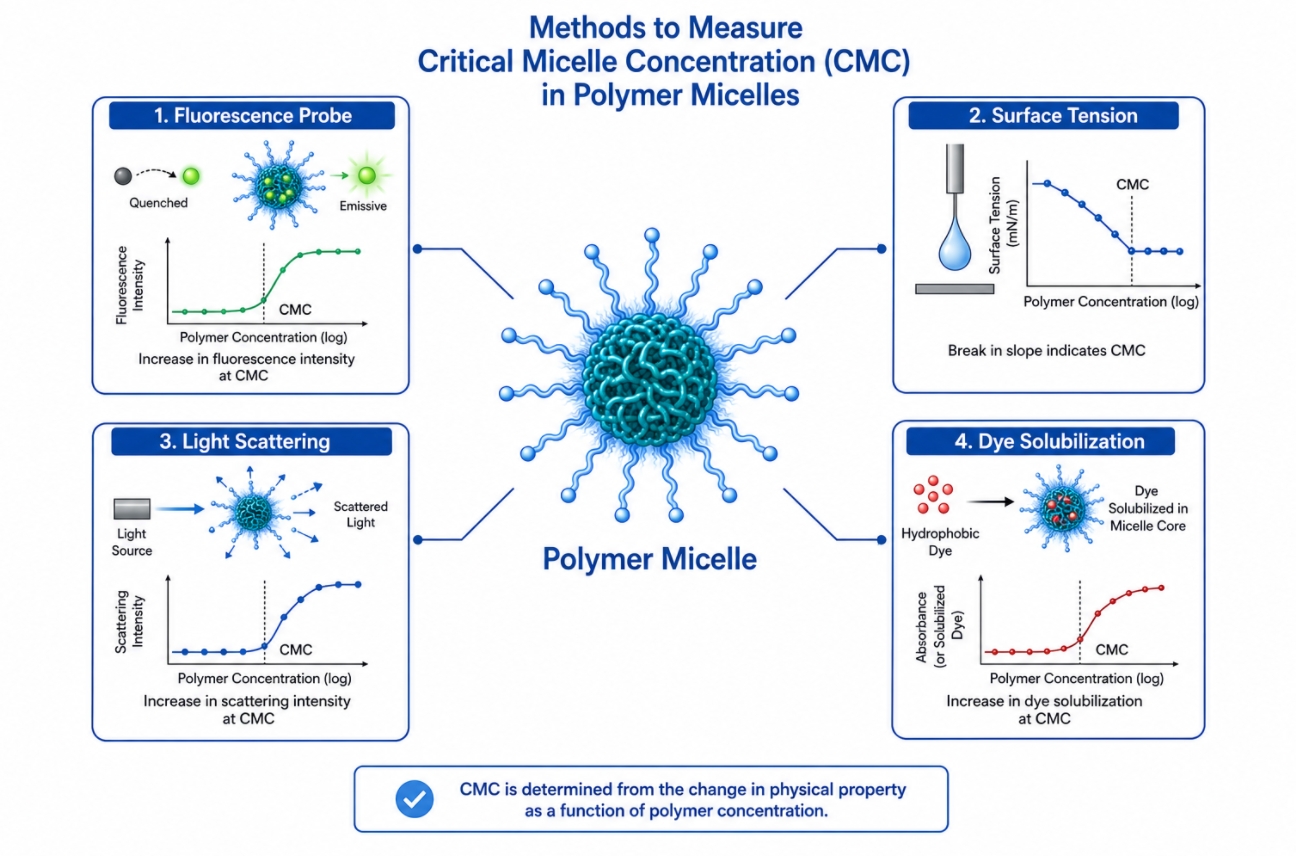 Fig. 2. Common analytical methods used to determine polymer micelle CMC (BOC Sciences Authorized).
Fluorescence Probe Methods
Fluorescence probe methods are among the most common ways to determine CMC in polymer micelles. A hydrophobic fluorescent probe is added to the system, and its spectral behavior changes as the probe moves from an aqueous environment into a more hydrophobic micellar domain. This method is popular because it is sensitive, convenient, and especially useful for systems with low CMC values. However, the result depends on the probe chosen, the probe concentration, and the assumption that probe partitioning accurately reflects the onset of micelle formation rather than later-stage core development.
Surface Tension, Conductivity, and Light Scattering Approaches
Surface tension methods monitor how amphiphilic molecules lower interfacial tension as concentration rises, while conductivity methods track changes in ionic behavior that occur when assembly begins. Dynamic or static light scattering can detect the appearance of larger aggregates as micelles form. These methods are all useful, but they differ in sensitivity and in the type of transition they capture. Surface tension and conductivity are often more familiar in smaller surfactant systems, whereas scattering approaches are especially informative when the polymer micelles produce clear changes in particle-related optical behavior.
Spectroscopic and Dye Solubilization Methods
Spectroscopic techniques and dye solubilization methods rely on the idea that a micellar environment changes the behavior or apparent solubility of a reporter molecule. When assembly occurs, a poorly water-compatible dye may partition into the micelle and show altered absorbance or fluorescence. These approaches can work well for polymer systems that are not easily captured by other low-signal methods. At the same time, they can exaggerate or blur the transition if the dye interacts too specifically with the polymer or if the system forms intermediate association states before well-defined micelles become dominant.
Why Different Methods May Produce Different CMC Values
Different methods produce different CMC values because they detect different manifestations of the transition. One method may respond when a hydrophobic domain first becomes available to a probe, while another may respond only when the sample contains enough larger aggregates to change scattering. Temperature, ionic strength, solvent composition, and polymer concentration range can further shift the apparent result. This is why reported CMC values should always be interpreted in the context of method and conditions rather than compared blindly across studies.
How to Choose a CMC Method for Your Micelle System
The best method depends on the polymer architecture, expected concentration range, probe compatibility, and the question being asked. For very low CMC systems, fluorescence probes are often practical because of their sensitivity. For systems where interfacial changes are large and clearly defined, surface methods may still be informative. If the goal is to relate CMC to population-level micelle appearance, scattering may be more useful. In all cases, method choice should reflect what kind of assembly event is most relevant for the intended formulation problem rather than what technique is simply most common in the literature.
| Method | What It Detects | Main Strength | Main Limitation | Best Use Scenario |
|---|---|---|---|---|
| Fluorescence probe | Microenvironmental change around a reporter probe | High sensitivity for low-CMC systems | Probe choice can bias the apparent transition | Hydrophobic-core-forming micelles with subtle transitions |
| Surface tension | Interfacial behavior with increasing concentration | Classical and conceptually straightforward | Often less sensitive in polymer systems | Systems with strong interfacial changes |
| Light scattering | Appearance of larger assembled populations | Links to aggregate formation directly | May miss early-stage association | Micelles with clear particle-size development |
| Dye solubilization/spectroscopy | Probe partitioning or signal shifts in assembled domains | Flexible and accessible | Can reflect probe-specific interactions | Comparative characterization across similar formulations |
How Should CMC Data Be Interpreted in Formulation Research?
CMC data become most useful when interpreted as part of a broader formulation story rather than as an isolated number in a table. In formulation research, the real question is rarely whether a polymer has a low CMC in abstract terms. The more relevant question is what that value means for self-assembly, retention, dilution response, and performance under the conditions relevant to the intended micelle system. Interpretation therefore requires context, comparison, and caution.
What a Reported CMC Value Actually Tells You
A reported CMC value tells you that, under a particular method and set of conditions, the polymer system showed evidence of transition from mainly unimers to a micelle-containing state around a specific concentration range. It does not tell you the entire population distribution at all concentrations, nor does it reveal how uniform the micelles are, how stable they remain over time, or how well they will behave after cargo loading. It is therefore informative, but only within the limits of what was actually measured.
Comparing Empty and Drug-Loaded Micelles
Empty and loaded systems should not be assumed to behave the same way. Cargo can strengthen the core, alter interfacial curvature, or disrupt packing, which in turn changes how the system responds to dilution and how the CMC appears experimentally. This is highly relevant in formulations such as polymer micelles for poorly soluble compounds, where guest incorporation is part of the functional design. Comparing empty and loaded CMC-related behavior helps reveal whether the intended formulation actually stabilizes the micelle or simply uses a pre-existing structure temporarily.
CMC, Probe Method, and Experimental Conditions
CMC values are strongly shaped by the environment in which they are measured. Temperature can affect polymer solvation and chain mobility. Salt can screen interactions. Cosolvents can weaken the hydrophobic driving force for assembly. Reporter probes can partition differently depending on both their own chemistry and the local structure of the micelle. These factors mean that CMC is not a universal constant for a polymer system. It is a condition-dependent descriptor that must be interpreted with full awareness of how the experiment was conducted.
Why CMC Should Be Read Together with Size, PDI, and Morphology
CMC becomes much more meaningful when read alongside size, polydispersity, and morphology. A low CMC combined with narrow size distribution and stable spherical morphology suggests a more coherent formulation state than a low CMC paired with broad populations or irregular aggregation. This is why CMC interpretation should be integrated with methods like particle sizing and structure analysis rather than isolated from them. In formulation research, one number rarely answers the whole structural question, especially in dynamic self-assembled systems.
Need Support with Polymer Micelle CMC Characterization or Stability Design?
BOC Sciences supports amphiphilic polymer design, polymer micelle preparation, and characterization workflows for CMC evaluation and stability-focused formulation development.
CMC and Dilution Stability: Related but Not Identical
CMC and dilution stability are closely related concepts, but they are not interchangeable. This distinction is often missed because low CMC values are frequently used as shorthand for strong micelle persistence. In reality, the ability of a polymer micelle to remain functional under dilution depends on more than just the concentration at which assembly becomes favorable. It also depends on how quickly chains exchange, how cohesive the core remains, and how the surrounding medium affects the assembled state.
Why Researchers Often Link CMC with Dilution Stability
The connection arises naturally because CMC gives a first indication of how much dilution a system might tolerate before assembly becomes less favorable. If micelles only form above relatively high polymer concentrations, then substantial dilution may lead quickly to dissociation. If they form at much lower concentrations, then there is a wider concentration window in which micelles may persist. This is a useful conceptual link, but it remains only a partial one because persistence after dilution may also depend on slow nonequilibrium processes and local environmental factors.
The Role of Chain Exchange and Kinetic Persistence
Some polymer micelles remain apparently stable after dilution because chain exchange between micelles and solution is very slow. In these systems, kinetic persistence can maintain the assembled state even when equilibrium considerations alone would not predict long-term stability. This is one reason why CMC should be paired with discussions of chain mobility and core dynamics. A system can have a favorable CMC yet still reorganize over time, or it can survive a transient dilution step because the disassembly process is kinetically hindered rather than immediately spontaneous.
How Biological Media Can Change the Stability Picture
Even if a polymer micelle behaves well in water or a simple buffer, biological or compositionally rich media can alter the picture. Salts, proteins, serum components, lipids, or competing hydrophobic molecules may affect corona hydration, interfacial tension, or guest partitioning. These interactions can shift the apparent stability without necessarily changing the original CMC measured in a simplified system. For this reason, dilution stability in application-relevant media should be considered a separate question from CMC itself, even though the two are related conceptually.
When Additional Stability Tests Are Necessary
Additional tests are necessary whenever the formulation objective depends on actual persistence of assembled micelles after dilution, not just on the onset of assembly at equilibrium. This includes cases where cargo must remain retained, where the system will encounter complex media, or where the micelles must remain structurally interpretable over time. Measurements such as size tracking, morphology comparison, retention studies, and controlled dilution experiments are essential complements to CMC. They are especially useful when comparing micelles against other carriers such as those discussed in platform comparisons among polymer micelles, microspheres, and nanoparticles.
How to Optimize Polymer Micelles for Lower or More Useful CMC?
In many projects the goal is not simply to achieve the lowest possible CMC, but to obtain a CMC profile that supports the intended micelle function. Some applications benefit from very low CMC and strong persistence, while others require a balance between assembly stability and responsiveness. Optimization should therefore focus on usefulness rather than on numerical minimization alone. A micelle with an ultralow CMC may still be suboptimal if it becomes too rigid, difficult to load, or hard to disassemble when desired.
Increasing Core Hydrophobicity Without Losing Processability
A common strategy is to increase the hydrophobicity or cohesion of the core-forming block so that micelles form at lower concentration. This can be achieved through segment choice, block length extension, or use of more strongly associating core chemistries. Yet stronger cores can also reduce processability, increase aggregation risk, or complicate loading of sensitive guests. Materials related to polylactic acid and other hydrophobic polyesters illustrate how stronger core formation can support lower CMC while also changing release and handling behavior.
Using Block Architecture to Improve Self-Assembly Persistence
Beyond simple hydrophobicity, polymer architecture can be tuned to promote more persistent self-assembly. Adjusting block ratio, total chain length, or topology can strengthen core-shell organization and reduce the readiness of the system to revert to unimers. Hydrophilic segments such as those found in PEG-derived materials are often used to maintain aqueous compatibility while preserving the balance necessary for low-CMC micelle formation. The best designs improve persistence without making the system so constrained that it becomes difficult to formulate or characterize.
Crosslinking, Hybrid Strategies, and Ultralow-CMC Concepts
Some strategies aim to go beyond conventional CMC control by adding crosslinking, supramolecular reinforcement, or hybrid material features that effectively lock the micelle-like structure in place. These systems can exhibit extremely strong persistence and very low apparent susceptibility to dilution. However, once the structure is partially fixed, the meaning of CMC becomes more complicated because the system no longer behaves like a simple reversible micelle. These approaches can be powerful, but they should be understood as altering the assembly paradigm itself rather than merely refining an ordinary low-CMC micelle.
Why Over-Optimization Can Create New Trade-Offs
Excessive focus on reducing CMC can produce new problems. A highly cohesive core may hold together well but load poorly, release too slowly, or respond weakly to desired triggers. An architecture designed for extreme persistence may be hard to reproduce or difficult to compare across batches. In responsive systems, lowering CMC too aggressively may also conflict with the goal of controlled disassembly. For this reason, optimization should be guided by the intended formulation task rather than by the assumption that the smallest possible CMC is always the best outcome.
Limitations of Using CMC as a Standalone Decision Metric
CMC is valuable, but it becomes misleading when treated as a universal ranking parameter for polymer micelles. Researchers often seek a single metric that summarizes self-assembly quality, yet micelle performance emerges from several interdependent properties. CMC can tell part of that story, but not all of it. A technically strong interpretation therefore treats CMC as one parameter within a larger characterization framework rather than as the sole basis for material selection.
Good CMC Does Not Always Mean Good Drug Retention
A micelle may have a favorable CMC while still releasing a guest rapidly if the core is not chemically compatible with that guest. This is especially important in formulations involving challenging hydrophobic molecules, where core-drug interaction can dominate performance more strongly than assembly onset alone. In such cases, the system may remain assembled but fail at the level of functional retention. CMC therefore has to be interpreted together with the intended payload and the chemistry of the core environment, not only with the empty carrier in mind.
Experimental Artifacts and Method Dependence
Because CMC is measured indirectly, it can be distorted by probe choice, concentration window, signal interpretation, or the presence of pre-aggregated species. Two studies on similar polymers may report different values simply because one method detects a local microenvironment shift and another detects aggregate growth. This dependence does not make CMC useless, but it does mean that the number has to be tied to the measurement context. A value without method, medium, and temperature information is much less meaningful than it first appears.
Biological Relevance vs Bench-Top Measurements
Bench-top CMC values are typically measured in simplified systems designed to isolate the assembly transition, but real use conditions often contain salts, proteins, competing hydrophobes, or dynamic dilution processes that alter micelle behavior. As a result, a favorable CMC measured under clean laboratory conditions may not map directly onto the formulation's behavior in complex media. This does not invalidate the measurement; it simply means that CMC captures one well-defined aspect of micelle behavior while biological relevance requires additional layers of testing.
What Other Parameters Should Be Evaluated Together
CMC should usually be evaluated together with size, PDI, morphology, dilution response, guest retention, and method-specific stability data. In some projects, preparation route also matters because the assembled state can depend strongly on how the system was made. This is one reason why discussions of CMC are often most meaningful when linked back to assembly pathways, such as those considered in polymer micelle preparation and formation strategy. A good micelle is defined by converging evidence, not by one parameter in isolation.
Advanced Polymer Synthesis and Formulation Services
At BOC Sciences, we support polymer micelle development from the perspective of amphiphilic polymer architecture, self-assembly behavior, and characterization-driven formulation design. Our capabilities help connect block selection, preparation route, CMC interpretation, and stability evaluation into a more coherent development workflow. Whether the project requires new amphiphilic materials, optimized micelle preparation, or analytical support for self-assembly studies, we focus on building technically interpretable structure-property relationships rather than isolated measurements.

Amphiphilic Polymer and Block Copolymer Design Support
- Custom design of amphiphilic polymers to tune hydrophilic-hydrophobic balance and self-assembly behavior.
- Support for materials selection based on block ratio, core chemistry, and intended micelle function.
- Development of new polymer systems through polymer synthesis support.
- Assistance in aligning molecular design with CMC and stability goals.
Micelle Preparation and Formulation Optimization Support
- Optimization of preparation routes for reproducible polymer micelle formation.
- Evaluation of how concentration, solvent history, and loading conditions affect assembled structure.
- Guidance for balancing persistence, processability, and responsive behavior in micelle systems.
- Support for formulation development where CMC interpretation must be tied to actual micelle performance.
CMC Characterization and Stability Evaluation Services
- Analytical support for CMC-related measurement planning and interpretation.
- Comparative evaluation of micelle stability under dilution and formulation-relevant conditions.
- Integration of self-assembly assessment with broader characterization workflows.
- Structure-related analytical support through polymer characterization services.
Custom Material Selection for Polymer Micelle Development
- Selection of polymer segments and building blocks for low-CMC or application-specific micelle systems.
- Comparison of structural outcomes using morphology-focused assessment.
- Support for correlating CMC with size, morphology, and colloidal persistence.
- Advanced analysis through polymer structure morphology analysis.
Do You Need A Consultation?
BOC Sciences provides tailored support for polymer design, micelle preparation, CMC characterization, and stability-focused formulation evaluation.
Unlock New Possibilities with Tailored and High-Performance Polymers
| Cat. No. | Product Name | CAS No. | Inquiry |
|---|---|---|---|
| 30846-39-0 | Poly(L-lactide glycolide) | 30846-39-0 | Bulk Inquiry |
| 9011-14-7 | Poly(methyl methacrylate) | 9011-14-7 | Bulk Inquiry |
| B2699-236504 | Poly-L-arginine hydrochloride | 26982-20-7 | Bulk Inquiry |
| 1055361-96-0 | Polyester bis-MPA dendron, 2 hydroxyl, 1 acetylene | 1055361-96-0 | Bulk Inquiry |
| 873849-86-6 | Polyester bis-MPA dendron, 2 hydroxyl, 1 azide | 873849-86-6 | Bulk Inquiry |
| 919988-18-4 | Polyester bis-MPA dendron, 4 hydroxyl, 1 azide | 919988-18-4 | Bulk Inquiry |
| 1282509-84-5 | Polyester bis-MPA dendron, 8 hydroxyl, 1 allyl | 1282509-84-5 | Bulk Inquiry |
| 873849-89-9 | Polyester bis-MPA dendron, 8 hydroxyl, 1 azide | 873849-89-9 | Bulk Inquiry |
| 36890-68-3 | Poly(caprolactone) diol | 36890-68-3 | Bulk Inquiry |
| 856893-75-9 | Poly(9,9-n-dihexyl-2,7-fluorene-alt-9-phenyl-3,6-carbazole) | 856893-75-9 | Bulk Inquiry |
Frequently Asked Questions
-
What does CMC mean in polymer micelles?
CMC in polymer micelles refers to the concentration range where amphiphilic polymer chains begin to assemble into micellar structures instead of remaining mainly as unimers. It marks the onset of self-assembly under specific conditions, but it does not fully describe micelle quality, persistence, or formulation suitability without supporting structural and stability data.
-
Why is low CMC important for polymer micelle formulations?
A low CMC is important because it usually indicates that the assembled micelle state is favored even at lower polymer concentrations, which can support better persistence during dilution. This is useful in formulation research, but its value depends on whether the micelles also maintain structure, retain cargo, and behave consistently in relevant media.
-
Does a lower CMC always mean a better polymer micelle?
No. A lower CMC can indicate stronger self-assembly, but it does not guarantee good drug retention, narrow size distribution, favorable morphology, or stability in complex environments. Some low-CMC systems still perform poorly because the core is mismatched to the guest or the micelles reorganize under realistic conditions despite apparently favorable equilibrium behavior.
-
Which methods are commonly used to measure CMC in polymer micelles?
Common CMC methods include fluorescence probe analysis, surface tension measurement, conductivity, light scattering, and dye solubilization or other spectroscopic approaches. Each method detects a different aspect of the assembly transition, so the most appropriate choice depends on the polymer system, expected CMC range, and the specific question being addressed.
-
Why can different CMC methods give different values?
Different methods can give different CMC values because they do not detect exactly the same event. One method may respond when a hydrophobic microdomain first forms, while another may respond only after larger aggregates appear. Experimental conditions, probe chemistry, and interpretation criteria also influence the reported transition and can shift the apparent value.
-
What other parameters should be evaluated together with CMC?
CMC should usually be evaluated together with particle size, PDI, morphology, dilution response, and guest retention. These parameters show whether the micelle is structurally coherent and functionally stable beyond the initial onset of assembly. Reading CMC alongside broader characterization data produces a much stronger and more realistic assessment of polymer micelle performance.