
Polymer Micelles for Hydrophobic Small-Molecule Drugs: Formulation, Loading, and Release
Polymer micelles are widely used to formulate hydrophobic small-molecule drugs because they offer more than a temporary increase in apparent solubility. Their value lies in creating a nanoscale core-shell environment where poorly water-compatible molecules can be partitioned, stabilized, and released in a more controlled way than they would be in simple cosolvent or surfactant systems. Yet successful formulation is never guaranteed by hydrophobicity alone. Drug structure, core chemistry, loading method, micelle stability, and release conditions all determine whether a micellar system becomes a practical formulation or merely a transient solubilization state. This page focuses on that formulation logic, explaining how polymer micelles accommodate hydrophobic small molecules, which types of compounds are most compatible, what controls leakage and controlled release, and how to evaluate whether a micelle formulation is truly robust.
What Are Polymer Micelles for Hydrophobic Small-Molecule Drugs?
In this context, polymer micelles are self-assembled nanoscale carriers formed from amphiphilic block copolymers in selective solvents, usually water, where the hydrophobic segment forms the inner core and the hydrophilic segment forms the outer corona. Their role in hydrophobic small-molecule drug formulation is to create a confined, relatively nonpolar domain that can host molecules that otherwise show poor aqueous compatibility. That function sounds simple, but formulation performance depends on far more than the existence of a core. The relevant question is whether the micelle can load the drug efficiently, keep it retained under realistic conditions, and release it at a rate that supports the intended formulation objective.
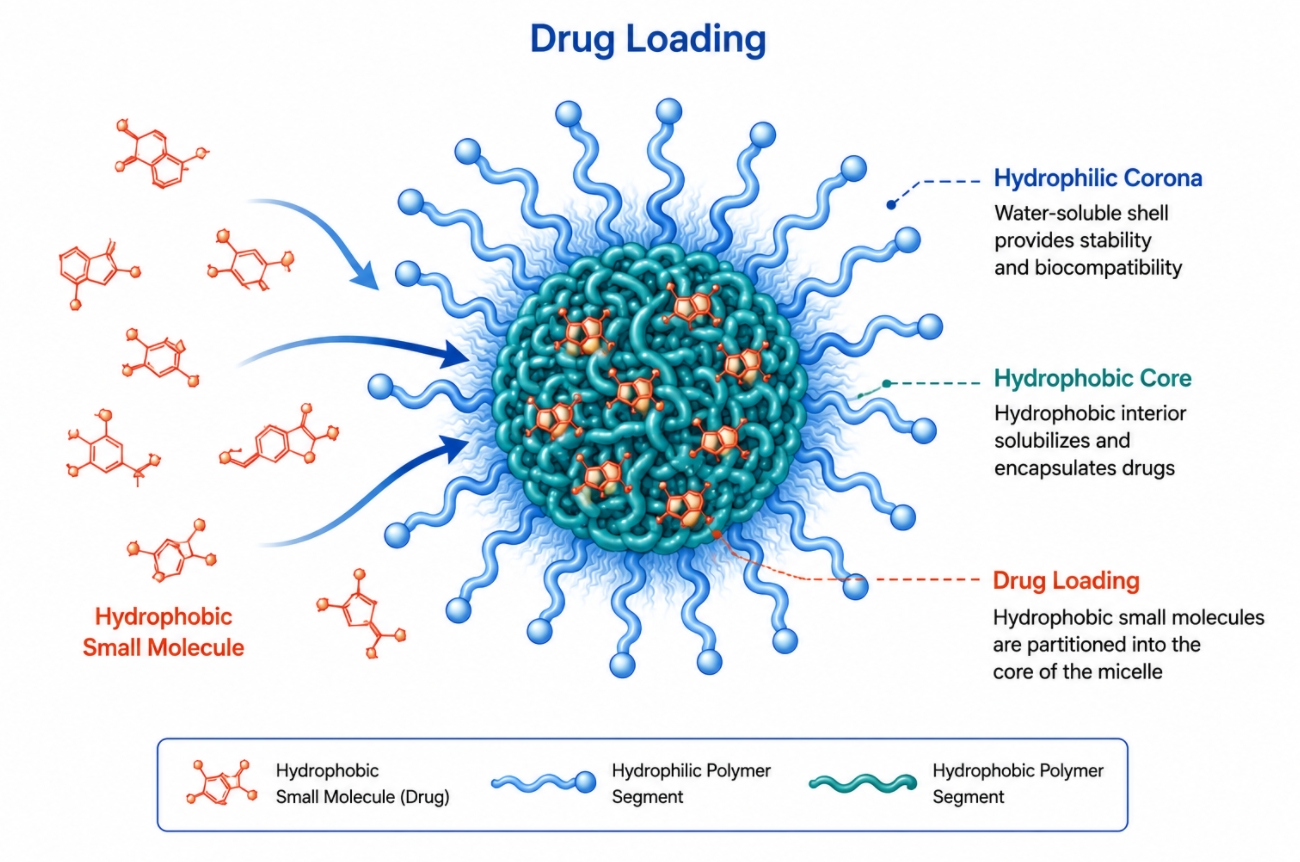 Fig. 1. Hydrophobic small molecules partition into the core of polymer micelles (BOC Sciences Authorized).
Why Hydrophobic Small Molecules Are a Natural Fit for Micelle Cores
Hydrophobic small molecules are often a natural fit for polymer micelle cores because the core provides an energetically favorable environment relative to bulk water. Instead of precipitating, crystallizing rapidly, or requiring large amounts of organic solvent, the molecule can partition into the core domain where polymer-drug interactions partially offset its unfavorable aqueous exposure. This does not mean every hydrophobic compound will load well, but it does explain why micelles are often considered early when the main problem is poor water compatibility rather than macromolecular instability or charge-driven delivery.
How Polymer Micelles Differ from Conventional Solubilization Approaches
Conventional solubilization approaches such as surfactants, cosolvents, or simple solubilizing excipients often improve apparent dispersion but may not provide the same degree of structural persistence or control over drug microenvironment. Polymer micelles differ because their higher molecular-weight amphiphiles usually produce lower critical micelle concentration (CMC) values and more stable core-shell organization than ordinary surfactant systems. This distinction is one reason why they are frequently compared with other organized carriers in discussions of conventional versus polymeric micelles. The key advantage is not merely stronger solubilization, but a more controllable relationship between assembly, retention, and release.
Polymer Micelles vs Other Nanocarriers for Hydrophobic Drugs
Polymer micelles are only one of several nanoscale options for hydrophobic drugs. More rigid matrix-based carriers may provide slower release, while denser particles may support stronger retention but at the cost of more complex preparation or lower dynamic adaptability. Micelles are especially attractive when the formulation benefits from reversible self-assembly, a well-defined hydrophobic domain, and relatively small particle size. By contrast, a different polymer carrier platform may be more suitable if long-term matrix entrapment or highly rigid structure is required.
Why Polymer Micelles Work for Hydrophobic Small-Molecule Formulation?
Polymer micelles work for hydrophobic small-molecule formulation because they create a compartmentalized environment that changes how the drug behaves in water. Instead of existing as free molecules with poor aqueous affinity, the drug can become associated with a stabilized nanoscale domain whose properties are defined by block copolymer architecture and core chemistry. This structural reorganization improves more than dispersibility. It can also influence apparent solubility, physical stability, concentration profile, and the rate at which the drug exits the carrier.
Core-Shell Organization and Hydrophobic Drug Partitioning
The hydrophobic core acts as a partitioning space for molecules that are poorly accommodated by water. When the core is chemically compatible with the drug, the molecule is less likely to remain in the surrounding medium and more likely to distribute into the micellar interior. The hydrophilic corona, meanwhile, stabilizes the resulting assembly in aqueous conditions. This two-domain organization is what makes micelles fundamentally different from a simple solubilizing polymer solution. It creates a structured formulation microenvironment rather than only a chemically modified bulk medium.
Improved Apparent Solubility and Aqueous Dispersion
One of the most visible outcomes of micelle formulation is improved apparent solubility. Hydrophobic drugs that would otherwise precipitate or remain poorly dispersed can appear as a stable nanosuspension or transparent colloidal formulation depending on loading and particle size. The improvement often comes not because the molecular solubility of the drug has truly changed in bulk water, but because the micelles provide a separate domain that keeps the drug dispersed at the system level. This distinction matters when later interpreting dilution behavior or release.
Protection Against Premature Precipitation and Crystallization
In many cases, micelles suppress rapid crystallization or precipitation by restricting how the drug molecules encounter each other and nucleate in the aqueous phase. The core environment can help keep the drug in a less crystalline or noncrystalline distributed state, especially when strong drug-polymer interactions are present. However, this protection is conditional rather than permanent. If the drug redistributes out of the core or the core reorganizes unfavorably, precipitation can still occur. The usefulness of the micelle therefore depends on how stable that protective environment remains during handling and use.
Support More Controlled Drug Exposure
Micelles can support more controlled drug exposure because they mediate how quickly the drug moves from the hydrophobic domain into the surrounding phase. In a well-matched system, drug release depends on core affinity, diffusion, and micelle stability rather than on immediate contact between drug crystals and water. This can moderate the initial exposure profile and reduce uncontrolled burst behavior. The degree of control varies greatly across systems, but the possibility of coupling solubilization with tuned release is one of the main reasons polymer micelles remain attractive for hydrophobic small molecules.
What Controls Hydrophobic Drug Loading in Polymer Micelles?
Not all hydrophobic small molecules load equally well into polymer micelles. Loading success depends on compatibility, packing, and dynamic behavior rather than on hydrophobicity as a single abstract property. Two molecules with similarly low water solubility may behave very differently in the same micelle because their shape, polarity distribution, aromaticity, and capacity for specific interactions with the core-forming block are different. For this reason, formulation success should be understood as a compatibility problem, not merely as a logP problem.
Drug-Polymer Compatibility Beyond LogP Alone
LogP or general hydrophobicity can provide a first impression of whether a molecule may partition into a micelle core, but it does not determine the full loading outcome. Compatibility also depends on how the drug fits within the polymer core at the molecular level. A highly hydrophobic compound may still load poorly if its shape, rigidity, or interaction profile is mismatched to the core environment. Conversely, a somewhat less hydrophobic molecule may load surprisingly well if it matches the core's local polarity and packing tendencies.
Core Chemistry, Polarity, and Intermolecular Interaction
The chemistry of the core-forming block determines whether the drug experiences favorable noncovalent interactions after entering the micelle. Hydrophobic attraction is important, but hydrogen bonding, aromatic interaction, dipolar alignment, and local segment flexibility can be equally important for retention. This is why core-forming segments derived from polyester materials or other hydrophobic blocks should be selected in relation to the drug's actual interaction profile rather than only by tradition or convenience.
Loading Capacity vs Encapsulation Efficiency
Loading capacity and encapsulation efficiency measure related but different aspects of formulation. Loading capacity indicates how much drug is present relative to carrier mass, while encapsulation efficiency indicates how much of the initial drug feed is retained after preparation. A formulation may have high encapsulation efficiency at low feed but still be impractical because total loading remains low. Another may reach higher loading but compromise structural integrity. These parameters should therefore be interpreted together and not used as isolated proof of formulation success.
How Drug Structure Can Change Micelle Size and Integrity
A loaded drug becomes part of the micelle's packing problem. It can expand the core, compact it, introduce heterogeneity, or destabilize the interface depending on how it fits between polymer chains. As a result, the same polymer may form different particle sizes and distributions before and after loading. A hydrophobic drug is therefore not a passive guest. It can alter the physical integrity of the micelle enough that a formulation which appears stable when empty becomes much less stable after drug incorporation.
Why Some Hydrophobic Drugs Leak Rapidly After Loading
Rapid leakage occurs when the drug is insufficiently stabilized by the core environment or when the assembly is too dynamic to retain it effectively. Leakage may also result from incomplete equilibration during preparation, high free volume in the core, or strong competition from surrounding media components after dilution. In such cases, the drug appears to load initially but redistributes outward soon afterward. This is one reason why drug loading data must always be paired with retention and release measurements rather than treated as evidence of long-term formulation stability.
Which Hydrophobic Small Molecules Fit Polymer Micelles?
A practical formulation page should not only explain what controls loading, but also provide a screening logic for which kinds of hydrophobic molecules are better candidates in the first place. Polymer micelles are especially useful for small molecules that benefit from a hydrophobic nanoscale domain yet do not immediately overwhelm the assembly through extreme crystallization, excessive rigidity, or poor compatibility with the chosen core-forming block. Thinking in terms of molecular categories helps narrow down realistic candidates before detailed formulation work begins.
Aromatic and Conjugated Molecules
Aromatic and highly conjugated molecules often fit polymer micelles well because they can benefit from hydrophobic partitioning and, in some systems, from favorable π-related interactions with the core-forming segment. Their relatively rigid structures can sometimes promote strong retention when the core environment is chemically compatible. At the same time, they may be prone to self-association or crystallization if the core is poorly matched, so their success depends on controlled molecular organization rather than hydrophobicity alone.
Neutral Molecules with Moderate Size
Neutral hydrophobic molecules of moderate molecular size are often practical candidates because they can enter the micelle core without generating excessive steric disruption. They are usually easier to distribute homogeneously than very bulky, highly rigid structures, and they are less dependent on electrostatic interactions than ionizable or strongly charged compounds. This class often represents the most straightforward formulation space for micelles because the balance between loading, core packing, and colloidal stability is easier to control.
Molecules with Strong Core Affinity
Some compounds are especially suitable not because they are the most hydrophobic, but because they interact favorably with the chosen polymer core. A molecule with the right combination of aromaticity, dipolar character, hydrogen-bonding potential, or conformational flexibility may remain associated with the micelle much more effectively than a more hydrophobic but poorly matched drug. This is why compatibility-focused formulation often outperforms purely hydrophobicity-driven screening when identifying strong micelle candidates.
Poorly Soluble but Crystallization-Prone Molecules
Many of the most relevant micelle candidates are compounds that are clearly poorly water-soluble yet also prone to crystallization during dispersion or storage. Micelles can be especially useful for these molecules because the core can reduce direct molecular contact in bulk water and suppress rapid precipitation. However, this benefit is fragile. If the molecule has a very strong tendency to self-crystallize, the formulation window may be narrow and stability must be evaluated carefully under realistic conditions.
Poor-Fit Molecules for Micelle Encapsulation
Some hydrophobic small molecules are poor fits for micelles because they are too large, too rigid, too strongly crystallizing, too weakly retained by the intended core, or too prone to rapid repartitioning after dilution. Others are structurally incompatible with a given core chemistry even if they appear hydrophobic on paper. In these cases, forcing the molecule into a micelle may create a formulation that looks acceptable at the time of preparation but fails rapidly afterward. Recognizing poor-fit candidates early can save substantial development effort.
How Are Polymer Micelles Formulated for Hydrophobic Small-Molecule Drugs?
The preparation route shapes the final micelle as much as the polymer and drug do. Polymer micelles are path-dependent systems, meaning the order of dissolution, solvent exchange, film formation, hydration, and solvent removal can all change how the drug partitions and how the core assembles. Formulation strategy therefore needs to be treated as a design variable in its own right rather than a purely technical afterthought.
Direct Dissolution, Dialysis, and Thin-Film Hydration
Direct dissolution can work when both drug and polymer can be introduced into a suitable solvent sequence without causing uncontrolled precipitation. Dialysis is useful when polymer and drug are first dissolved in a mutual solvent and then gradually transferred into water, allowing self-assembly during solvent exchange. Thin-film hydration begins from a co-dissolved polymer-drug film that is rehydrated to produce micelles. Each route creates a different kinetic path for core formation and drug incorporation, so none should be treated as interchangeable. Broader assembly route differences are also reflected in discussions of how polymer micelles form and are prepared.
Solvent Selection and Solvent Removal Effects
Solvent choice affects the initial conformational state of the polymer, the solvation state of the drug, and the rate at which the hydrophobic core collapses during micellization. A solvent that strongly plasticizes the core-forming block may temporarily improve loading but later produce leakage when removed. Rapid solvent removal may trap nonequilibrium distributions, while gradual removal may permit more homogeneous organization. These effects mean solvent is not simply a processing medium. It is part of the pathway that shapes the final micelle.
Drug-to-Polymer Ratio and Loading Window Optimization
The drug-to-polymer ratio determines whether the micelle remains within a workable loading window. Too little drug may give poor formulation productivity, while too much can disrupt core packing, increase PDI, and promote leakage or precipitation. An optimized loading window should therefore preserve micelle integrity while delivering meaningful drug content. This optimization is best done with post-loading structural data rather than by relying only on feed composition or initial appearance.
How Preparation Method Influences Micelle Quality and Release
Preparation method influences not just particle size, but also how the drug is distributed inside the core and how easily it later exits. A kinetically trapped system may show high loading yet unstable release behavior because the drug is not truly well accommodated. A more equilibrated preparation may produce lower initial loading but better retention and a cleaner release profile. The quality of a micelle formulation is therefore inseparable from the path by which it was formed.
How Controlled Release Works in Hydrophobic Drug-Loaded Micelles?
Controlled release from hydrophobic drug-loaded micelles is not governed by one mechanism alone. Instead, it emerges from the combined effects of drug diffusion, partitioning between core and medium, internal polymer mobility, and the overall structural persistence of the micelle. A useful formulation must therefore be designed with release logic in mind rather than assuming that loading into a core automatically produces slow or predictable release.
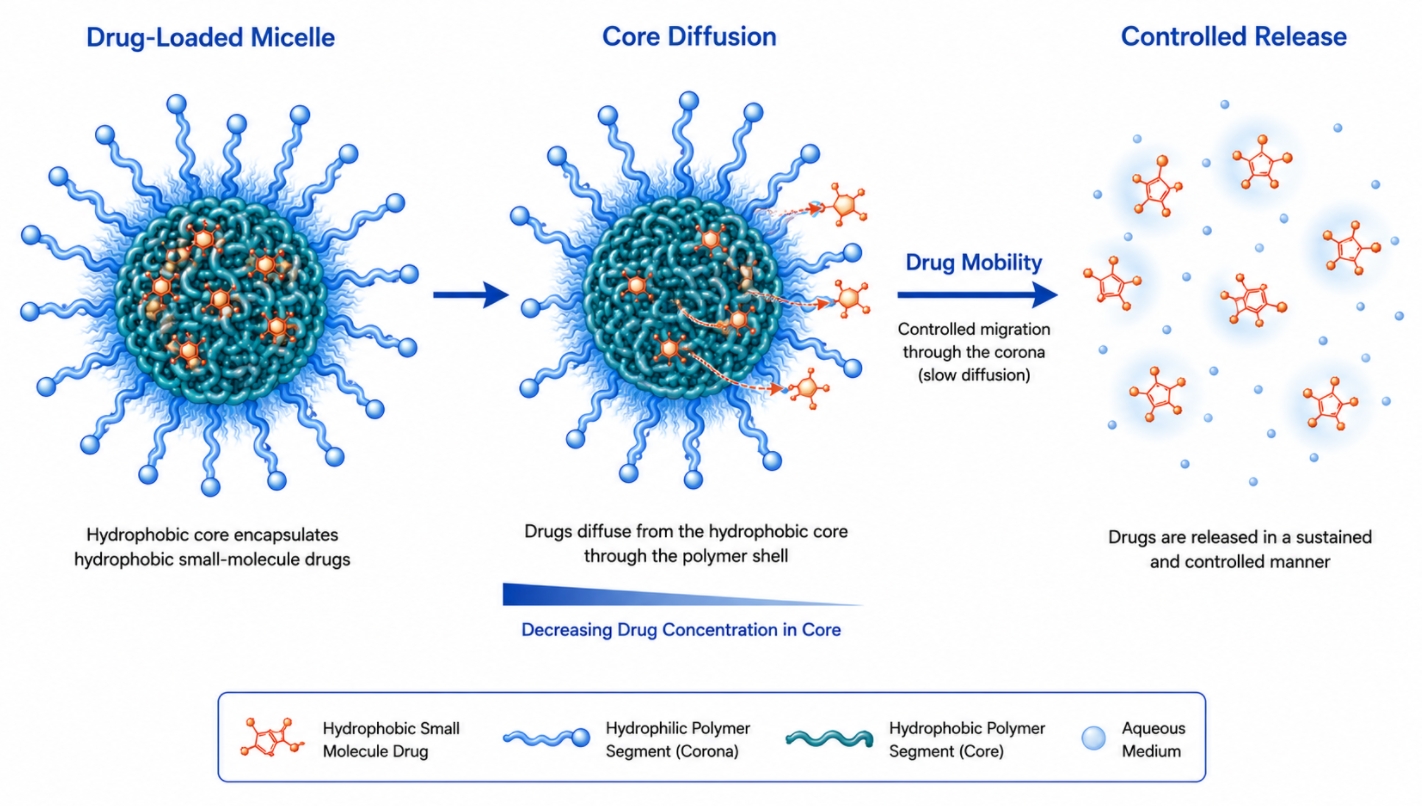 Fig. 2. Controlled release from polymer micelles depends on core structure and drug mobility (BOC Sciences Authorized).
Core Diffusion and Drug Partitioning Effects
A hydrophobic small molecule is released when it diffuses through the core and partitions into the surrounding medium. The rate of that process depends on how strongly the drug prefers the core environment over the external phase. Stronger affinity slows outward partitioning, while weaker affinity allows faster escape. Release is therefore partly a transport problem and partly a thermodynamic preference problem. A drug that is only loosely associated with the core is unlikely to show truly controlled release even if the micelle itself remains intact.
Polymer Mobility, Core Packing, and Release Rate
Core mobility strongly influences how fast a guest can diffuse. A densely packed or less mobile core can slow drug movement and produce more gradual release, whereas a more fluid or loosely packed core may permit faster redistribution. Polymer mobility is shaped by block chemistry, segment rigidity, temperature, and the effect of the loaded drug itself. Release rate therefore depends on internal microstructure rather than just on the existence of a hydrophobic core in a general sense.
Burst Release vs Sustained Release Behavior
Burst release usually occurs when a significant fraction of the drug is weakly associated, interfacially located, or easily redistributed after initial contact with the surrounding medium. Sustained release is more likely when the drug is deeply integrated into a cohesive core and when diffusion out of that environment is relatively slow. Many real systems show both phases: an early burst from loosely held molecules followed by slower release from more strongly retained populations. Interpreting this pattern requires understanding where the drug resides inside the micelle, not just how much is present.
Stimuli-Responsive Release Opportunities for Hydrophobic Drugs
In some cases, controlled release can be improved by using architecture that responds to environmental triggers such as pH, redox conditions, or other local changes. These systems can help maintain retention under baseline conditions while allowing release to accelerate once the relevant trigger appears. The main challenge is preserving colloidal integrity until activation occurs. This design logic overlaps with stimuli-responsive polymer micelle strategies, but in hydrophobic small-molecule formulations the responsive mechanism must still be compatible with drug-core interactions and not merely attractive in concept.
Need Support with Hydrophobic Small-Molecule Micelle Formulation?
BOC Sciences supports amphiphilic polymer design, polymer micelle preparation, drug loading optimization, and release characterization for hydrophobic small-molecule formulations.
Stability Challenges in Hydrophobic Small-Molecule Micelle Formulations
Stability is one of the main points where promising hydrophobic drug micelles fail. A formulation can show excellent initial loading and still break down in useful terms if the micelles dissociate under dilution, the drug leaks rapidly, or the core reorganizes during storage. Stability therefore has to be evaluated as a multi-part property involving both the carrier and the drug, not just the empty micelle or the freshly prepared sample.
Dilution Stability and Micelle Persistence
Dilution matters because micelles are self-assembled systems whose equilibrium and kinetic behavior depend on polymer concentration. Even low-CMC polymer micelles can respond differently after dilution depending on block architecture and medium composition. Structural persistence is one reason polymeric systems are often discussed alongside polymeric micelles for poorly soluble drugs, but practical persistence still has to be demonstrated rather than assumed.
Premature Drug Leakage and Repartitioning
Leakage can occur even when the micelle remains nominally assembled. A drug may repartition from the core into the medium if its affinity for the surrounding environment increases after dilution or if the core becomes less cohesive in the new condition. This means that micelle persistence and drug retention are related but distinct properties. A stable-looking carrier may still be a poor formulation if the drug no longer remains where the carrier is.
Drug Crystallization, Core Reorganization, and Storage Concerns
Over time, a loaded drug may crystallize within or outside the micelle if the system drifts away from its initial metastable distribution. The polymer core may also reorganize, especially if residual solvent, thermal fluctuations, or strong drug-polymer mismatch is present. Storage stability therefore has to consider both colloidal appearance and internal structural evolution. A formulation that looks visually unchanged can still lose quality if the drug becomes unevenly distributed or slowly separates from the micelle core.
Why Biorelevant Media Matter More Than Water Alone
Water-only measurements rarely capture the full stability picture. Salts, proteins, and other media components can alter corona hydration, extract loosely held drug, or change the effective partitioning behavior of the guest. A formulation that looks stable in water may behave very differently in more compositionally relevant environments. This is why realistic evaluation should always move beyond simplified bench-top conditions when the goal is to understand actual formulation robustness rather than only initial self-assembly.
How to Evaluate Polymer Micelles for Hydrophobic Small-Molecule Drugs?
Evaluation should combine micelle structure, drug content, retention behavior, and release performance. No single metric is enough. A good hydrophobic small-molecule formulation should show not only nanoscale assembly, but also convincing evidence that the drug is incorporated meaningfully, remains associated under relevant conditions, and exits the carrier in a controlled or at least interpretable way. This is why a multi-method characterization strategy is essential.
Size, PDI, CMC, and Morphology
Particle size, polydispersity, CMC, and morphology provide the first structural layer of evaluation. They help establish whether the polymer forms a coherent nanoscale assembly and whether loading changes the aggregate state. These measurements are necessary because unstable or heterogeneous carriers are unlikely to support reliable loading or release. They are not sufficient, but they define whether the system is structurally plausible before more formulation-specific questions are asked.
Drug Loading, Encapsulation Efficiency, and Retention
Loading and encapsulation efficiency quantify how much drug enters the system initially, while retention clarifies whether the drug remains there after preparation and environmental change. Retention is especially important because high loading that disappears rapidly is less useful than moderate loading that remains stable. These metrics must therefore be interpreted as a sequence: initial loading, post-processing retention, and behavior over time rather than as a single isolated endpoint.
Release Testing Under Sink and Biorelevant Conditions
Release studies should reflect both idealized and more realistic conditions. Sink conditions are useful for comparing intrinsic differences among formulations, while biorelevant conditions help reveal whether those differences persist in more complex environments. The same formulation may appear controlled in one setting and unstable in another. Release testing should therefore be designed to distinguish transport-limited release from structure-limited release and to show whether the observed behavior is robust across relevant conditions.
Why Multiple Characterization Methods Are Necessary
Multiple methods are necessary because each one answers a different question. Sizing methods indicate colloidal quality, analytical assays quantify drug content, and release studies reveal kinetic behavior. Morphological methods clarify whether the loaded system still behaves as the intended micelle. Without combining these approaches, it becomes easy to overinterpret one favorable result. A reliable formulation conclusion is based on convergence across methods rather than on a single strong-looking metric.
| Evaluation Dimension | Key Question | Representative Readout | Why It Matters | Common Limitation |
|---|---|---|---|---|
| Micelle structure | Has a coherent nanoscale assembly formed? | Size, PDI, CMC, morphology | Establishes structural credibility | Good colloidal data do not prove good retention |
| Drug incorporation | How much drug entered the micelle initially? | Loading capacity, encapsulation efficiency | Defines formulation productivity | May overstate performance without retention data |
| Drug retention | Does the drug stay associated after preparation or dilution? | Leakage studies, post-processing drug content | Distinguishes stable loading from transient loading | Retention can change sharply in complex media |
| Release behavior | Is drug release interpretable and controlled? | Sink and biorelevant release profiles | Connects structure to functional formulation behavior | Method design strongly influences apparent release quality |
Design Trade-Offs and Common Mistakes in Formulating Hydrophobic Small Molecules
Polymer micelles are powerful formulation tools, but they are not automatically the best answer for every poorly soluble small molecule. Many failures come from treating micelles as universal solubilizers rather than as specific self-assembled systems with distinct strengths and limits. A useful design strategy therefore has to recognize the trade-offs between loading, retention, release, and reproducibility.
Stronger Core Retention vs Slower Desired Release
A stronger core can reduce premature leakage, but that same cohesion may also slow the desired release of the drug once delivery begins. This can be a benefit or a problem depending on the formulation objective. The best system is not always the one with the most retentive core, but the one whose retention and release behavior are aligned with the intended exposure profile.
Higher Drug Loading vs Micelle Instability
Increasing the drug feed often looks attractive because it raises apparent formulation efficiency, yet high loading can destabilize the micelle, broaden the size distribution, or push the drug toward crystallization and leakage. A loading target therefore has to be judged by what the micelle remains after loading, not by the feed ratio alone. More drug is useful only when structural quality remains acceptable.
Better Solubilization vs Poor Release Performance
A formulation that dramatically improves apparent solubility may still fail if release becomes too slow, too burst-like, or too environment-sensitive. Solubilization is only one stage of the formulation problem. The drug also has to leave the carrier in a useful way. This is why micelle development should evaluate solubilization and release together rather than assuming that a strong increase in dispersed drug automatically corresponds to better functional performance.
When Another Carrier May Work Better Than a Micelle
Some hydrophobic small molecules are better suited to other carriers when the main requirement is not dynamic nanoscale solubilization but rigid entrapment, stronger long-term retention, or a different release mechanism. In those cases, alternative strategies discussed in small-molecule polymer formulation design may provide a more appropriate route. The right carrier is the one whose material behavior matches the problem, not the one with the most familiar platform name.
Hydrophobic Small-Molecule Micelle Formulation & Release Support
At BOC Sciences, we support hydrophobic small-molecule micelle development by connecting polymer architecture, drug compatibility, preparation route, and release evaluation into one formulation-focused workflow. For this topic, the key challenge is not simply making a micelle, but building a micelle system that loads the intended small molecule effectively, retains it under realistic conditions, and produces an interpretable release profile. Our support is therefore structured around compatibility-driven polymer selection, loading optimization, micelle quality control, and stability-focused release characterization.

Amphiphilic Polymer and Block Copolymer Design
- Selection and design of amphiphilic polymers for hydrophobic small-molecule compatibility.
- Adjustment of core-forming and corona-forming segments to support loading and retention.
- Custom development through polymer synthesis services.
- Guidance on matching polymer architecture to formulation goals rather than using generic micelle templates.
Micelle Formulation and Loading Optimization
- Support for preparation route selection, solvent strategy, and loading window development.
- Optimization of drug-to-polymer ratio for stable micelle formation.
- Refinement of formulation variables through polymer modification support where needed.
- Development of micelle systems with better balance between loading productivity and colloidal quality.
Release Characterization and Stability Evaluation
- Comparative evaluation of retention, dilution response, and release behavior for drug-loaded micelles.
- Analytical support for structure-linked formulation assessment.
- Integrated workflows through polymer characterization services.
- Testing strategies that connect loading success with practical release performance.
Material Selection for Hydrophobic Drug Formulations
- Support for selecting polymers and related materials suitable for difficult hydrophobic small molecules.
- Comparison of core chemistries and self-assembly behavior for formulation-specific needs.
- Morphology-related assessment via polymer structure morphology analysis.
- Application-oriented decision support for choosing micelles only when the platform truly fits the molecule.
Do You Need A Consultation?
BOC Sciences provides tailored support for hydrophobic small-molecule micelle formulation, release evaluation, and stability-focused polymer selection.
Unlock New Possibilities with Tailored and High-Performance Polymers
| Cat. No. | Product Name | CAS No. | Inquiry |
|---|---|---|---|
| 30846-39-0 | Poly(L-lactide glycolide) | 30846-39-0 | Bulk Inquiry |
| 9011-14-7 | Poly(methyl methacrylate) | 9011-14-7 | Bulk Inquiry |
| B2699-236504 | Poly-L-arginine hydrochloride | 26982-20-7 | Bulk Inquiry |
| 1055361-96-0 | Polyester bis-MPA dendron, 2 hydroxyl, 1 acetylene | 1055361-96-0 | Bulk Inquiry |
| 873849-86-6 | Polyester bis-MPA dendron, 2 hydroxyl, 1 azide | 873849-86-6 | Bulk Inquiry |
| 919988-18-4 | Polyester bis-MPA dendron, 4 hydroxyl, 1 azide | 919988-18-4 | Bulk Inquiry |
| 1282509-84-5 | Polyester bis-MPA dendron, 8 hydroxyl, 1 allyl | 1282509-84-5 | Bulk Inquiry |
| 873849-89-9 | Polyester bis-MPA dendron, 8 hydroxyl, 1 azide | 873849-89-9 | Bulk Inquiry |
| 36890-68-3 | Poly(caprolactone) diol | 36890-68-3 | Bulk Inquiry |
| 856893-75-9 | Poly(9,9-n-dihexyl-2,7-fluorene-alt-9-phenyl-3,6-carbazole) | 856893-75-9 | Bulk Inquiry |
Frequently Asked Questions
-
Why are polymer micelles useful for hydrophobic small-molecule drugs?
Polymer micelles are useful because they provide a hydrophobic nanoscale core that can improve the apparent solubility and dispersion of poorly water-compatible small molecules. More importantly, they can regulate drug partitioning, reduce premature precipitation, and support more interpretable release behavior than simple solubilization approaches when polymer-drug compatibility is strong enough.
-
Do all hydrophobic small molecules load well into polymer micelles?
No. Hydrophobicity alone does not guarantee good loading. Successful encapsulation depends on drug-polymer compatibility, core chemistry, molecular size, rigidity, and the tendency of the compound to crystallize or repartition. Some highly hydrophobic molecules still perform poorly because they disrupt core packing, leak rapidly after dilution, or remain only weakly retained inside the micelle.
-
What controls release from hydrophobic drug-loaded micelles?
Release is controlled by a combination of drug diffusion through the core, the thermodynamic preference of the drug for the core versus the surrounding medium, the mobility of the polymer core, and the structural persistence of the micelle itself. Controlled release therefore depends on both transport and compatibility rather than on micelle existence alone.
-
Why do some hydrophobic drugs leak rapidly from polymer micelles?
Rapid leakage often occurs when the drug is only loosely associated with the core, when the core has too much free volume or mobility, or when surrounding media components compete effectively for the drug after dilution. In other cases, the preparation route traps the drug temporarily, but the final micelle structure does not truly stabilize it during later storage or use.
-
Which formulation methods are commonly used for hydrophobic small-molecule micelles?
Common methods include direct dissolution, dialysis-based solvent exchange, and thin-film hydration. Each method creates a different path for self-assembly and drug incorporation, so they are not functionally equivalent. The best choice depends on polymer solubility, drug compatibility, desired loading window, and whether the system needs more equilibrium-driven organization or faster, more practical preparation.
-
When should another carrier be chosen instead of a polymer micelle?
Another carrier may be better when the hydrophobic drug is too crystallization-prone, too poorly retained, or too difficult to stabilize within a self-assembled core. If the formulation needs rigid entrapment, stronger long-term retention, or a fundamentally different release mechanism, a nanoparticle, matrix system, or other polymer-based carrier can be more suitable than a micelle.